

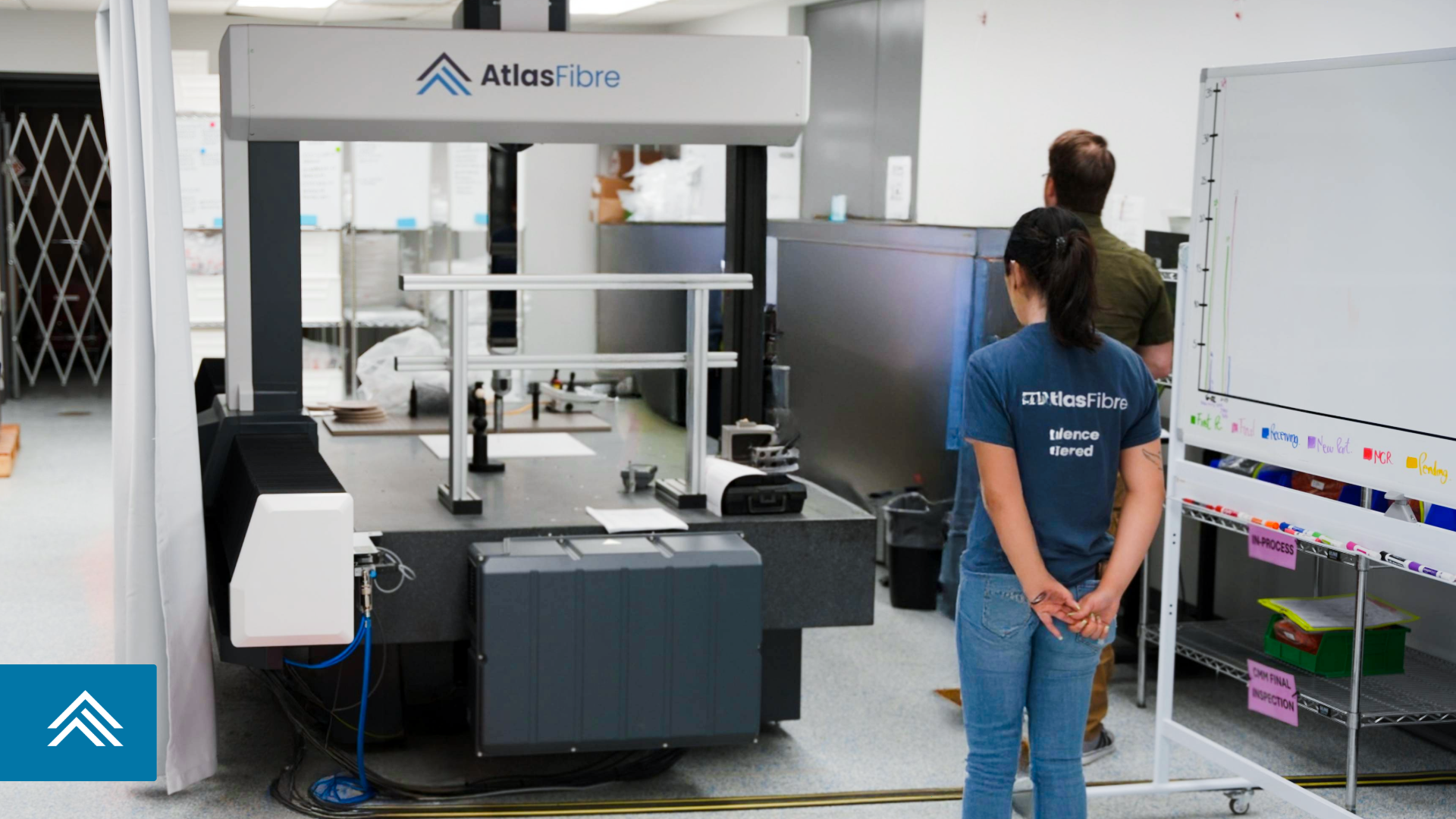
How Coordinated Measuring Machine (CMM) Technology Elevates Advanced Plastics Machining – And Why It Matters for Atlas Fibre Customers
In advanced plastics machining, precision isn’t just a technical achievement – it’s a competitive advantage.
High-performance materials like thermoset composites and thermoplastics demand a level of dimensional control that most machine shops simply aren’t built for.
That’s where Atlas Fibre stands apart.
For years, we’ve integrated Coordinate Measuring Machine (CMM) technology into our machining and quality processes (part of our broader quality initiative). Not as an optional inspection step or an occasional check, but as a core element of how we produce parts.
CMM’s are a critical part of the machining process; they provide customers the confidence that their components are produced at a facility that prioritizes precision and uses CMM technology as a standard part of its machining and inspection process.
Why CMM Capability Matters in Plastics Machining
Advanced plastics behave differently from metals in ways that make traditional measurement tools unreliable:
- They expand and contract with small temperature changes
- They flex under probing pressure
- They relax and “creep” after machining
- Their geometries often blend complex surfaces that calipers and pins can’t capture
Without the right metrology tools, even well-machined parts can be difficult to validate. Our CMM eliminates this uncertainty and does so with proven, repeatable accuracy. We treat the CMM as our microscope – the tool that lets us see what other shops can’t.
This allows us to verify:
- tight profiles on thermoset laminates
- thin-wall thermoplastic geometries
- precise bores and pockets
- GD&T features like true position, flatness, and parallelism
- complex multi-axis surfaces that require full 3D evaluation
The result isn’t just precision – it’s traceable proof of precision.
Being a Better Machinist Starts With Measuring Better
Almost any shop can cut plastic. Far fewer can machine it consistently.
Our approach is built around CMM-informed machining workflows that allow us to control the process – not react to it.
In-Process Verification: We don’t wait until the end of a run to determine whether a feature meets spec.
We use the CMM throughout production to verify critical dimensions and adjust offsets before variation becomes scrap.
Predictive Tool Wear Insight: By analyzing CMM data across a production run, we can detect early signs of tool drift – long before it affects parts – ensuring dimensional stability from first article to final piece.
Engineering Plastics Behavior, Understood Through Data: Plastics warp. They move. They relax.
Years of CMM data across thousands of parts allow us to predict that movement, optimize our machining strategies, and deliver geometry that stays stable.
Full 3D Control for Complex Geometries: Blended surfaces, tight pockets, multi-axis contours – features that hand tools simply can’t validate – are routine for our inspection programs.
The CMM as a Quality System Advantage
Industries that rely on advanced plastics – semiconductor, aerospace, medical, automotive – expect documentation and dimensional evidence, not assumptions.
Our CMM enables us to provide:
- FAIRs
- PPAPs
- full GD&T reports
- traceable dimensional data
- stable, repeatable measurement routines
- SPC insights when required
Because our CMM capability is established, mature, and integrated into everyday operations, we deliver documentation that’s not only accurate but repeatable across future orders.
This makes us a more predictable, more reliable machining partner.
How Customers Directly Benefit From Our CMM-Integrated Process
The value of our CMM doesn’t lie in the machine itself – it lies in the results our customers receive.
Higher Precision and Reliability: Parts are machined, measured, and validated with traceable accuracy, reducing risk and improving long-term performance.
Fewer Surprises and Less Rework: In-process verification prevents downstream issues, late-stage deviations, and tolerance stack-ups.
Faster, More Confident Approvals: Detailed reports give engineering teams immediate clarity, reducing back-and-forth and accelerating qualification.
Scalable Repeatability: Whether you order a prototype or a long-running production part, our CMM-driven process ensures dimensional consistency across the entire lifecycle of your program.
Why Atlas Fibre Leads in This Space
Many shops are just now beginning to adopt CMM inspection. Atlas Fibre has operated with this capability for years.
What that means for our customers is simple:
- Our inspection routines are already refined.
- Our team has deep experience probing materials that move, flex, and warp.
- Our machining strategies are informed by real dimensional data.
- Our quality process doesn’t depend on hand tools – it’s grounded in metrology.
- Our customers receive parts with proven accuracy, not assumed accuracy.
Precision isn’t aspirational at Atlas Fibre. It’s built into the workflow.
The Bottom Line
In advanced plastics machining, the margin for error is small – and the demands for documentation, repeatability, and true 3D accuracy are only growing.
By integrating CMM technology into every stage of our process, Atlas Fibre delivers more than a machined part.
We deliver certainty: certainty that the geometry is right, certainty that the material behaves as expected, and certainty that the part will perform exactly the way the design intends.
For our customers, that certainty is the real advantage.