

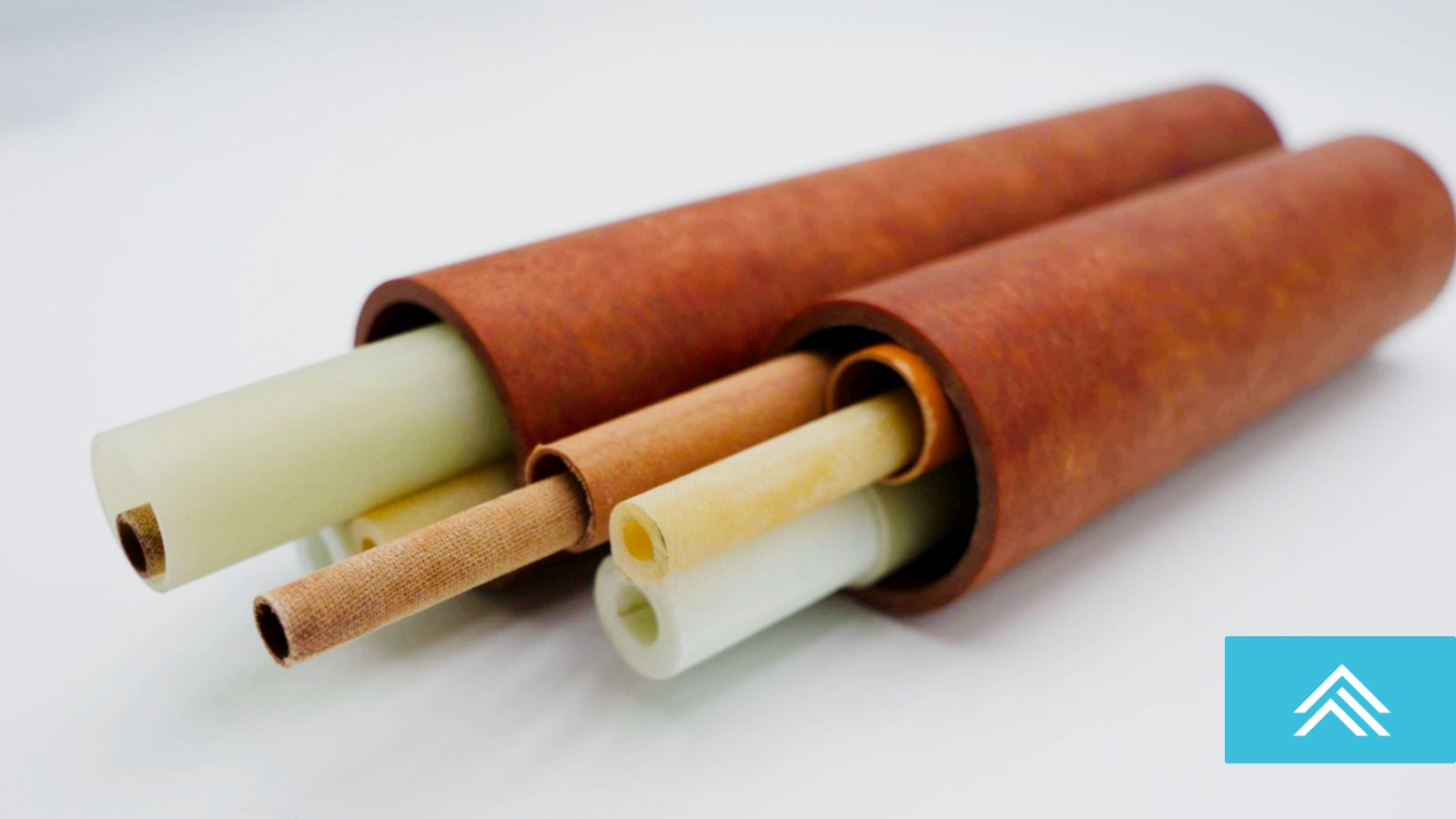
Exploring the Structural and Electrical Uses & Advantages of Concentric Thermoset Construction
Convolute wound tube is one of those materials most people never see – but it quietly solves structural, electrical, and mechanical problems across industries.
Unlike spiral-wound tubes (where material is wrapped at an angle), convolute tubes are made by wrapping a single sheet around a mandrel in concentric layers. The plies run around the circumference of the tube, not diagonally.
That construction difference matters.
It creates thicker walls, higher beam strength, better crush resistance, and improved internal pressure handling. And when composite tubes are made from thermoset like paper or cotton phenolic, it also delivers excellent electrical insulation and dimensional stability.
Here’s where that performance shows up in the real world.
Structural Cores for Roll Goods
When textiles, carpet, window blinds, films, or metal foils are wound into large rolls, the core carries the load.
If the core deflects, the material wrinkles.
If it crushes, the roll fails.
Convolute wound tubes are used as high-strength cores because they resist bending and crushing better than spiral tubes. Their thicker wall and circumferential construction provide consistent rigidity across the full length.
For heavy rolls or high-tension winding operations, that strength makes the difference.
Wire Harness and Cable Protection
Automotive systems. Aerospace assemblies. Industrial equipment. Marine environments.
Wire bundles in these systems are exposed to vibration, abrasion, fluid exposure, and constant movement.
Convolute tubes serve as protective sleeving, shielding harnesses from mechanical damage while still allowing enough flexibility to route through tight spaces.
When produced from thermoset composite materials, they also resist oils, chemicals, and heat better than many commodity alternatives.
Protection without unnecessary bulk.
Electrical Insulation and Machined Dielectric Components
When made from paper or cotton phenolic, convolute wound tube becomes more than structural – it becomes electrical.
These tubes are frequently machined into components like bushings, bearings, and insulating tubes.
The uniform wall thickness and thermoset construction provide stable dielectric performance and mechanical strength in industrial and electrical applications.
And because thermosets don’t soften under heat like thermoplastics, they maintain dimensional stability under load and temperature.
For electrical systems, predictability matters.
Pyrotechnic and Pressure-Holding Applications
Small-diameter tubes used in pyrotechnics and other pressure-containing systems require circumferential strength.
The single-sheet, concentric wrap of convolute construction handles internal pressure better than spiral-wound designs, which rely on angled seams.
When internal force pushes outward, the material’s fiber orientation works with the pressure – not against it.
That makes convolute tubes a reliable choice where burst resistance is critical.
Robotics and Dynamic Cable Management
Modern robotics demands materials that can move repeatedly without failing.
Convolute wound tubes are used as flexible conduit in dynamic systems – guiding cables through tight bends and continuous motion paths while protecting them from abrasion and impact.
The material balances stiffness and flexibility. It holds its shape, protects internal wiring, and resists fatigue over time.
In automated environments, durability under motion isn’t optional.
From Tube to Finished Component
At Atlas Fibre, convolute wound tubes don’t stop at raw material.
Because we manufacture and machine thermoset composites in-house, these tubes are routinely transformed into finished, production-ready components.
That includes precision-machined bushings, electrical insulating sleeves, structural spacers, bearings and wear components, and tight-tolerance industrial parts.
With CNC machining centers and automated production equipment, thermoset composite tubing is machined to exact specifications – including critical dimensions, surface finishes, and repeat production volumes.
For OEMs and industrial manufacturers, that means the material and the finished component come from the same controlled process.
No handoffs.
No material substitutions.
No guesswork on machinability.
Just engineered thermoset composite parts built from the right tube – and machined for the application.
Why Convolute Construction Works
Across industries, the performance advantages come back to a few structural realities:
- Circumferential ply orientation
- Thick wall construction
- High beam strength
- Improved crush resistance
- Better internal pressure handling
- Consistent dielectric properties when made from thermosets
It’s a simple idea – wrap the material the right way – but the results show up everywhere from roll cores to robotics.
And when that tube is precision machined into a finished component, it becomes more than a material.
It becomes part of a working system.