
Why do some parts (components) hold their shape no matter what you throw at them – heat, pressure, humidity – while others warp, swell, and drift out of spec?
The answer comes down to dimensional stability.
At its core, dimensional stability is a material’s ability to stay the same size and shape over time, even when conditions change. Heat it up, cool it down, expose it to moisture, put it under load; stable materials shrug it off. Unstable ones don’t.
That difference might sound subtle, but in the real world, it’s often the line between a system that works and one that fails.
When it Comes to Dimensional Stability, “Close Enough” Isn’t Good Enough
In everyday life, small changes in size don’t matter much. But in engineering, they matter a lot.
Think about a tight-fitting electrical connector, a precision-machined component, or a sealing surface. These aren’t forgiving systems. If a part expands too much, it binds. If it shrinks, it loosens. If it warps, everything built around it starts to misalign.
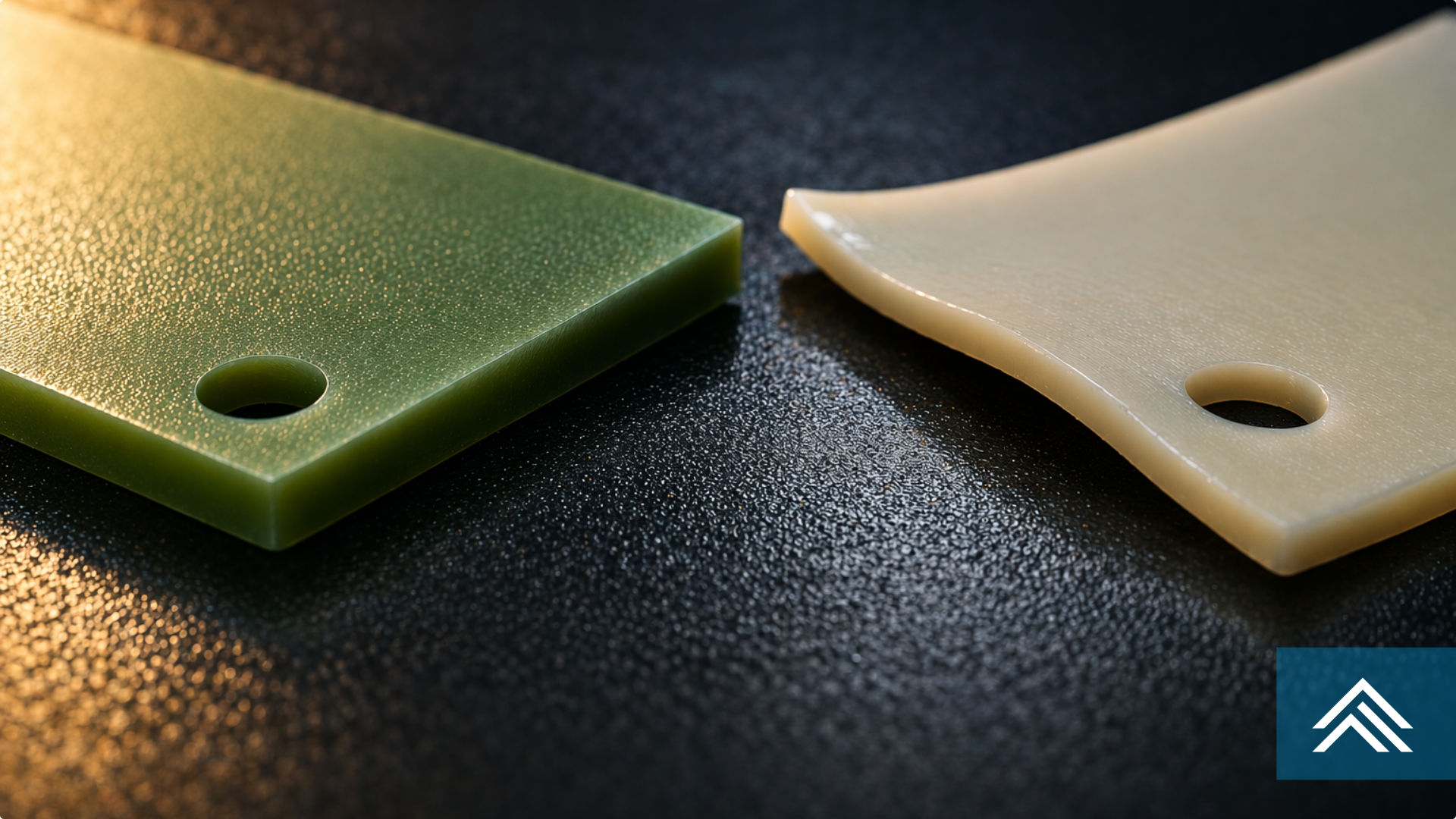
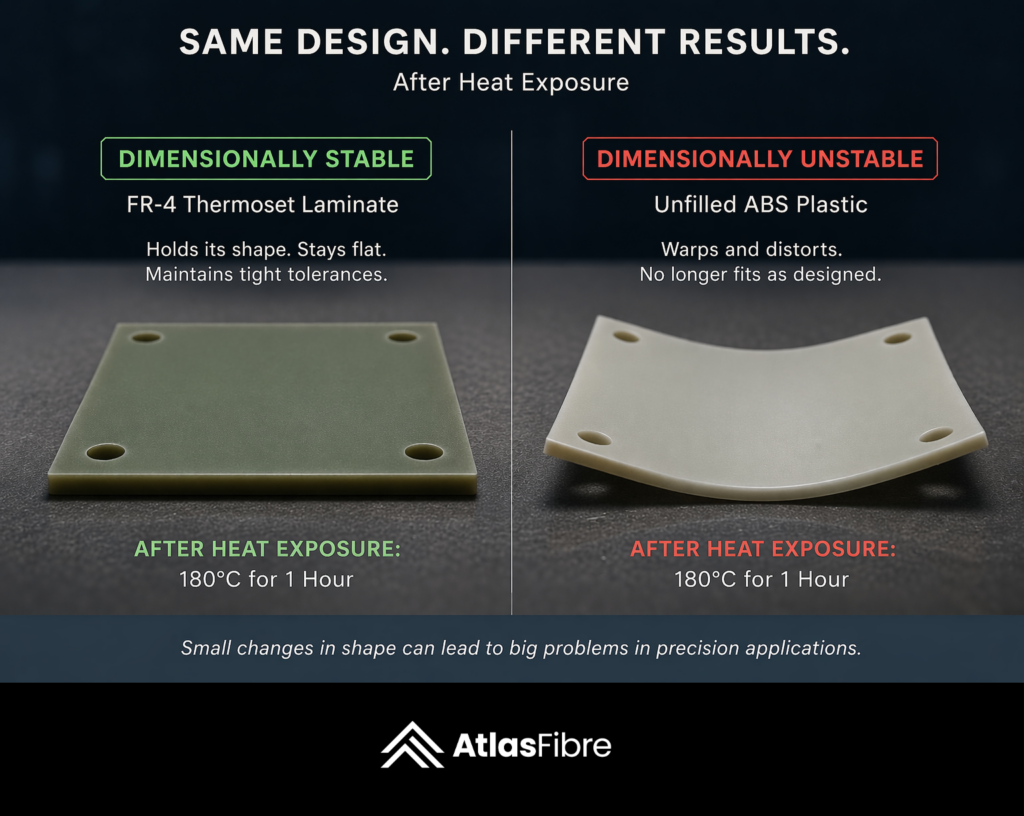
Even something as simple as a plastic cover tells the story. If it comes out of service heat still flat and properly sized, the material did its job. If it curls, shrinks, or no longer fits, it didn’t.
And those small dimensional shifts can cascade into bigger problems: leaks, vibration, electrical failure, or complete mechanical breakdown.
The Hidden Challenge of Engineering Plastics
Plastics are everywhere in modern engineering, often replacing metal in parts that demand precision. They’re lighter, corrosion-resistant, and easier to process – just some of the reasons that engineers are choosing advanced plastics like thermoset composite laminates.
But they come with a tradeoff.
Compared to metals, most plastics expand more when heated and are more sensitive to moisture. Some even continue to deform slowly under load; a phenomenon known as creep (see how materials like G10/FR4 fare against creep).
That means a part that looks perfect on day one can slowly move out of tolerance in service.
The risks show up in familiar ways:
- Parts stop fitting the way they should
- Seals lose their effectiveness
- Components drift out of alignment
- Surfaces warp or distort over time
To counter that, engineers look for materials with low thermal expansion, low moisture absorption, and minimal internal stress. Add glass fiber reinforcement, and you can dramatically improve how well a material holds its shape.
How Do You Measure Something That Moves?
Dimensional stability isn’t a single number – it’s something you have to test under real-world conditions.
Engineers typically measure it by exposing a material to heat, humidity, or both, then comparing its dimensions before and after. The change is often expressed as a percentage of the original size.
But the real insight comes from how that change happens.
Heat a material and measure how much it expands – that’s where the coefficient of thermal expansion (CTE) comes in. Expose it to moisture and track swelling. Cycle it through both, and you start to see how it behaves over time.
Here’s the catch: the same material can look stable in one test and unstable in another. Temperature, humidity, direction of measurement – even how the part was machined – all play a role.
In other words, stability isn’t absolute. It’s contextual.
The Materials That Get It Right
Some materials are simply better at holding their shape than others.
At the high-performance end, engineering thermoplastics like PEEK, PPS, PEI, and PAI are known for staying stable in tough environments – high heat, mechanical stress, and long service life.
More common options like acetal and PET-based materials also perform well, especially when moisture control and machinability matter.
But if dimensional stability is the top priority, thermoset composite laminates often take the lead.
Materials like G-10, G-11, FR-4, and other epoxies are built with glass reinforcement, which acts like a skeleton inside the material, resisting expansion, shrinkage, and creep.
Among them, G-11 stands out. With lower thermal expansion and better performance at elevated temperatures, it’s often the go-to when tight tolerances need to stay tight.
A Closer Look at Expansion
One of the clearest ways to compare materials is through their thermal expansion.
G-11, for example, expands at roughly 13 parts per million per degree Celsius. FR-4 comes in slightly higher, around 14 to 17 ppm/°C in-plane – but its behavior changes dramatically through its thickness, especially at higher temperatures.
That difference matters more than it might seem.
In layered or multi-material systems, uneven expansion can introduce stress, distortion, or failure over time. A material that expands consistently – and minimally – has a major advantage.
Why Dimensional Stability All Comes Back to Design
Dimensional stability isn’t just a material property – it’s a design decision.
The right material, processed the right way, in the right environment, is what keeps parts aligned, seals intact, and systems running as intended.
Ignore it, and problems show up later – often when the system is already in the field.
Get it right, and everything just works.