

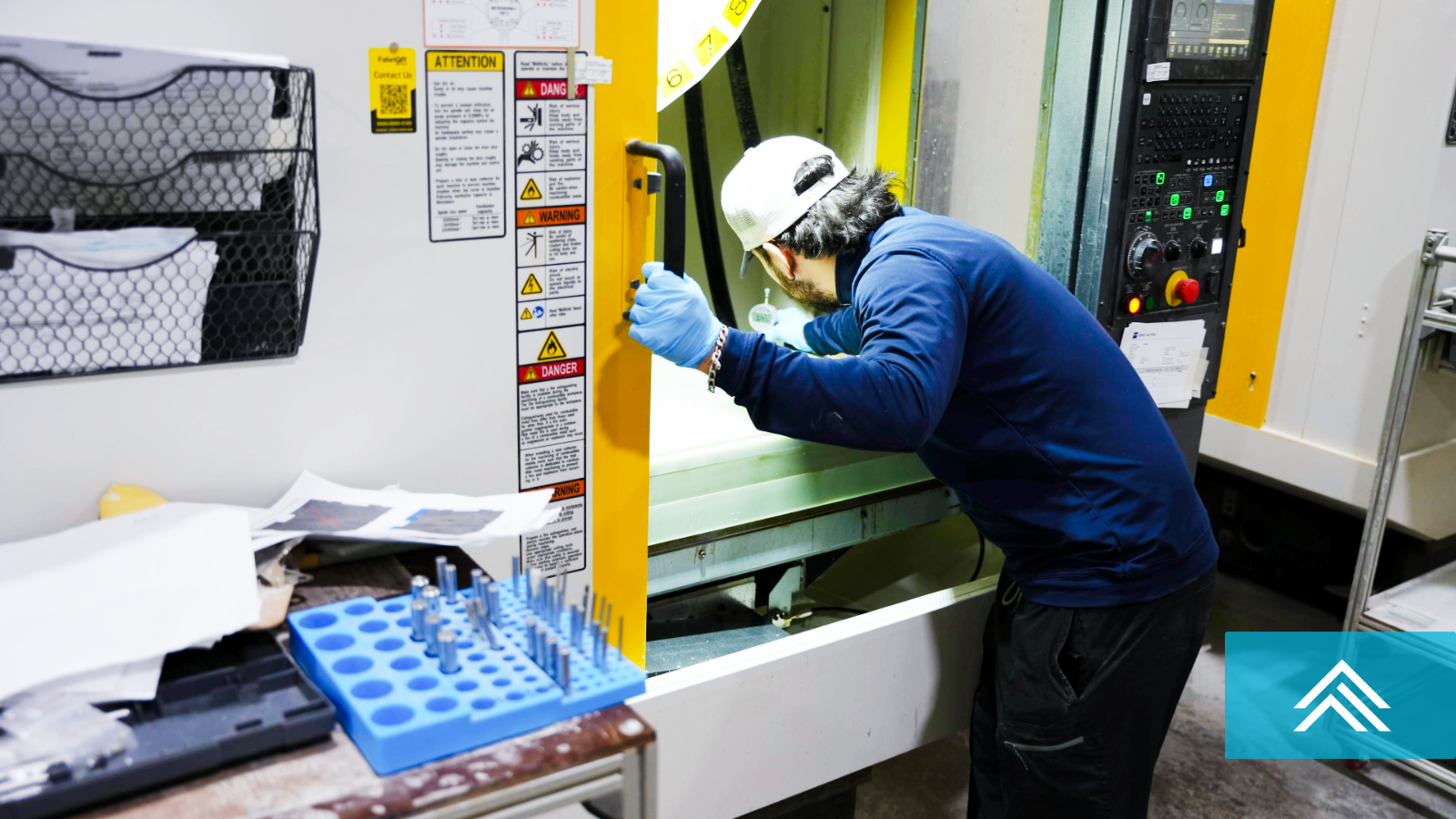
Maintaining Flatness, Stability, and Edge Integrity When Machining Composite Sheets
Machining thermoset composite sheets – such as G10/FR4, paper phenolics, and epoxy laminates – presents a unique challenge. These materials are highly stable in service, but during machining they can release residual stress, respond poorly to heat, and distort under clamping forces. If you’re not experienced with machining advanced composite materials, the result can often be unwanted warp, loss of flatness, or chipped and fractured edges.
Achieving consistently flat parts with clean edges requires more than sharp tooling. It demands control of the entire process – from stock preparation through fixturing, machining strategy, and inspection. In practice, success comes down to managing stress before, during, and after the cut.
Start Before the Cut: Stock Conditioning and Preparation
Flat parts begin with stable stock.
Thermoset laminates can retain moisture or thermal gradients from storage and shipping. These conditions often reveal themselves only after machining, when parts are unclamped and allowed to relax. Conditioning sheets to the shop environment – both temperature and humidity – for 24 to 48 hours before machining significantly reduces post-machining movement, particularly in thinner sections.
Starting flat is equally important. Pre-warped or highly stressed sheets tend to move regardless of how carefully they are fixtured. When flatness is critical, selecting the flattest available stock and rejecting visibly bowed or twisted sheets upfront is often the most effective control.
For demanding applications, a staged machining approach can further improve results. Rough machining both faces to a consistent allowance, followed by stress relief where the laminate grade allows, then completing final light finish passes minimizes the chance of movement while achieving final flatness.
Fixturing and Balanced Material Removal
How a sheet is held during machining often determines whether it remains flat after release.
Over-constraining thin laminates can temporarily force the material flat, but it often stores elastic energy that releases as soon as the part is unclamped. This is common with aggressive vacuum fixturing or point clamping, where the sheet is restrained at only a few discrete contact points rather than being fully supported. Instead, support should be distributed evenly using soft pads, sacrificial sub-plates, or fixtures designed to spread load across the entire surface.
Material removal must also be balanced through the thickness. Removing significant material from one face while leaving the opposite face untouched introduces stress imbalance. When that imbalance finally releases, the part moves.
A symmetric machining strategy consistently delivers better results: rough machine side A, flip and rough side B, then perform light finish passes on both faces. For critical components, finishing both sides with mirrored, low-force passes around the mid-plane of the sheet greatly improves stability.
Protecting Edge Quality During Machining
Edge integrity is often the first visible casualty of poor machining strategy, particularly in glass-filled laminates.
Sharp carbide tooling with composite-specific geometries – high rake angles and polished flutes – is essential. Radial and axial engagement should remain modest to reduce cutting forces and prevent micro-cracking along edges.
Climb milling (also called down milling, is a machining method where the cutting tool rotates in the same direction as the feed of the workpiece) generally produces cleaner edges than conventional milling in thermoset sheets. On materials such as G10/FR4 and phenolics, climb milling reduces chip-out and leaves a more consistent profile.
For drilling and through-routing operations, exit-side support is critical. Backing boards or sacrificial layers beneath the sheet prevent splintering and breakout as the tool exits the material, protecting both geometry and appearance.
Managing Heat and Chip Evacuation
Thermoset laminates are typically machined dry. Flood coolant can introduce moisture, leading to swelling or delayed warp after machining. Instead, strong vacuum combined with directed air is commonly used for chip evacuation and localized cooling.
Cutting parameters should remain conservative, especially on thin sheets or high-glass-content materials. Excessive surface speed, deep stepdowns, or long uninterrupted toolpaths can generate heat that relaxes internal stress mid-operation, allowing the part to move while still on the machine.
Breaking long toolpaths into multiple lighter passes and allowing brief cooling intervals between operations improves dimensional stability.
Inspection and Process Feedback
Flatness should be verified using a repeatable method – such as a surface plate and indicator or CMM – not only immediately after unclamping, but again after a short dwell period. Some movement is time-dependent, and early inspection alone can mask future distortion.
Patterns in movement provide valuable feedback. Parts that consistently cup toward the last machined face often indicate unbalanced material removal or excessive clamping force. Small adjustments based on inspection data are what transform a process that “usually works” into one that delivers consistent results.
Maintaining flatness and edge integrity in thermoset sheets is less about aggressive cutting and more about controlling stress. When stock conditioning, fixturing, machining strategy, and inspection are aligned, composite laminates machine cleanly and predictably – producing parts that remain flat and stable long after machining is complete.