

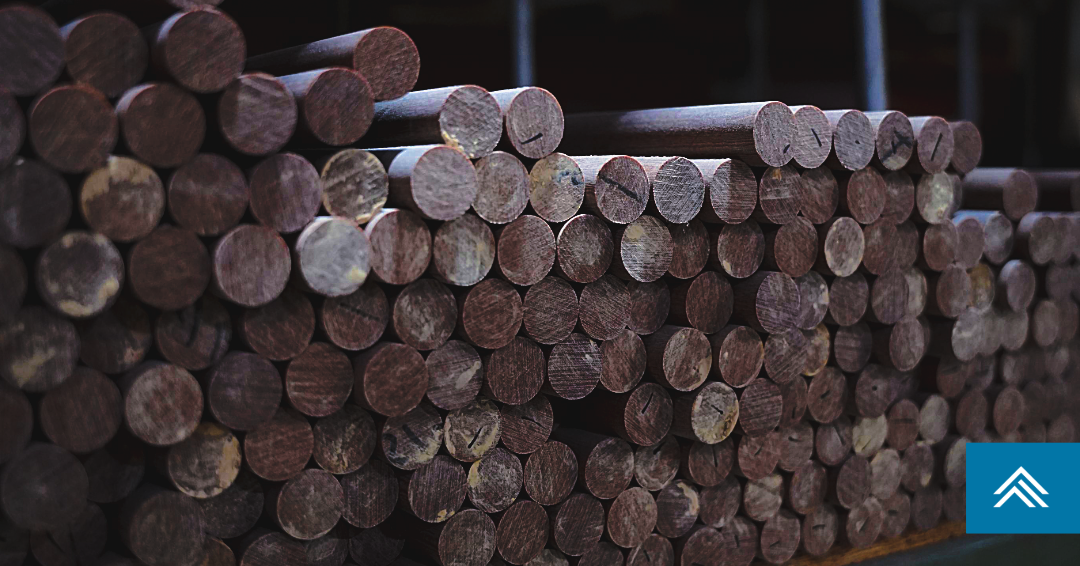
Discover how fiber orientation, load paths, and manufacturing methods cause thermoset composite rods to perform very differently than sheets—and why assuming otherwise can lead to failure.
The chemistry didn’t change. The performance did – and that difference can make or break a design.
If you take a thermoset composite sheet and turn it into a rod, it’s easy to assume the material will behave the same way – just in a different shape. Same resin. Same reinforcement. Same cure.
That assumption is one of the most common ways composite components end up overdesigned, underperforming, or failing in service.
In practice, composite rods and sheets made from the same thermoset material can behave very differently. The reason isn’t chemistry. It’s geometry, fiber orientation, and how the material is forced to carry load.
In thermoset composites, shape doesn’t just define form. It determines which properties actually show up – and which ones don’t.
What Doesn’t Change: The Chemistry
Thermoset composites cure into a rigid, crosslinked molecular network. Once cured, they don’t soften with heat or allow reshaping the way thermoplastics do. That chemistry stays the same whether the material ends up as a flat sheet or a round rod.
Glass transition temperature, chemical resistance, and thermal stability are set during cure. Any residual stresses or cure gradients introduced during processing are locked into the final geometry.
This is why thermoset rods hold their dimensions under load and temperature—but it’s also why you don’t get a second chance to “fix it later”. If the rod geometry, fiber architecture, or processing route isn’t right from the start, no amount of post-processing will change the underlying behavior.
Fiber Direction Becomes the Dominant Variable
In a sheet, loads can spread across a plane. In a rod, they can’t.
When a thermoset composite is formed into a rod, the manufacturing process usually drives fibers into preferred orientations—most often aligned along the rod’s length, sometimes helically or circumferentially. This makes the material strongly anisotropic.
Axial tensile strength and stiffness increase significantly when fibers align with the rod axis. At the same time, transverse and interlaminar properties may be much lower by comparison.
This tradeoff is exactly why composite rods perform so well in tension, compression, bending, and torsion—and why they can fail unexpectedly at grips, bearings, or poorly supported interfaces.
From a design and sourcing perspective, this is where problems start if rod geometry is treated as interchangeable with sheet.
Geometry Forces the Material to Show Its Strengths – and Its Limits
Rod geometry naturally channels structural demand into axial load paths. That’s ideal for thermoset composites, which combine high fiber stiffness with a matrix that resists creep and thermal distortion.
The result is a rod that can deliver:
- Exceptional stiffness-to-weight and strength-to-weight performance
- Low thermal expansion
- Long-term dimensional stability under sustained load
This is why thermoset composite rods often outperform thermoplastics and metals of similar mass in structural roles. But it also means they must be designed and sourced as structural components, not just round stock.
Ignoring that distinction can lead to conservative designs, unnecessary weight, or premature failure.
How the Rod Is Made Matters More Than Many Specs Suggest
Two composite rods can look identical on a drawing and behave very differently in the field.
Pultrusion, filament winding, rolling and molding from fabric, or machining from laminate plate each produce different internal architectures. Those differences affect void content, fiber volume fraction, residual stress, fatigue life, and fracture behavior. For example:
- Pultruded rods maximize axial performance but are highly directional.
- Filament-wound rods can be optimized for torsion or combined loading.
- Rolled or molded rods can offer more uniform strength through the cross-section.
- Rods machined from stacked laminate plate may retain internal planes that promote shear-type failures.
At this point, material selection becomes inseparable from how the rod is produced—and from who is supplying it.
Surface Finish, Machining, and Real-World Risk
Turning or grinding a composite into a rod changes how fibers intersect the surface. Machining can expose fibers, introduce resin-rich layers, or create microcracks that act as initiation sites under bending or fatigue.
Thermoset rods remain readily machinable, but they cannot be heat-reformed once cured. Dimensional corrections are mechanical only.
In applications where fatigue, alignment, or long-term loading matter, surface quality and machining strategy stop being details and start being risk factors.
When a thermoset composite becomes a rod, its chemistry stays the same—but geometry, fiber architecture, and manufacturing route decide which properties dominate.
That’s why switching from sheet to rod isn’t just a dimensional decision. It’s a structural one, a sourcing one, and often a cost-of-failure decision.
In composites, the material will always do exactly what it was built to do. The only question is whether it was built for the job you’re asking it to perform.