

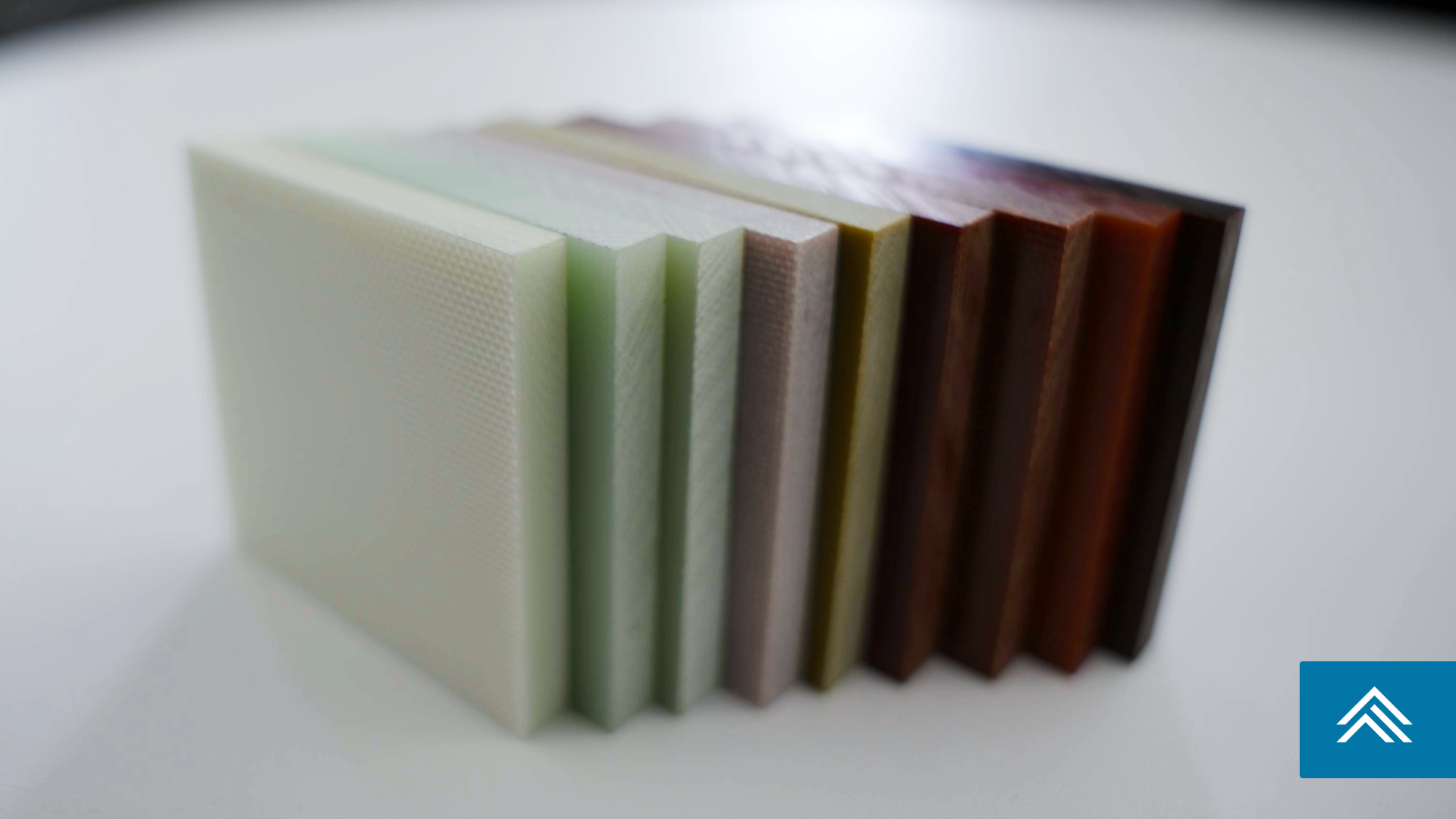
Smart Shops Engineer Their Processes To Keep Parts Clean, Strong, and Reliable.
Thermoset composite laminates are remarkable materials – lightweight, strong, and engineered to perform in applications where metals fall short. But machining them isn’t the same as machining aluminum or steel. Across the industry, cutting composite material creates unique challenges that require a different mindset and a more scientific approach at the spindle.
As a manufacturer and machinist of advanced engineering plastics, we work at this intersection every day. The key isn’t that composites are “problematic”- it’s that composites are built from layers of fibers and resin that each respond differently when cut. Because of that, they need a machining approach that’s a little more dialed-in than what you’d use for metal.
Here’s what the broader composites world encounters – and what Atlas Fibre proactively engineers against.
The Industry’s Most Well-Known Composite Machining Challenges
Across the aerospace, semiconductor, automotive, and industrial sectors, machinists face a handful of common damage modes when cutting composite laminates. These aren’t material “failures”- they’re simply the mechanical responses of fibers and resin when machining parameters, tool geometry, or support conditions aren’t optimized.
By understanding these mechanisms, we make sure they don’t occur in our own machined components.
Delamination: The Classic Composite Challenge
In the industry, delamination is the most frequently studied composite machining defect. It’s a separation between layers that can occur during drilling or trimming—especially when thrust forces run too high or support is insufficient.
- Peel-up at hole entry
- Push-out at hole exit
- Step-type separations along trimmed edges
In our own manufacturing environment, machinability of thermosets is always top of mind. Controlling thrust, tool condition, and backing support are just some variables central to our process design. The result: crisp, clean hole boundaries and minimal post-machining finishing.
Matrix Cracking and Microcracking
Intralaminar cracking happens in the broader composites field when local thermal or mechanical loads spike during machining. These microcracks often originate in resin-rich regions.
We avoid this by tuning feeds, speeds, and tool engagement to maintain low thermal loads – one reason precision composite machining demands such tight process window control.
Fibre Pull-Out and Fuzzing
Every machinist who has ever cut carbon- or glass-reinforced composites has seen this: frayed edges, uncut fibers, or fuzzing caused by:
- Worn tooling
- Unfavourable fibre cutting angles
- Insufficient matrix support during chip formation
Our machining strategy (particularly G10 machining) focuses on tool sharpness, optimized helix geometry, and axis control to ensure fibers shear cleanly rather than bend or tear.
The Composite “Burr”
Unlike metal burrs, composite burrs are bundles of fibers bent out of plane at hole exits. They’re well documented in the field and often become a key inspection point in bonded or sealed assemblies.
Through proper fixturing and toolpath engineering, we suppress burr formation to preserve surface integrity for downstream bonding and sealing.
Thermal Effects: Burning and Surface Roughness
If cutting temperatures climb, the resin can soften or char, or the fiber/matrix interface can degrade – again, a widely observed phenomenon in high-speed composite machining.
Our machining environment is built around thermal control: sharp cutters, optimized chip loads, and fixture setups that draw away heat to maintain consistent surface quality.
Why This Matters for Component Performance
These machining effects aren’t “material issues”- they’re process-related phenomena. When not managed, they can influence strength, stiffness, fatigue life, joint performance, and long-term durability. That’s why the machining strategy matters as much as the laminate design.
Strength & Fatigue Performance
Industry research consistently shows that delamination or fiber damage – if present – can reduce the load-carrying capability of a machined feature. By mitigating these effects during machining, we help ensure that the laminate performs as designed.
Bonding, Sealing & Fit-Up
Composite edges and hole walls are functional surfaces. Minimizing roughness, fuzzing, and burrs supports predictable adhesive bonds, proper fastener seating, and consistent interface performance.
Long-Term Durability
Microscopic cracking or delamination – if created during composite machining – can grow under vibration, impact, or thermal cycling. Our goal is simple: machine parts so cleanly that the service life of the finished component reflects the full potential of the material.
Quality, Yield & Scrap Reduction When Machining Composites
Across the composite machining industry, drilling-related delamination is one of the top causes of part rejection. By understanding these mechanisms deeply and controlling them, we improve throughput, reduce rework, and deliver higher-quality components.
The Key Takeaway on Machining Composites
Composite laminates reward precision. They perform extraordinarily well when machined with a process tailored to the unique behaviors of fibers and resin.
As both a materials manufacturer and a precision machining operation, we know exactly what to look for – and how to prevent it – when it comes to composite machining. The more we understand the mechanics of the fabrication process of these advanced materials, the cleaner and more reliable every finished part becomes.