

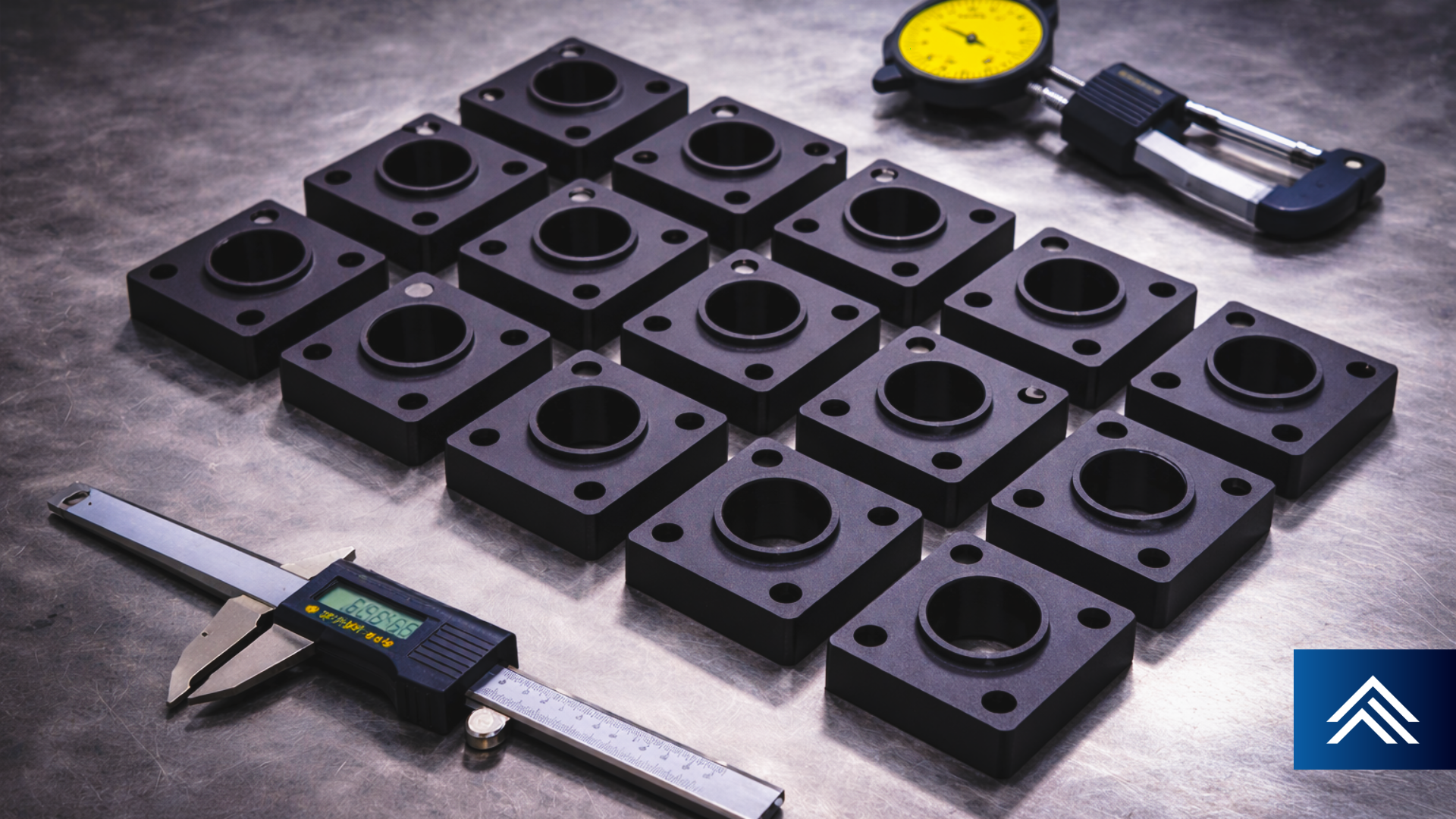
When production moves into repeat manufacturing, machining consistency can become the bottleneck… or the advantage.
Thermoset composite laminates stand out in high-production environments not just because of how they’re made, but because of how they behave when machined repeatedly under controlled conditions.
Stability That Carries Into the Machine
Once a thermoset laminate is cured, its structure is permanently cross-linked. It doesn’t soften with heat, and it doesn’t re-form under cutting conditions.
That stability shows up immediately in machining:
- The material holds its shape during cutting
- Heat generated at the tool interface has minimal impact on geometry
- There’s less risk of movement or deformation mid-process
For machinists, this translates to a more predictable cut, especially in longer runs where small variations can compound.
Predictable Tool Interaction
In repeat machining environments, consistency at the tool-material interface is everything.
Thermoset laminates offer:
- Consistent hardness and density across the part
- Uniform fiber/resin distribution (when upstream processes are controlled)
- Minimal variation in cutting resistance from part to part
Once feeds, speeds, and tooling are dialed in, they tend to stay valid across long production runs.
There’s less need to constantly chase adjustments, which is often required with materials that respond more dynamically to heat or stress.
Dimensional Control Over Long Runs
One of the biggest challenges in high-volume machining is maintaining tight tolerances over time.
Because thermosets do not relax, creep, or soften under typical machining temperatures, they help maintain:
- Tight dimensional tolerances
- Flatness and positional accuracy
- Edge integrity and surface finish consistency
This is especially important for components used in electrical systems, aerospace assemblies, and other applications where even small deviations can impact performance. Learn more about choosing the right material for different applications based on operating temperatures.
Repeatability Comes From Process Discipline
Thermoset materials reward shops that run controlled, repeatable processes.
If the following are consistent:
- Material grade and laminate structure
- Fixturing and workholding
- Tooling geometry and wear management
- Machine parameters
Then the output is highly repeatable.
In many cases, once a process is validated, it can run with minimal intervention, making thermosets well suited for production environments focused on throughput without sacrificing precision.
Less Sensitivity to Thermal Variation
Unlike thermoplastics, which can soften or move slightly under heat, thermosets remain dimensionally stable during machining.
This reduces:
- Thermal expansion concerns during cutting
- Part movement due to localized heating
- Variability between early and late parts in a run
The result is a more stable machining window, particularly in operations where heat buildup is unavoidable.
Where This Shows Up in Production
These machining characteristics are why thermoset laminates are commonly used in high-production environments for:
- Electrical insulation components
- Precision structural parts
- Aerospace and defense applications
- Industrial systems requiring repeatable performance
In these settings, the goal is not just to make parts—but to make the same part, over and over, with minimal deviation.
The Tradeoff
Thermosets are not as forgiving when things go wrong.
Because the material cannot be reshaped or reprocessed:
- Scrap is scrap
- Rework options are limited
- Upstream and machining processes must be well controlled
That makes them less flexible, but far more stable once the process is established.
Thermosets vs. Thermoplastics in Machining
From a machining perspective, the difference is straightforward:
Thermoplastics offer flexibility. They can be reshaped, and in some cases are more forgiving during processing. But they can also introduce variability under heat and load.
Thermosets offer stability. They machine more consistently over time, particularly in applications where heat, tolerance, and repeatability matter.
A Simple Way to Think About It
If your priority is to machine the same part repeatedly – with tight tolerances and minimal variation – thermoset composite laminates provide a strong foundation.
They don’t just support high production.
They make high production more predictable.