
Planning Machined Composite Parts for Scale
In high-volume manufacturing, consistency is not just a quality goal. It is a production requirement.
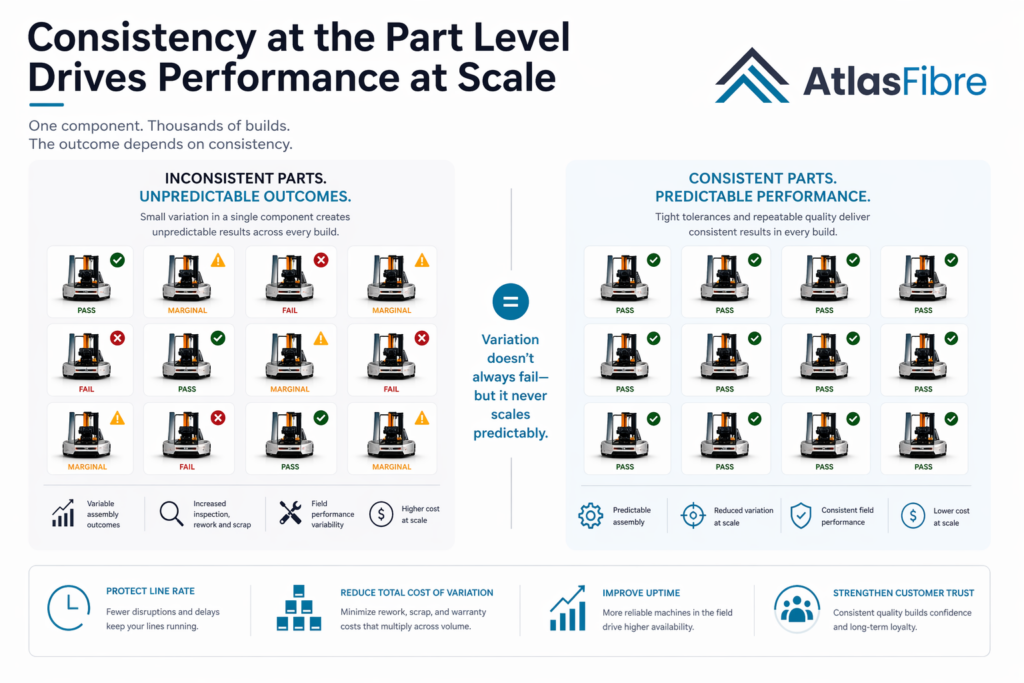
The same design may be built thousands of times, with every assembly depending on each component performing the same way. But small variations at the part level can create much larger problems once production scales. A minor deviation in one machined composite part may not always cause an immediate failure, but it can still introduce variability in assembly, inspection, field performance, and cost.
That is why OEMs should think about prototype for production from the start.
The way a part is sourced early can affect what happens later. Material selection, tolerance expectations, inspection requirements, and stocking strategy all influence whether a part can be produced repeatedly, reliably, and cost effectively. A prototype may prove that a design works, but a production-focused prototype helps prove that the design can be manufactured consistently at scale.
Designing with repeatability in mind helps reduce surprises once demand increases. Confirming material availability, planning stocking strategies, and completing first article inspection all create a stronger foundation for repeat production. Once a part is validated, the goal should be to reduce unnecessary friction every time it is ordered again.
Repeat production systems can help protect delivery timelines by minimizing delays caused by re-quoting, setup, and scheduling. Instead of treating every order like a one-off project, OEMs with ongoing part needs can create a more predictable path from demand to delivery.
The infographic below highlights why consistency at the part level matters at scale. Variation does not always create immediate failure, but it rarely scales predictably. For OEMs building the same products again and again, consistent machined composite parts can help protect line rate, reduce the total cost of variation, improve uptime, and strengthen customer trust.