
The Hidden Plastic That Keeps Grid-Scale Batteries From Killing Themselves
Crack open a battery energy storage system, one of those shipping-container-sized boxes popping up next to solar farms and substations everywhere, and you won’t find much that looks like a battery. You’ll find copper. Lots of it. Racks of it, actually, carrying enough voltage to stop a heart several times over, packed a few inches from thousands of lithium cells that really, really don’t want to overheat.
Keeping all of that from becoming a very expensive fire starts with something you’d never guess: a stiff, glassy plastic panel that looks like it belongs in a 1990s circuit board. In a lot of ways, it does.
Thermoset composite laminates – rigid, fiber-reinforced plastics like the FR-4 board hiding inside every computer you’ve ever owned – have quietly become one of the load-bearing members of grid battery safety. They don’t store energy. They don’t move electrons where they need to go. What they do is stand in the way of the electrons that are not supposed to go anywhere, while holding the whole assembly together under vibration, heat, and years of charge cycles.
Here’s how a material best known for keeping your laptop from short-circuiting ended up as critical infrastructure for the energy transition.
It’s Not the Battery, It’s Everything Around It
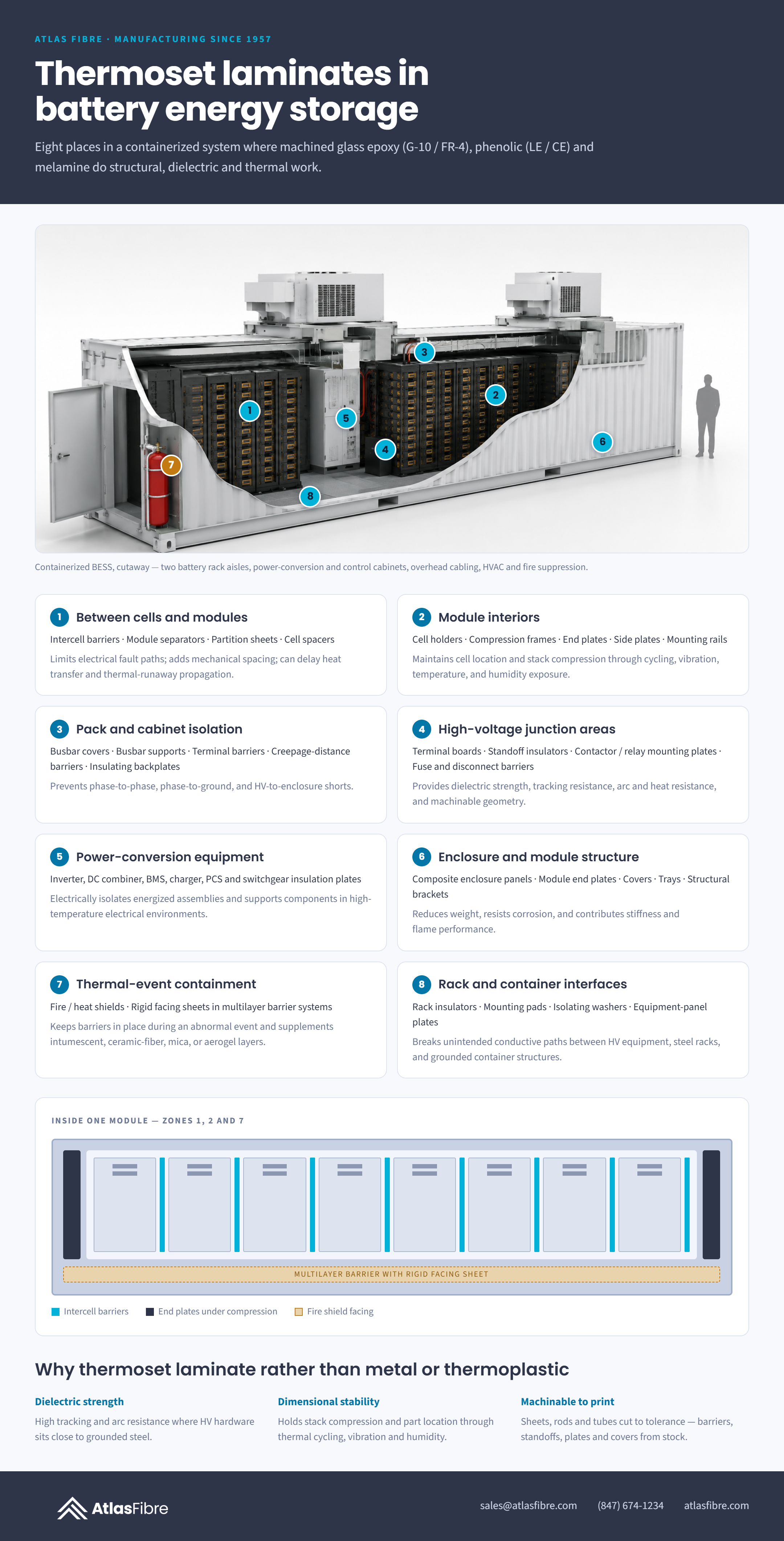
A single lithium cell is a chemistry problem. A battery system is an engineering problem, and that’s where composite laminates live. Inside a module, rack, or cabinet, you’ll find them doing structural and electrical duty in places like:
- Between cells and modules; thin barrier sheets and partitions that block stray electrical paths and buy a few extra seconds before heat jumps from one cell group to the next
- Inside the module; end plates, compression frames, and mounting rails that keep cells locked in position through thousands of charge cycles
- Around busbars and terminals; covers, standoffs, and creepage barriers that stop 1,000-volt copper from arcing to a grounded aluminum frame
- In the power electronics; insulation plates for inverters, chargers, and battery management systems
- In the enclosure itself; lightweight, corrosion-proof panels and brackets that don’t rust the way steel does in a coastal or industrial site
The throughline: every one of these jobs needs a material that’s both an electrical insulator and structurally solid. Most materials are good at one or the other. This one does both, which is why it shows up so often in gear nobody outside an electrical engineer ever thinks about – switchgear, circuit breakers, panelboards – and why it made the natural jump into battery storage.
The Electrical Bodyguard
Grades like G-10 and FR-4 – the glass-and-epoxy composites your motherboard is made of – get machined into the parts standing between energized copper and everything it shouldn’t touch: busbar covers, terminal boards, standoff blocks, insulating washers, mounting plates for contactors and fuses.
A flexible film or a sprayed coating could technically insulate too. But it can’t hold a busbar in exact position while it’s doing it. A rigid laminate can do this which means one part does two jobs, isolate and locate, instead of needing a separate structural piece bolted on next to the insulation.
One catch worth knowing: “FR-4” isn’t a magic password. Two parts stamped with the same designation can behave very differently once you factor in moisture exposure, tracking resistance, and how hot they’ll actually run in service. Spec by performance requirement, not by name alone.
Keeping Cells in Line, Literally
Batteries move. Not dramatically, but enough. Charge cycles cause expansion and contraction. Vibration from transport and operation shakes things loose over time. Somebody has to keep the cell stack exactly where it’s supposed to be, cycle after cycle, year after year.
That’s a second job for these laminates: cell-array locating plates, insulating end plates, non-conductive compression frame parts that hold stack pressure steady. It’s a quieter task than the electrical insulation story, but arguably just as important – foam and thin thermoplastic sheets can creep, soften, or shift under sustained compression and heat. A rigid laminate mostly doesn’t.
What Happens When a Cell Goes Rogue
This is the part that matters most, and where it’s easy to overstate what this material can actually do.
When a lithium cell fails badly – thermal runaway – temperatures can spike toward 800 to 1,000°C. That is nowhere near what a standard glass-epoxy laminate is built to survive. Treating it as a fireproof shield would be a serious misread of the material.
Instead, the real defense is layered, like a bucket brigade:
Cell → laminate → dedicated thermal barrier → next cell
The laminate’s job in that chain isn’t to soak up 1,000-degree heat. It’s to stay rigid and intact long enough to hold a specialized barrier material – mica, ceramic fiber, silica aerogel – exactly where it needs to be while that material does the actual heat-blocking. Think of the laminate as the scaffolding and the aerogel or mica as the fire blanket. Neither one works without the other doing its specific job.
And the whole assembly only matters if the boring parts hold up too – the adhesives, the fasteners, the seams. A perfect barrier material with a gap at the edge is not a barrier.
Picking the Right Plastic for the Job
Not every composite laminate is interchangeable. The material families split out by what they’re actually good at:
| Material | Utilized In | Warnings |
|---|---|---|
| FR-4 / G-10 (glass-epoxy) | Busbar insulation, terminal barriers, mounting plates | Moisture absorption, tracking resistance |
| G-11 / FR-5 (glass-epoxy) | Contactors, fuses, hotter zones near power electronics | Continuous-use temperature rating |
| Phenolic laminates | Arc-resistant boards, structural insulation | Can be more brittle, moisture-sensitive |
| Silicone-glass laminates | High-heat insulation, semirigid barriers | Machinability, chemical compatibility |
| Molded thermosets (SMC/BMC) | Enclosures, covers, repeatable large parts | Better for volume geometry than one-off machined parts |
| Laminate + mica/aerogel/ceramic | Multilayer thermal-runaway barriers | Only as good as the full assembly, joints included |
There’s no single best answer here; only the best answer for what a specific part actually needs to do: insulate, support weight, block heat, resist corrosion, or some combination.
The Fine Print That Actually Matters
If you’re speccing this stuff, or just want to know what separates a battery system built to last from one waiting to make headlines; these are the details that count:
Spacing beats material. No laminate compensates for a design that puts energized conductors too close together. Creepage distance, clearance, and dielectric withstand ratings have to match the system voltage and environment first.
“Continuous rating” and “thermal event” are two different conversations. A material rated to run hot all day long is not automatically rated to survive a runaway event for even a few seconds. Keep those two numbers separate in your head.
A flame test isn’t a system certification. UL 94 tells you how a material responds to a lab flame test. It does not tell you how the finished module, enclosure, or barrier assembly performs in a real thermal event. Those are different questions with different answers.
Machined edges are the weak point. Cutting into a laminate exposes reinforcement fibers. Sharp internal corners, unsupported thin sections, and rough drilled holes are where these parts actually fail – edge sealing is cheap insurance in humid or outdoor installations.
Everything expands at a different rate. Laminate, aluminum, copper, and steel don’t grow and shrink with temperature at the same pace. Designs that ignore that mismatch eventually loosen, crack, or bind.
The Bottom Line for Composites in Battery Energy Storage Systems
Nobody’s going to put a composite laminate panel on a spec sheet next to the battery chemistry and cycle life numbers. But it’s doing real work in nearly every high-voltage compartment of a modern storage system, holding cells in place, keeping thousands of volts from finding a path to ground, and buying critical seconds during the worst-case event nobody wants to think about.
It’s not flashy. It’s not the innovation getting the press release. It’s just the material quietly making sure the flashy stuff doesn’t catch fire.