

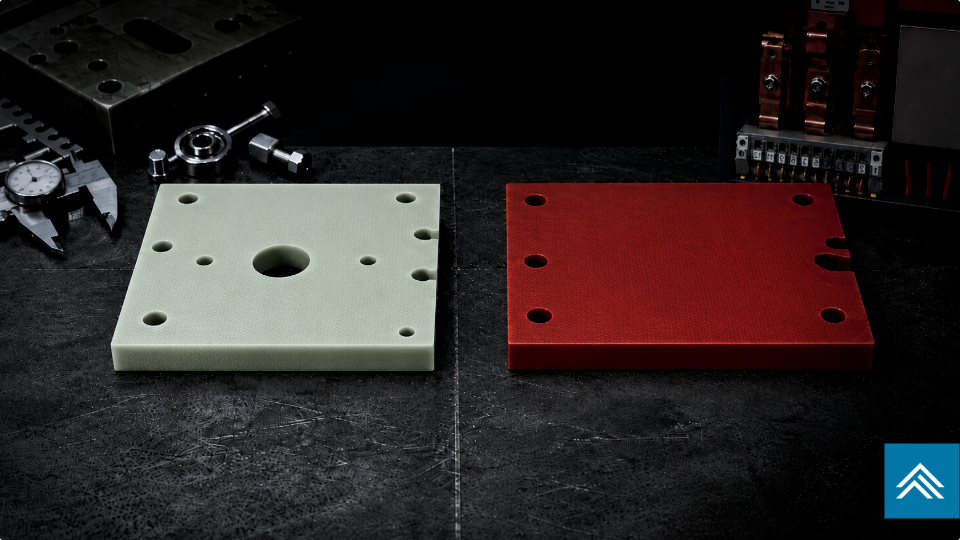
How to Pick the Right Thermoset Composite Laminate Before the Job Starts
GPO-3 and G-10 get compared for a practical reason: they often show up in the same places.
Electrical insulation panels. Switchgear components. Bus bar supports. Terminal boards. Fabricated insulating parts. Distributor catalogs. Customer drawings.
Both materials are fiberglass-reinforced thermoset laminates. Both can be used in electrical and mechanical applications. Both are familiar to engineers, fabricators, and maintenance teams working with industrial insulation materials.
That overlap is exactly why they get confused.
On paper, GPO-3 and G-10 can look close enough to invite a substitution conversation. In practice, they are built around different strengths. One (G-10) leans hard into mechanical performance. The other is often selected for its flame-retardant electrical insulation attributes.
So the real question is not, “Which one is better?”
The better question is, “What does the part actually need to survive?”
What is G-10?
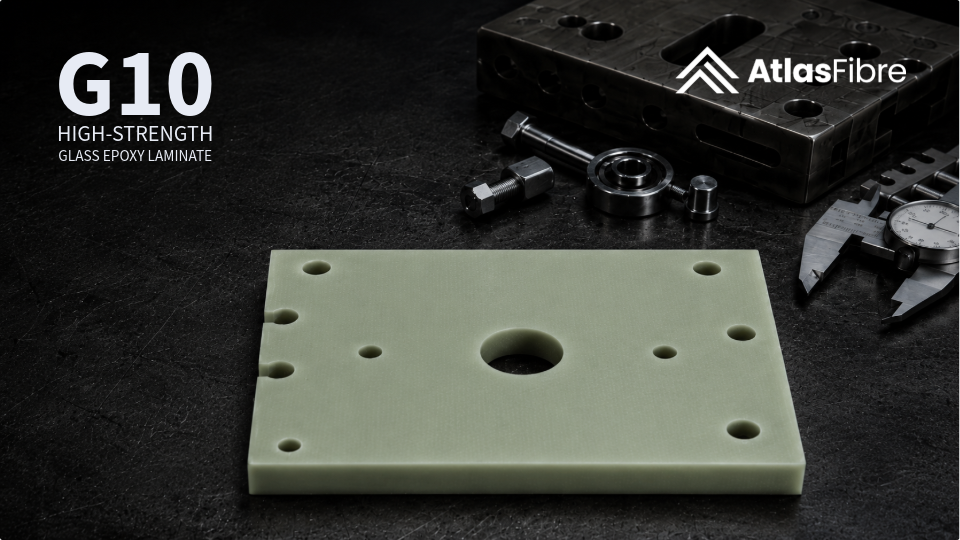
G-10 is a glass epoxy laminate made from woven fiberglass and epoxy resin. It qualifies to NEMA G10 and MIL-I-24768/2 Type GEE.
It is commonly used when a part needs a combination of mechanical strength, dimensional stability, and electrical insulation. If the application involves load, clamping, machining, bolting, flexing, or a structural requirement beyond basic insulation, G-10 usually deserves a close look.
In simple terms: G-10 is the stronger mechanical performer.
The material boasts tensile strength of 40,000 psi, compressive strength of 65,000 psi, flexural strength of 75,000 psi, and shear strength of 19,000 psi. It also has a 24-hour water absorption value of 0.11%.
Those numbers are the reason G-10 often enters the conversation when the part has to do more than sit between conductive surfaces.
Need help specifying a laminate for your application?
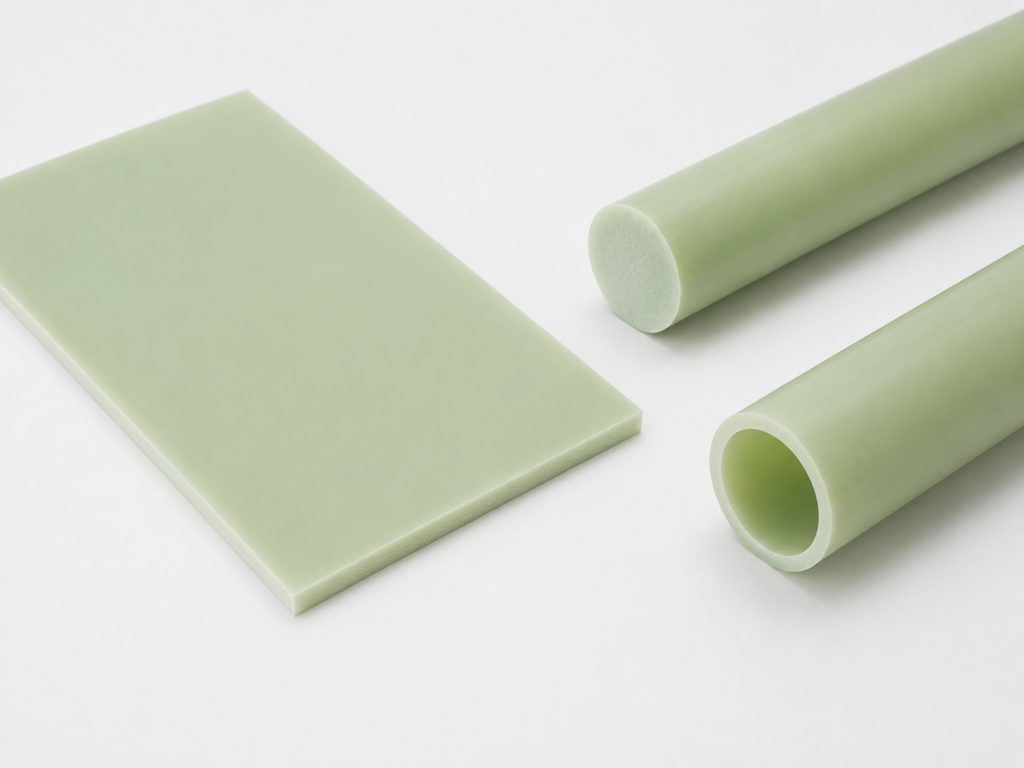
Check the G10 data sheet for dielectric strength, flexural strength, moisture resistance and other values. For a closer look at how G10 material properties stack up against other thermoset composite laminates, review the comparative data sheet from Atlas Fibre.
What is GPO-3?
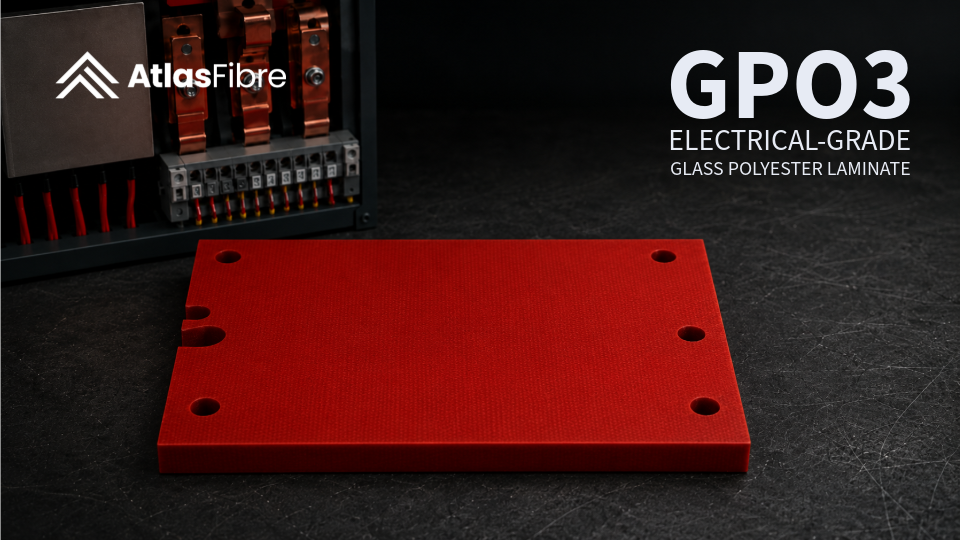
GPO-3 is a glass polyester laminate made from flame-retardant polyester resin and fiberglass reinforcement. It meets NEMA GPO-3 and MIL-I-24768/6 Type GPO-3 specifications.
It is commonly used in electrical insulation applications where flame performance matters. That makes it a frequent choice for switchgear, electrical panels, terminal boards, supports, and other insulating components where the part is not just separating electrical components, but also needs to meet flame-retardant requirements.
In simple terms: GPO-3 is often the stronger starting point for flame-retardant electrical insulation.
Atlas Fibre’s GPO-3 offers a UL 94 V-0 flammability rating, a maximum operating temperature of 311°F / 155°C, tracking index resistance of 600V, and water-saturated insulation resistance of 0.5 x 10¹¹ ohms.
That combination makes GPO-3 especially relevant when the application is centered on electrical insulation, flame retardance, and performance in humid electrical environments.
Quick comparison: GPO-3 vs. G-10
| Requirement | Better starting point | Why it matters |
|---|---|---|
| Higher tensile strength | G-10 | 40,000 psi for G-10 vs. 8,000 psi for GPO-3. |
| Higher compressive strength | G-10 | 65,000 psi for G-10 vs. 33,100 psi for GPO-3. |
| Higher flexural strength | G-10 | 75,000 psi for G-10 vs. 28,800 psi for GPO-3. |
| Higher shear strength | G-10 | 19,000 psi for G-10 vs. 11,600 psi for GPO-3. |
| Flame retardance | GPO-3 | GPO-3 is UL 94 V-0; G-10 is UL 94 HB. |
| Higher listed operating temperature | GPO-3 | 311°F / 155°C for GPO3; 284°F / 140°C for G-10. |
| Lower water absorption | G-10 | G-10 – 0.11%; GPO-3 – 0.4%. |
| Tracking resistance data | GPO-3 | GPO-3 has a tracking index resistance of 600V. |
| Water-saturated insulation resistance | GPO-3 | GPO-3 lists 0.5 x 10¹¹ ohms. |
| General mechanical durability | G-10 | G-10 has stronger listed mechanical properties across the data sheet. |
| Flame-retardant electrical insulation | GPO-3 | GPO-3 is the clearer starting point when UL 94 V-0 and electrical insulation are priorities. |
The big difference: mechanical strength vs. flame-retardant insulation
G-10 and GPO-3 are not separated by a single property. They are separated by the way their strengths stack up.
G-10 has the stronger listed mechanical profile. Its tensile, compressive, flexural, shear, bond, hardness, and impact values are all higher than those listed for GPO-3. That matters when the material is being machined into a part that must carry load, resist stress, hold shape, or perform in a demanding mechanical environment. Learn more about Atlas Fibre’s G10 machining services.
GPO-3 has the stronger flame-retardant insulation profile. Its UL 94 V-0 rating, higher listed operating temperature, tracking index resistance, and water-saturated insulation resistance make it a practical choice when electrical insulation and flame performance are the main requirements.
This is why the decision can get tricky. These materials are often close enough in application territory to be compared, but different enough in performance that the wrong substitution can create problems.
It is a little like two contractors quoting the same job with different grades of lumber. Both quotes may look like they solve the same problem. But once you know whether the structure needs appearance, load capacity, moisture resistance, code compliance, or a specific span rating, the difference between the options starts to matter.
The same is true here. GPO-3 and G-10 may both belong in the conversation. The application decides which one belongs in the part.
When G-10 is usually the better starting point
G-10 is typically the better starting point when the part needs mechanical strength along with electrical insulation.
That may include fabricated components that will be drilled, machined, fastened, loaded, or exposed to stress in service. If the application depends on rigidity, higher strength, impact resistance, or lower moisture absorption, G-10’s mechanical profile gives it an advantage.
The decision logic is straightforward: if failure is more likely to come from cracking, bending, loading, compression, wear, or mechanical stress, G-10 should be evaluated first.
That does not mean G-10 is automatically the answer for every demanding application. If the drawing requires a flame rating that G-10 does not meet, or if the application has specific electrical performance requirements tied to another material callout, the decision needs a closer review.
But when strength is the driver, G-10 is usually the stronger place to start.
When GPO-3 is usually the better starting point
GPO-3 is typically the better starting point when the application is centered on flame-retardant electrical insulation.
That may include insulating panels, switchgear components, bus bar supports, terminal boards, and other electrical parts where flame rating, insulation performance, and tracking resistance are central to the design. If the drawing calls for NEMA GPO-3, MIL-I-24768/6, or UL 94 V-0 performance, GPO-3 is not just a convenient option. It may be tied directly to the design requirement.
The decision logic is just as direct: if failure is more likely to come from an electrical insulation issue, flame performance requirement, or humid-environment electrical concern, GPO-3 should be evaluated first.
Where the conversation gets more nuanced is when the application needs both flame-retardant electrical insulation and higher mechanical strength. In that case, the answer may not be a simple GPO-3-or-G-10 choice. It may be worth reviewing FR-4, G-11, FR-5, or another thermoset laminate depending on the specification, operating temperature, mechanical load, and electrical requirement.
That is exactly the kind of decision that should happen before material is purchased and before the job reaches the floor.
Are GPO-3 and G-10 interchangeable?
Sometimes GPO-3 and G-10 can be interchangeable, but it is not an automatic decision.
They can appear in similar applications, and in some cases someone may ask whether one material can stand in for the other. But the material name alone is not enough to make that call.
Before substituting GPO-3 for G-10, or G-10 for GPO-3, check the drawing, the NEMA or MIL specification, the flame rating, the electrical requirements, the operating temperature, the environment, and the mechanical loads.
A GPO-3 part may not be the right substitute for G-10 if the application depends on high mechanical strength. A G-10 part may not be the right substitute for GPO-3 if the application requires UL 94 V-0 flame performance.
That is the mistake to avoid: treating two materials as interchangeable just because they show up in similar catalogs, similar applications, or similar conversations.
The bottom line on GPO-3 and G10
If the job needs higher mechanical strength, start with G-10.
If the job needs flame-retardant electrical insulation, start with GPO-3.
If the application needs both, slow down and review the full requirement before making a substitution. There may be another material that better fits the total performance profile.
GPO-3 and G-10 get confused because they often show up in the same real-world applications. But they solve different problems. When the drawing does not make the answer obvious, that is exactly the conversation worth having before the job hits the floor.
Atlas Fibre supplies and fabricates GPO-3, G-10, and a wide range of other thermoset composite laminates and advanced plastics. If you are comparing material callouts, reviewing a drawing, or looking for a cross-reference, our team can help identify the best fit based on the application, specification, and availability. Connect with an Atlas Fibre representative to learn more.