

What changes when you switch to a composite laminate?
When a metal part becomes a composite part, the drawing can stay the same. The material’s behavior does not.
Say you’ve designed a precision component in aluminum. The holes, pockets and mounting surfaces are dimensioned and the tolerances are tight. Now the material changes to G-10, a glass-reinforced thermoset laminate. The part looks the same and the CNC process is similar. The finished part can still measure differently.
The reason is that machining accuracy and dimensional stability are not the same thing. A machine can cut a feature to size. What happens to that feature after it leaves the machine depends on the material: how it responds to temperature, moisture, released internal stress and cutting forces.
A tolerance that is routine in aluminum can be difficult or expensive to hold in a thermoset laminate. In some directions, the laminate is actually more stable than aluminum. Knowing which is which helps engineers put tight tolerances where they matter and control machining cost.
Laminates Are Built in Layers, and That Changes How They Move
Most engineering metals behave about the same in every direction. Thermoset laminates do not.
G-10/FR-4, G-11 and phenolic grades are made by stacking layers of reinforcement saturated with thermosetting resin, then curing the stack under heat and pressure. The reinforcement is woven fiberglass in G-10, FR-4 and G-11. In phenolic grades it is paper, cotton canvas or linen. G-11 uses a higher-temperature epoxy than G-10, so it holds its properties at higher operating temperatures.
The result is a material with two distinct directions:
- In-plane (along the length and width of the sheet): the reinforcement controls behavior. Expansion and deflection are relatively low.
- Through the thickness (across the layers): the resin has more influence. Expansion is higher and the bond between layers is the weakest direction.
Engineers call this directional behavior anisotropy. Plywood is a familiar example of the same idea. For a precision part, it means each feature’s tolerance depends on which direction that feature runs relative to the layers.
Five Factors That Affect Tolerances in Thermoset Laminates
Temperature: Stable In-Plane, Less So Through the Thickness
In-plane, G-10 expands less than aluminum. Its coefficient of thermal expansion (CTE) along the sheet is about 5–8 µin/in·°F, compared with about 13 µin/in·°F for 6061 aluminum. A 2.000 in. dimension that warms 15°F grows about 0.0004 in. in aluminum and about 0.0002 in. in G-10.
Through the thickness, the picture reverses. G-10’s CTE in that direction is roughly 25–40 µin/in·°F. A 2.000 in. thick block measured 15°F cooler than it was machined can shrink about 0.001 in. On a ±0.001 in. tolerance, that is the full allowance on one side.
ASME Y14.5 and ISO 1 set 68°F (20°C) as the reference temperature for dimensions. For tight through-thickness tolerances, measure at or near that temperature, after the part has had time to stabilize.
The takeaway: For in-plane features, G-10 is often more thermally stable than aluminum. Apply extra caution to tight tolerances through the thickness.
Removing Material Releases Internal Stress
A flat laminate sheet can bow after machining. Curing under heat and pressure leaves residual stress in the sheet. Removing material changes the balance of those stresses, and the remaining part moves to a new shape.
Deep pockets, thin walls and heavy stock removal from one face make this more noticeable. The machine did nothing wrong; the material responded to the change in its structure.
Machinists typically manage this by 1) removing material from both faces in alternating passes, 2) rough machining, letting the part rest, then finish machining, and 3) stress relieving the part between roughing and finishing for demanding parts.
For more on thin features, see our post on thin-wall composite machining.
The takeaway: Geometry and machining sequence affect flatness as much as the tolerance on the drawing does.
Some Grades Absorb Moisture
Metal parts do not change size with humidity. Some laminates do. Paper, canvas and linen phenolics use cellulose reinforcement, which absorbs water. Typical 24-hour absorption for these grades is about 1–2.5%. G-10 absorbs much less, about 0.1–0.25%.
For most industrial parts, the resulting size change is too small to matter. For close-fitting parts, or parts that move between dry and humid environments, choose a low-absorption grade or allow for the change. Our post on moisture absorption in laminates covers this in more detail.
The takeaway: Grade selection and operating environment determine whether a tight tolerance holds in service.
Lower Stiffness Means More Deflection Under Cutting Forces
G-10’s flexural modulus is about 2.4–2.8 Msi, roughly one-quarter of aluminum’s elastic modulus of about 10 Msi. Under the same cutting force, thin walls, long unsupported sections and slender features deflect more. When the tool moves away, part of that deflection recovers, and the machined dimension changes.
Laminates also conduct heat poorly, so heat stays near the cutting edge instead of moving into the part and chips. Sharp tooling, suitable feeds and speeds, and rigid workholding control both effects.
The takeaway: Holding tolerance in laminates depends on support and cutting strategy, not just machine positioning accuracy.
Glass Reinforcement Wears Tools Quickly
Glass fiber is abrasive. As a cutting edge wears, hole diameters and profile dimensions drift, and edges can fray or delaminate at tool exit. A tolerance that holds on the first part may not hold on the five-hundredth.
Carbide or diamond-coated tooling, planned tool changes and in-process inspection keep dimensions consistent over a run. These add cost, which is one reason to apply tight tolerances only where the function requires them.
The takeaway: Repeatability across a production run matters as much as accuracy on a single part.
Check the Stock Thickness Tolerance First
Laminate sheet is sold with a published thickness tolerance (NEMA LI-1 lists these by grade and thickness). That tolerance is much wider than for ground metal plate, and it widens as the sheet gets thicker.
This creates a common conflict when a metal drawing is reused. If the drawing calls a tight thickness on a face that will be left as-supplied, the stock may not meet it. The options are:
- Open the thickness tolerance to match the stock tolerance
- Start from thicker stock and machine both faces to the required dimension
- Machine only the faces where thickness affects fit or function
Machining both faces adds cost and can release internal stress (see factor 2), so decide this during design.
What About Thermoplastics?
We’re focusing on thermoset laminates in this overview, but thermoplastics such as acetal, nylon and UHMW also behave differently, and in several ways, they are harder to hold to tight tolerances:
- Thermal expansion: Roughly 4–8 times that of aluminum, in all directions.
- Moisture: nylon absorbs several percent water by weight and grows measurably as it does.
- Creep: thermoplastics deform slowly under sustained load, which affects press fits and clamped joints over time.
Thermoset laminates do not soften when heated and resist creep better, which is one reason they are chosen for structural and electrical insulating parts with dimensional requirements.
Where Metal and Laminate Tolerances Differ Most
Achievable tolerance depends on grade, geometry, size, workholding and inspection conditions. These are the features where the difference is largest.
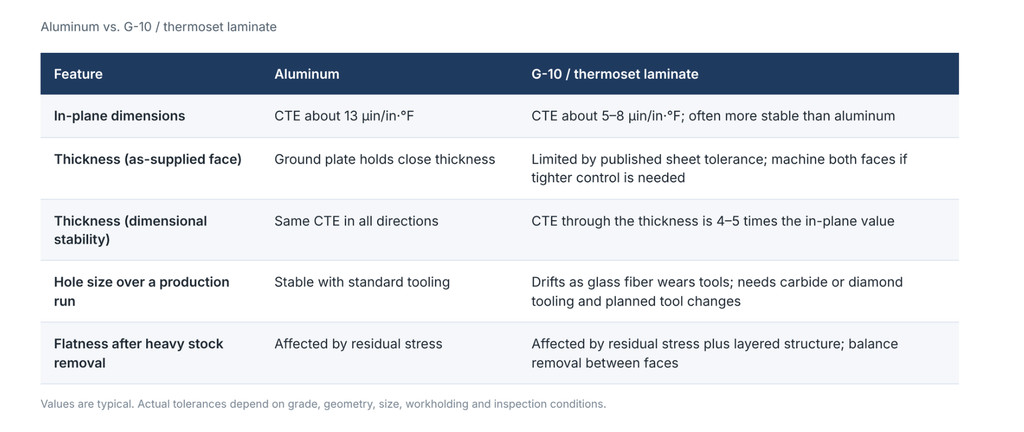
On a typical part, a ±0.010 in. general tolerance may suit non-critical edges while a locating hole or mating feature needs ±0.002 in. Both can exist on the same drawing. The question is whether each feature needs its tolerance, and whether the material and process can hold it consistently.
Six Things to Check Before Converting a Metal Part to a Laminate
Thermoset laminates offer electrical insulation, lower weight and corrosion resistance. Getting those benefits without manufacturing problems takes a drawing review.
- Separate critical tolerances from general ones. Metal drawings often carry blanket tolerances that are tighter than a laminate part needs. Identify the dimensions that control assembly, alignment or performance, and open the rest. A mounting hole that sets alignment may need a tight positional tolerance. An outside edge that touches nothing usually does not.
- Check thickness against the stock tolerance. If a face will be left as-supplied, make sure the drawing tolerance covers the published sheet tolerance for that grade and thickness.
- Specify laminate orientation. For parts with directional loads or tight tolerances in one direction, state on the drawing which way the layers run.
- Define how the part is restrained for inspection. A thin plate may bow slightly when it sits free on an inspection table. If it will be bolted to a rigid assembly, the installed condition matters more. ASME Y14.5 allows a restrained-condition note that tells inspectors how to fixture the part before measuring flatness or profile.
- Rethink press fits and threads. Laminates do not yield like ductile metals. An interference fit that works in aluminum can crack a laminate. Threads tapped into the edge of a sheet run parallel to the layers and can strip or split them. Through-bolts, threaded inserts or tapped holes through the face are usually more reliable.
- Review critical tolerances with your machining supplier before production. Tooling, workholding, stock thickness and machining sequence can all be planned for, but only if the critical features are known at the start.
Match the Tolerance to the Material and the Function
Thermoset laminates can be machined to tight tolerances. G-10 is more thermally stable than aluminum in-plane. The difference is that thickness, moisture, internal stress and tool wear need to be considered when a tolerance is set, not discovered at inspection.
Atlas Fibre manufactures and machines precision parts from thermoset composite laminates. Learn more about our plastic machining capabilities and G-10/FR-4 material.
Converting a metal part to a laminate? Send us your drawing and we’ll identify the tolerances to review before quoting.