
A Beginner’s Guide to UL 94 Flame Ratings
Understanding how materials behave when exposed to flame is essential in industries like electronics, aerospace, automotive, and consumer products. To help manufacturers compare materials and ensure safety, Underwriters Laboratories (UL) created UL 94, a widely used flammability standard for plastic and composite materials.
While the full testing procedures can be technical, the core idea is simple: UL 94 measures how a material burns – and how it stops burning – under controlled conditions. Different tests simulate real-world scenarios like horizontal exposure, vertical exposure, and exposure to dripping molten material.
Explore the following primer to understand the major UL 94 tests.
Why UL 94 Testing Matters
When materials catch fire, what happens next matters just as much as ignition:
- Do they burn slowly or quickly?
- Do they self-extinguish once the flame is removed?
- Do they drip flaming particles that could ignite something else?
- Do they leave behind glowing embers that continue burning?
UL 94 ratings help engineers choose materials that meet safety requirements for their applications – and help manufacturers demonstrate compliance and reliability.
The Two Main UL 94 Test Types
UL 94 contains two foundational burn orientations:
- Horizontal Burn (HB)
- Vertical Burn (V-0, V-1, V-2)
From these, additional specialized tests are built for thicker, thinner, or more flexible materials.
Below is a clear overview of each.
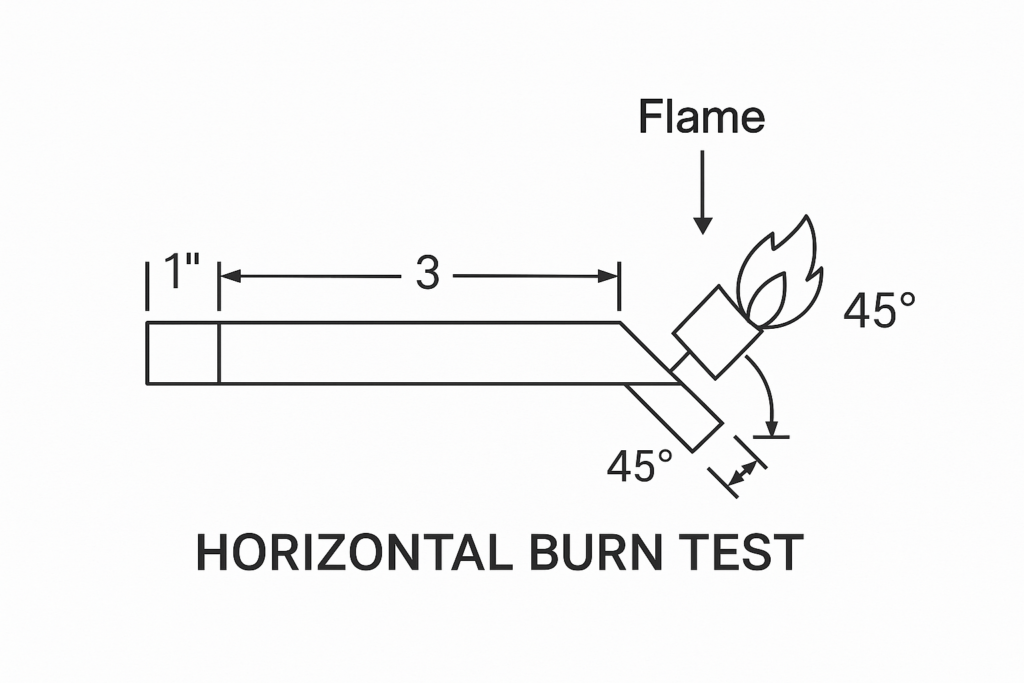
Horizontal Burn Test (HB)
What it simulates:
A flame contacting a material lying horizontally – similar to how a wire cover or panel might be oriented.
How the test works:
- A rectangular specimen is placed horizontally and tilted to a slight 45° angle.
- A flame is applied for up to 30 seconds or until the flame front reaches the first measurement mark.
- After the flame is removed, the burning rate is measured between the 1-inch and 4-inch marks along the sample’s length.
- The test records how fast the fire travels – or whether it self-extinguishes before reaching the end.
To earn an HB rating:
The material must burn slowly enough (no more than 1.5 in/min for common thicknesses, or 3 in/min for thinner samples).
It must self-extinguish before the flame front reaches the 4-inch mark.
This is the most basic UL 94 rating – materials that pass HB may still burn, but at a controlled, predictable rate.
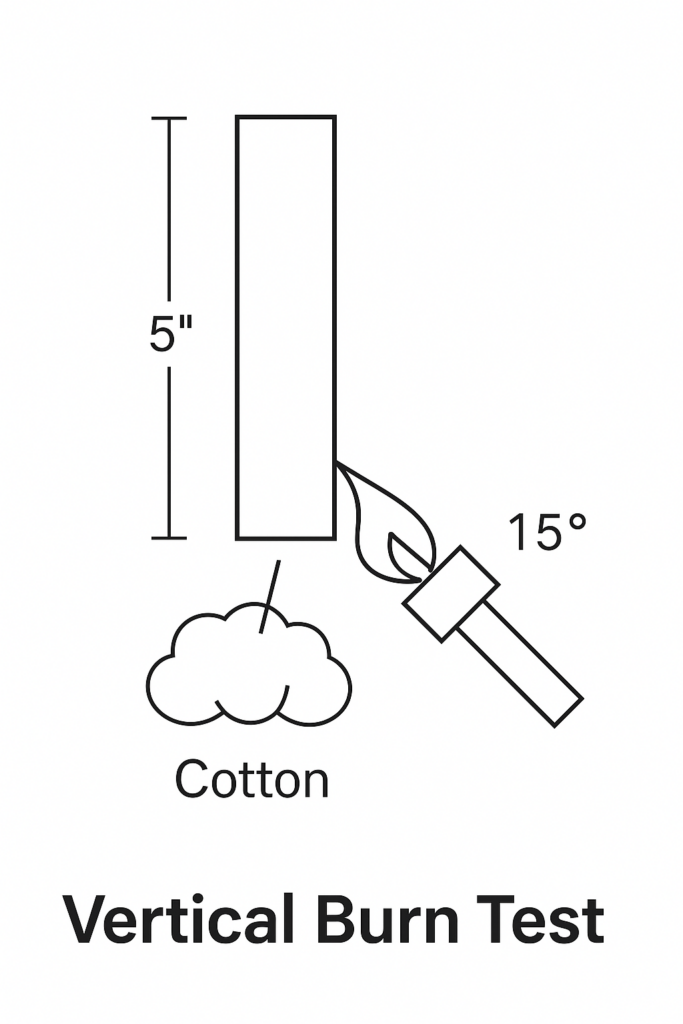
Vertical Burn Tests (V-0, V-1, V-2)
What they simulate:
More demanding conditions where a material is positioned vertically – similar to circuit boards, enclosures, or components mounted upright. Vertical testing is more stringent than horizontal testing because flame naturally travels upward.
How the test works:
- The specimen is clamped vertically.
- A flame is applied to its bottom edge for 10 seconds, removed, and the time to self-extinguish is measured.
- The flame is applied a second time for another 10 seconds.
- Cotton placed below the sample checks whether flaming drips fall and ignite it.
- Five specimens are tested, and total burn times and behaviors are recorded.
The three ratings:
V-0 (most stringent)
- Must stop burning within 10 seconds after each flame application.
- No flaming drips that ignite the cotton.
- Minimal glowing combustion remaining after the flame is removed.
V-1
- May burn slightly longer (up to 30 seconds after each flame application).
- Still no flaming drips.
- Glowing combustion must extinguish relatively quickly.
V-2
- Similar burn time limits to V-1.
- Flaming drips are allowed – but they must not ignite the cotton.
- These ratings help differentiate materials that simply self-extinguish from those that also resist dripping molten material.
5V Testing (5V, 5V-A, 5V-B)
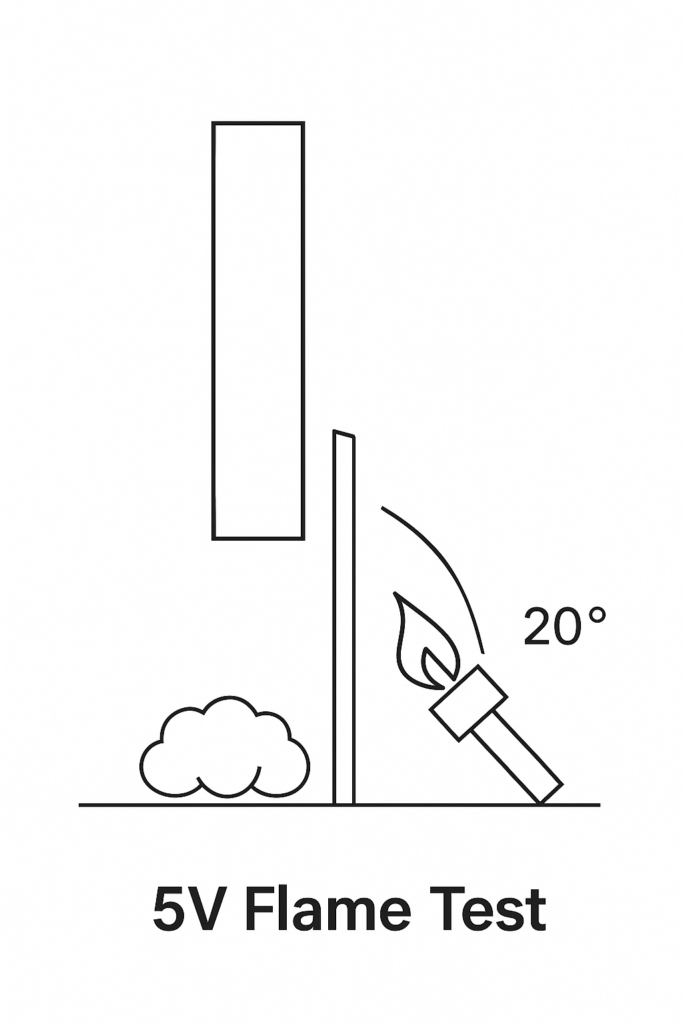
When applications require even more demanding performance – such as large enclosures or housings that may experience repeated flame exposure – the 5V series is used.
How the test works:
- Specimens are held vertically.
- A flame is applied for five seconds, removed, and this cycle is repeated five times.
- As with earlier tests, cotton below the sample detects flaming drips.
- Both bars and plaques (flat panels) may be tested.
Ratings:
5V
- The material cannot burn more than 60 seconds after the final flame application.
- No flaming drips are allowed.
- The specimen must not be destroyed in the flame area.
5V-A
- Same as 5V but with additional requirement that plaques cannot exhibit burn-through (a hole).
5V-B
- Similar to 5V-A but burn-through is permitted, depending on the intended application.
5V ratings indicate extremely flame-resistant materials suited for more hazardous or mission-critical environments.
Vertical Testing for Thin Materials (VTM-0, VTM-1, VTM-2)
Some materials – especially films, foils, thin laminates, or flexible sheets – cannot be tested in standard vertical form because they distort or curl when exposed to heat. In these cases, the material is rolled into a small cone for testing.
How the test works:
- A thin sheet is wrapped around a mandrel to form a cone shape and then taped.
- The cone is suspended vertically.
- A flame is applied for 3 seconds, removed, then applied again for 3 seconds.
- Burn times, dripping, glowing, and flame spread are recorded.
Ratings:
The performance criteria mirror the standard vertical test but are adjusted for the unique behavior of flexible materials:
- VTM-0: Very fast self-extinguishment (under 10 seconds), no flaming drips, very limited glowing.
- VTM-1: Longer extinguish time allowed (up to 30 seconds), no flaming drips.
- VTM-2: Similar burn limits to VTM-1, but flaming drips are allowed if they do not ignite the cotton.
These tests are essential for materials used in insulation films, tapes, and thin-layer composites.
Putting It All Together
UL 94 ratings aren’t simply labels – they’re indicators of how materials behave under real-world fire exposure. Here’s a quick hierarchy from most to least flame-resistant:
5V → V-0 → V-1 → V-2 → HB
(With VTM ratings paralleling the V-series for thin materials.)
The right rating depends on your application. For example:
- HB may be sufficient for non-critical housings or large components with low ignition risk.
- V-0 or V-1 is common for electronics, transportation, or areas near heat sources.
- 5V is used where repeated or intense flame exposure is possible.
Interested in Flammability and Flame Resistance?
Read more on this topic at Atlas Fibre: