
Engineered for Heat, Wear, and Electrical Isolation
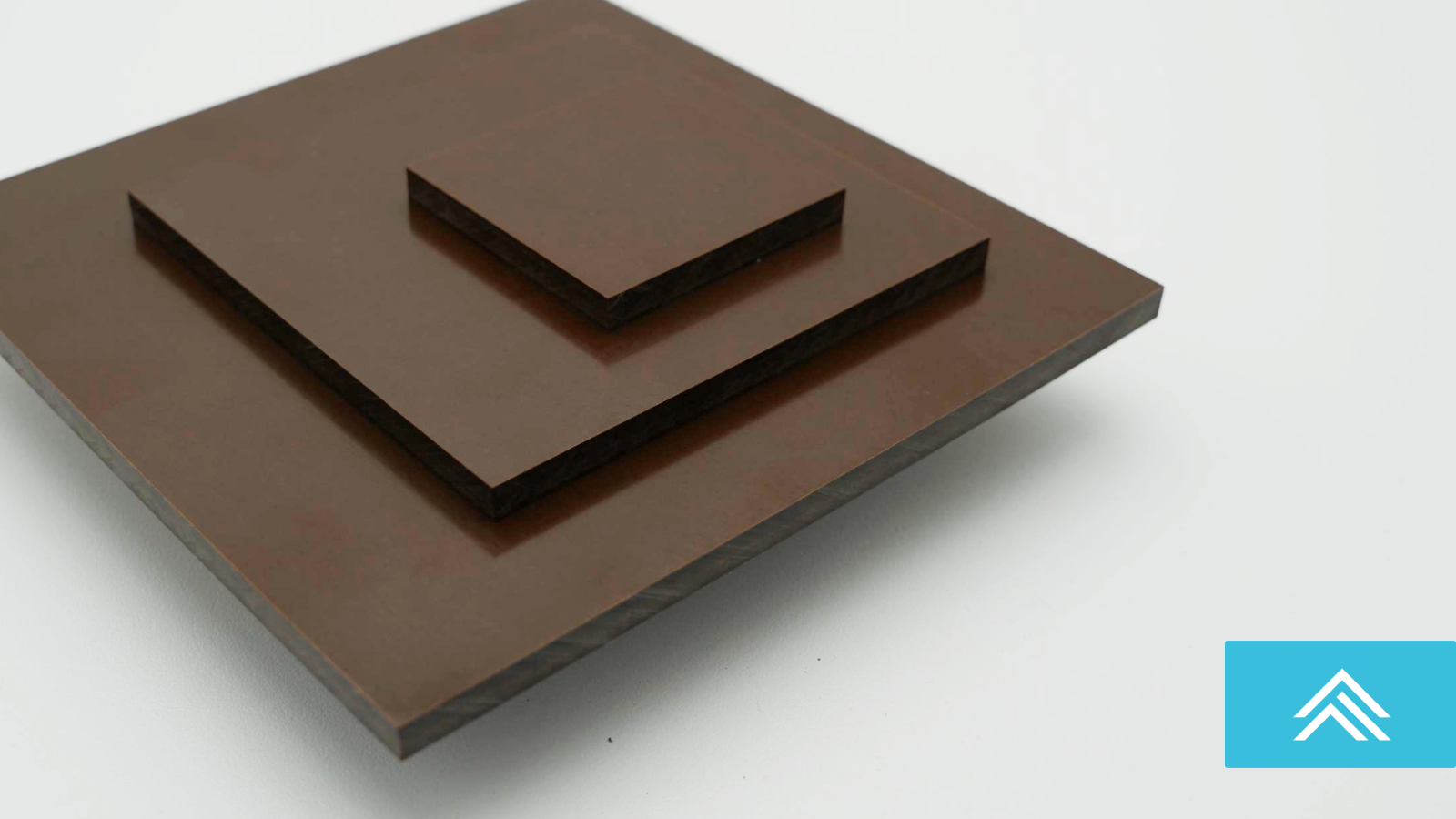
Phenolic composite laminates remain one of the most versatile and cost-effective thermoset materials for applications where heat, friction, and electrical isolation converge. Their performance comes from a rigid, highly cross-linked phenolic resin matrix that permanently cures around a reinforcing substrate, creating a material system that does not melt, creep, or flow under load.
At Atlas Fibre, phenolics are not treated as a commodity. They are engineered materials – selected, processed, and machined with an understanding of how resin chemistry, reinforcement type, and machining strategy interact to determine real-world performance.
Performance Where It Matters
High-Heat Environments
Phenolic laminates are inherently thermally stable. Once cured, the phenolic network does not melt; instead, it softens minimally and then chars at elevated temperature. This behavior allows parts to retain shape and function rather than dripping, flowing, or deforming under heat.
Many industrial phenolic grades operate continuously in the 120-150 °C range, with certain glass-reinforced systems tolerating higher intermittent excursions while maintaining mechanical strength and dielectric integrity. Their low thermal conductivity further allows phenolics to act as thermal insulators, protecting adjacent components and assemblies from heat transfer.
This combination makes phenolics a reliable choice for fixtures, electrical components, and wear parts exposed to sustained hot-running conditions.
Friction and Wear Resistance
Phenolic matrices bond exceptionally well to fibrous reinforcements such as paper, cotton, and glass. The result is a tough, dimensionally stable laminate with strong compressive and flexural properties under load.
In frictional or sliding contact, phenolic composites behave differently than thermoplastics. Rather than melting, they tend to form a stable transfer film or controlled char layer, reducing seizure and maintaining surface integrity. This makes them well-suited for brake and clutch components, bearing surfaces, wear plates, and other high-friction applications.
Importantly, phenolics retain stiffness and strength far better than most thermoplastics at elevated temperature, minimizing vibration, deformation, and loss of tolerance over time.
Electrical Isolation and Reliability
Phenolic laminates offer high dielectric strength and volume resistivity, making them effective electrical barriers in switchgear, transformers, terminal boards, and power distribution hardware.
Unlike many materials, phenolics maintain insulating performance across both dry and humid environments and over a wide operating temperature range. This reliability allows a single component to function as both a structural element and an electrical insulator, simplifying assemblies and reducing part count.
Practical Advantages in Industrial Service
Beyond headline performance, phenolic laminates provide advantages that matter in production environments:
- Low creep and excellent dimensional stability due to their thermoset nature
- Consistent performance through thermal cycling
- Resistance to oils, solvents, and industrial fluids
A favorable performance-to-cost ratio compared to higher-end glass-epoxy or polyimide systems for “high – but not extreme – duty” conditions
These characteristics make phenolics a dependable solution for long-term service where precision, stability, and cost control are all required.
Paper vs. Glass Reinforced Phenolics
Selecting the Right Balance of Cost, Strength, and Stability
Reinforcement selection dramatically changes how phenolic laminates behave mechanically, thermally, electrically, and during machining.
Mechanical Performance
Paper-reinforced phenolics offer lower tensile and flexural strength, making them ideal for light-to-moderate loads, insulating panels, spacers, and fixtures.
Glass-reinforced phenolics significantly increase strength, stiffness, impact resistance, and wear resistance, enabling use in structural components, high-load electrical parts, and demanding industrial environments.
Thermal and Environmental Stability
Paper phenolics perform well at moderate temperatures but are limited by the cellulose reinforcement under sustained heat.
Glass phenolics provide improved high-temperature capability and dimensional stability, maintaining properties more reliably in hotter, more variable environments.
Electrical and Moisture Behavior
Paper phenolic offers excellent insulation at low cost but is more hygroscopic, which can affect dimensions and dielectric performance in humid conditions.
Glass phenolic maintains strong dielectric properties with better moisture resistance, making it preferable for outdoor, high-humidity, or temperature-cycling applications.
Typical Uses and Cost Considerations
Paper-reinforced phenolics are economical, easy to machine, and commonly used for terminal boards, insulating plates, and low-stress components.
Glass-reinforced phenolics cost more and are harder on tooling, but they are selected where structural strength and electrical isolation must coexist, such as aircraft components, precision insulators, and high-temperature electrical hardware.
Reinforcement and Electrical Behavior
Why Processing Quality Matters
The phenolic matrix provides the baseline electrical insulation. Reinforcement modifies that baseline by introducing interfaces, leakage paths, and moisture behavior.
Glass fibers, when properly bonded, add highly resistive paths with minimal moisture uptake, helping maintain dielectric strength over a wider range of conditions. Increased fiber content and good fiber distribution increase leakage path length and breakdown voltage.
Conversely, conductive reinforcements (carbon, graphene, metal fillers) intentionally sacrifice insulation for EMI shielding or dissipative behavior.
Processing quality is critical. Poor wet-out, voids, or contamination create local electric field intensification and early breakdown. Material selection and manufacturing discipline matter as much as the resin system itself.
Dust Control, Cooling, and Safety
Phenolics are typically dry-machined. Liquid coolants can cause swelling or warping, so compressed air is used for chip evacuation and modest cooling.
All phenolics generate fine dust; glass grades add respirable glass particles. Effective extraction, sealed machining environments, and disciplined PPE practices are essential – especially in high-volume production.
Atlas Fibre: The Materials and Machining Authority
Phenolic laminates reward experience. Performance depends not just on resin and reinforcement, but on material selection, machining strategy, and process control.
Atlas Fibre brings these together—combining deep phenolic material knowledge with advanced machining capability to deliver parts that hold tolerance, maintain insulation, and perform reliably in heat- and wear-intensive environments.
Whether the application demands cost-effective paper phenolic or high-performance glass-reinforced systems, Atlas Fibre approaches phenolics as engineered solutions – not just raw material.