

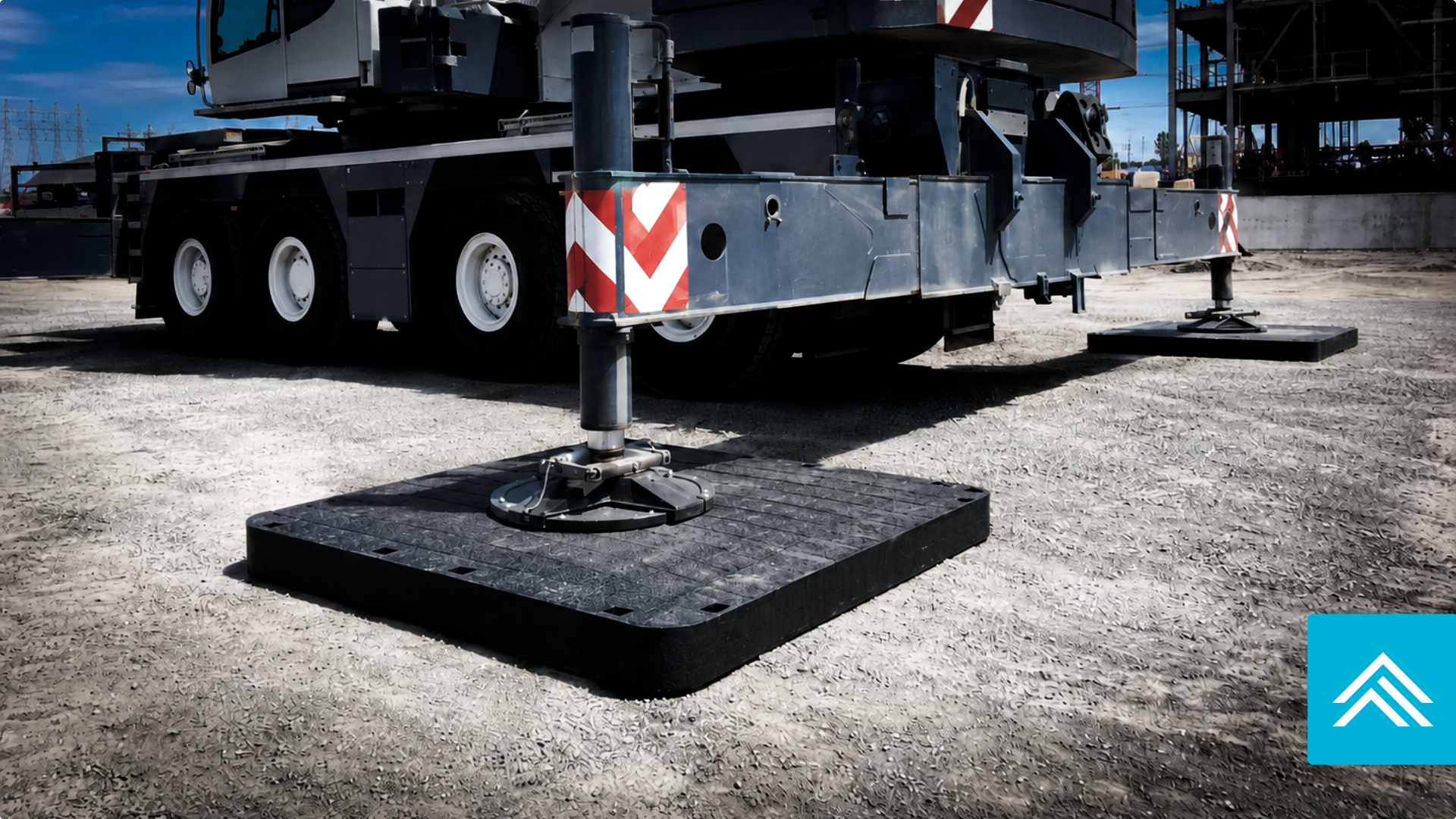
Composite outrigger pads play a critical role in safe equipment setup. Used under cranes, boom trucks, aerial lifts, bucket trucks, digger derricks, and other equipment with stabilizer legs, they help distribute concentrated outrigger loads over a larger surface area.
That larger footprint reduces ground pressure, helping prevent equipment from sinking, tipping, or damaging the surface below. While outrigger pads can be made from several materials, composite pads have become a strong choice for demanding jobsites because they combine strength, durability, and manageable weight.
What an outrigger pad does
An outrigger pad is a load-distribution plate placed between the equipment’s outrigger foot and the ground. Its job is to increase the contact area between the machine and the surface below.
That matters because an outrigger foot concentrates a significant amount of force into a relatively small area. Without a properly sized pad, that force can exceed what the ground can safely support.
A well-selected outrigger pad helps:
- Increase contact area under the outrigger foot.
- Reduce pressure on soft, uneven, or finished surfaces.
- Improve equipment stability during lifting or setup.
- Limit surface damage and reduce the risk of sinkage.
Why composites are well suited for outrigger pads

Composite outrigger pads offer an attractive balance of strength, stiffness, durability, and handling. Compared with wood, composites are more consistent and less variable from pad to pad. Compared with steel, they are typically lighter and easier to move around the jobsite. Compared with some polymer-only options, engineered composites can provide added stiffness and controlled deflection under heavy loads.
That combination is useful because outrigger pads need to do more than simply sit under the equipment. They need to distribute load, resist cracking, tolerate jobsite abuse, and perform reliably across changing conditions.
Composite outrigger pads are often chosen because they can provide:
- High strength-to-weight performance.
- Controlled deflection under load.
- Resistance to moisture, cracking, and repeated use.
- Better consistency than wood or plywood.
- Easier handling than steel.
- Durability in outdoor and demanding environments.
For crews working across mixed jobsite conditions, that balance can make composites a practical choice when both performance and usability matter.
How to size a composite outrigger pad
The right pad starts with the maximum load on a single outrigger. This information should come from the machine’s load chart or manufacturer data whenever possible.
From there, the goal is to size the pad so the pressure transferred to the ground stays below the allowable bearing pressure of the surface.
A common starting formula is:
Pad area = outrigger load ÷ allowable ground bearing pressure
For example, if a machine places 12 tons on one outrigger and the ground is rated for 30 tons per square meter, the minimum pad area would be:
12 ÷ 30 = 0.4 square meters
That number gives you the minimum calculated footprint. In real jobsite conditions, especially on soft soil, mud, gravel, or uneven terrain, it is often wise to go larger than the calculated minimum.
Pad thickness matters too. If the pad flexes too much under load, a larger footprint alone may not be enough. A thicker composite pad can help improve stiffness, reduce bending, and provide more reliable load distribution.
Matching composite pads to the jobsite
Different surfaces place different demands on an outrigger pad. On hard, finished surfaces, the pad should provide enough area to reduce point loading while helping avoid unnecessary surface damage. On softer ground, the pad needs more footprint and stiffness to limit sinkage and bending.
Composite pads are especially useful in applications where the jobsite changes frequently. A crew may move from concrete to asphalt to compacted gravel to softer ground in the same week. In those situations, a durable composite pad can provide a dependable middle ground between lightweight handling and serious load-distribution performance.
Climate should also be considered. Moisture, temperature swings, and repeated outdoor exposure can affect pad performance over time. Engineered composites are often selected because they are built to withstand those variables better than traditional wood cribbing.
Where other materials fit
Composite pads are not the only option. Engineering thermoplastics including UHMW polyethylene and high-strength nylon can be useful when lightweight, wear-resistant, non-marking performance is the top priority. Wood or plywood can also work for simpler cribbing applications, though performance can be less consistent. Steel too offers high strength for specific heavy-duty applications, but it is often heavier and less friendly to finished surfaces.
The best choice depends on the equipment, expected load, surface condition, and handling requirements. For many demanding lifting and stabilizing applications, composites offer a strong balance of performance, durability, and practicality.
A simpler way to estimate pad size
Choosing an outrigger pad involves both load calculation and jobsite judgment. A simple in-page calculator can help users estimate the minimum pad area by entering the expected outrigger load and allowable ground bearing pressure.
That calculation should be treated as a starting point. The final pad selection should also account for material, thickness, ground conditions, expected deflection, safety margin, and equipment manufacturer guidance.
For many applications, a properly sized composite outrigger pad can provide the strength, consistency, and durability needed to help keep equipment stable and crews working safely.