

Next-generation product design is defined by increasingly tight constraints – reduce mass, improve reliability, simplify production, and maintain performance under demanding operating conditions. Advanced plastics, particularly thermoset composite laminates, give design engineers a practical and technically rigorous path to meet those requirements when metals or commodity thermoplastics introduce unnecessary weight, corrosion risk, or dielectric limitations.
What Thermoset Composite Laminates Actually Are
Thermoset composite laminates are engineered structural materials formed by combining reinforcing fiber systems – woven glass, aramid, carbon, or hybrid configurations – with resin matrices that undergo irreversible crosslinking during cure. Unlike thermoplastics, thermosets cannot be remelted after processing. That irreversibility is a feature, not a limitation: the resulting network structure delivers dimensional stability, creep resistance, and mechanical performance that thermoplastics struggle to match in sustained-load or elevated-temperature service.
The result is a material platform with a compelling combination of properties: high specific stiffness, electrical insulation across a broad frequency range, chemical and solvent resistance, and thermal endurance well above what most engineering thermoplastics can sustain. In a way, they are next generation plastics. For components operating under mechanical load, thermal cycling, vibration, or high-voltage conditions, these properties are not incidental – they are the design requirement.
Engineering the Right Fit: Performance-First Material Selection
The strongest composite designs begin with the load case, not the material catalog. Before selecting a laminate grade, engineers should define the full performance envelope:
- Mechanical requirements: static and dynamic load cases, safety factors, expected fatigue cycles, bearing and shear loads at fastener locations
- Thermal requirements: continuous operating temperature, short-term excursions, thermal cycling range, and coefficient of thermal expansion (CTE) compatibility with mating components
- Electrical requirements: dielectric strength, comparative tracking index (CTI), arc resistance, and dissipation factor across the operating frequency range
- Environmental exposure: chemical resistance to process fluids, solvents, humidity, and UV – particularly where surface degradation could compromise function
- Dimensional tolerances: tight fits, stack-up tolerances, and GD&T requirements that must be held through both cure and finish machining
From that performance map, the fiber architecture, resin system, laminate orientation, and fabrication method can be selected with engineering intent rather than material substitution logic.
The Central Role of Precision Machining
One of the most consequential – and often underappreciated – aspects of thermoset laminate component production is precision machining. Unlike injection-molded thermoplastics, thermoset laminates are typically manufactured as stock sheet, rod, or tube and then machined to final geometry. That means the machined part is the final part, and its dimensional and structural integrity depends entirely on how well the machining process is engineered and controlled.
This has direct design implications:
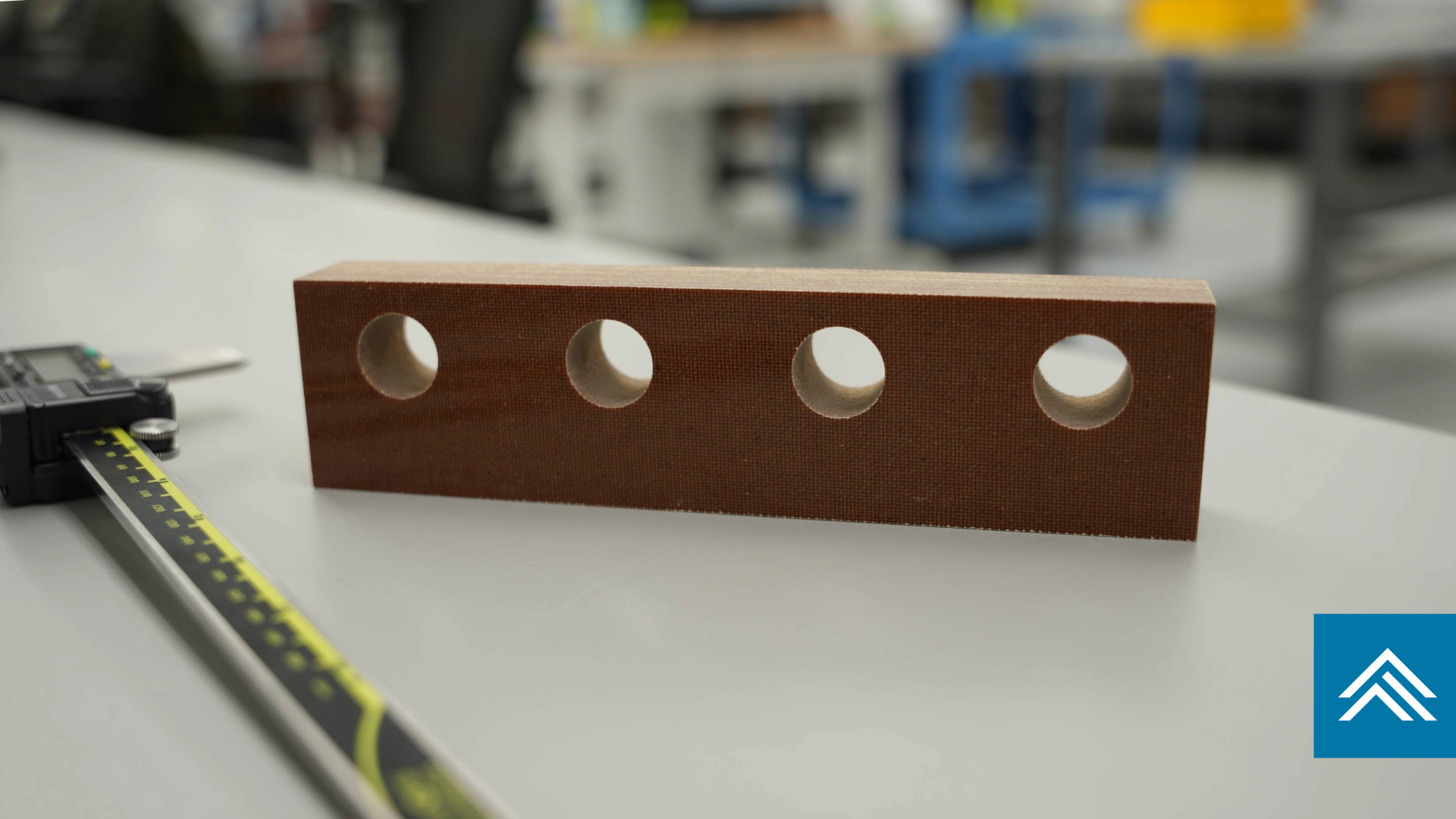
Hole geometry and fastener interfaces are critical. Delamination, fiber pullout, and bearing surface degradation can occur if drilling parameters – spindle speed, feed rate, tool geometry, backing support – are not optimized for the specific laminate grade. Countersinks, counterbores, and close-tolerance bored holes require rigid fixturing and appropriate tooling to maintain circularity and avoid subsurface damage.
Edge conditions matter structurally. Rough or chipped edges on highly loaded composite parts are not merely cosmetic. Edge quality affects interlaminar stress concentrations and fatigue performance, particularly in cyclically loaded brackets, spacers, or bearing surfaces. Proper cutting tool selection and edge finishing are part of the engineering specification, not an afterthought.
Wall thickness and section transitions must account for both structural requirements and machinability. Abrupt thickness changes, thin webs, and deeply pocketed geometries can be challenging to hold to tolerance without careful fixturing and toolpath planning. Designing with manufacturability in mind – maintaining uniform sections where possible, avoiding unnecessarily aggressive depth-to-width ratios – reduces the risk of deflection, chatter, or dimensional drift during machining.
Tight tolerance features – precision bores, slots, and mating surfaces – are achievable in thermoset laminates, but they require a controlled process. Thermal growth during cutting, tool wear effects, and moisture absorption in some laminates can all introduce dimensional variability. Specifying realistic tolerances informed by the material and process, rather than defaulting to metal-equivalent tolerances, produces better outcomes.
Surface finish requirements should be defined by function. A bearing surface, a sealing interface, and a structural mounting face each have different surface finish needs. Matching the finish specification to the actual functional requirement – rather than applying a blanket Ra value – allows the machinist to optimize the process and reduces unnecessary rework.
Resin System Selection: More Than a Grade Number
For components in electrical or thermal service, resin system selection deserves engineering-level attention. Different thermoset matrices – epoxy, phenolic, cyanate ester, bismaleimide, polyimide – offer meaningfully different profiles across dielectric strength, heat deflection temperature, moisture uptake, processability, and outgassing behavior.
Epoxy-based laminates offer a broad performance baseline with good mechanical properties and moderate thermal resistance. Phenolics extend thermal and arc-resistance performance but introduce brittleness tradeoffs. High-performance matrices like cyanate ester or BMI push thermal capability further but drive up material and processing cost. Selecting the right system for the actual service environment – rather than defaulting to the most familiar grade – is an engineering decision with real consequences for part life, weight, and cost.
What Is Changing: Smarter Processing and Better Design Tools
The evolution of advanced plastics is as much about process engineering and design tools as it is about new material chemistries. Key developments reshaping thermoset composite part production include:
Improved curing systems that enable lower processing temperatures, shorter cure cycles, and more uniform crosslink density – directly affecting part-to-part consistency and reducing residual stress.
Process monitoring and sensor integration that allow manufacturers to track cure state, temperature distribution, and dimensional response in real time, reducing the reliance on empirical trial-and-error and improving first-article yield.
Simulation tools for composite structures that can model fiber orientation effects, laminate failure modes, and CTE mismatch behavior before a part is ever cut – tightening the loop between design intent and manufactured result.
Automated and precision CNC machining with toolpath strategies optimized for composite materials, enabling tighter tolerances, better edge quality, and more repeatable production at higher volumes.
Together, these capabilities mean engineers can be more deliberate and data-driven in how they specify, design, and produce thermoset laminate components.
The Practical Engineering Takeaway on Next Generation Plastics
Thermoset composite laminates are not drop-in substitutes for metal or thermoplastic components. They are best treated as a precision material platform – one that rewards careful design and penalizes late-stage rework.
The highest-value applications combine performance requirements that play directly to composite strengths: a part that needs to be lightweight, structurally stiff, electrically insulating, thermally stable, and dimensionally precise is exactly where a well-designed thermoset laminate, properly machined to final geometry, delivers a compelling advantage over any single-property alternative.
Getting there requires integrating material selection, laminate design, tolerance specification, and machining process engineering from the start. When those disciplines are aligned early, thermoset composites do not just meet the performance bar – they redefine what is possible in a next-generation component.