


Thermally Stable, Dielectric, and Lightweight
EV battery engineers have to balance (at least) three demands in a limited space: keep the pack rigid, maintain electrical isolation, and control mass. Sourcing teams face a related question: how many materials, processes, and assembly steps does it take to achieve those goals?
A battery stiffener – whether it is a plate, rail, rib, crossmember, or end plate – helps a module, tray, or enclosure resist flexing and deformation. Near high-voltage components, a thermoset composite laminate can do more than reinforce the structure. It can provide electrical insulation in the same part, creating an opportunity to simplify the assembly.
Look beyond the price of the brace
Steel and aluminum are familiar/common choices for structural supports. Where a conductive brace must be isolated from high-voltage hardware, however, the finished assembly may also need a dielectric coating or film, separate shims, and additional inspection or installation steps.
A glass epoxy laminate such as G-10 or FR-4 combines structural and insulating functions. If the design allows those separate features to be removed, the potential savings extend beyond part price: fewer components to purchase, fewer steps on the assembly line, and fewer opportunities for a coating or insulator to be damaged or installed incorrectly. The useful comparison is the cost of the complete, validated assembly – not the cost per kilogram of the stiffener alone.
There is a mass opportunity, too. Atlas Fibre lists a specific gravity of approximately 1.8 for G-10 and 1.85 for FR-4, compared with roughly 7.8 for steel. At equal volume, that makes the laminate part about three-quarters lighter. An actual stiffener may need a different thickness, shape, or joint design to carry the same loads, so pack-level weight savings must be calculated from the finished parts.
Keep the intended vent path intact
A cell failure can release hot gas and rapidly raise pressure inside a battery enclosure. The pack needs a planned pressure-relief feature and a route that directs discharge away from vulnerable areas. Dual-stage battery vents, for example, can equalize gradual pressure changes during normal use and provide higher-flow relief during a fault.
The battery stiffener itself does not release that gas. Its role is to help the cover, tray, and surrounding structure retain the geometry that the venting design depends on. A laminate component might reinforce the area around a designated relief panel, support an insulating baffle, or help maintain clearance along a gas channel during a pressure transient. Those possibilities have to be evaluated in the assembled pack: deformation elsewhere in the enclosure could still obstruct a vent or redirect a hot gas jet toward neighboring cells.
Glass epoxy also conducts less heat than metal, making it a potential thermal break within the structure. That property may help reduce heat transfer through a particular load path, but a stiffener alone cannot be credited with preventing cell-to-cell propagation. Temperature exposure, gas flow, dedicated thermal barriers, and the complete pack design determine the result.
Match the material to the requirement
Material names are a starting point. Electrical performance, flame rating, strength, and cost must be checked for the specific grade, thickness, geometry, and manufacturing process under consideration.
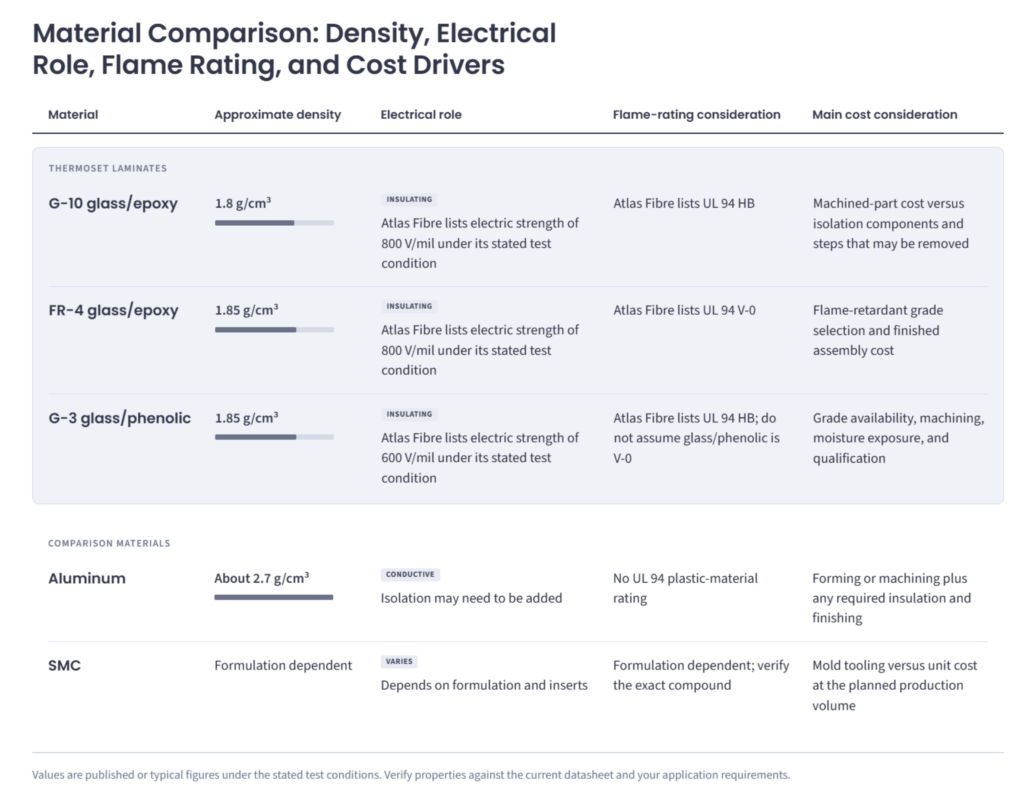
Laminate figures above come from Atlas Fibre’s G-10, FR-4, and G-3 data sheets. Published properties describe material test conditions; they are not finished-part ratings or cost quotations.
When an OEM specification calls for a UL 94 V-0 material rating, the cited FR-4 grade provides a documented starting point. G-10 and G-3 do not meet that stated rating in the cited data sheets. A V-0 rating also does not establish that a battery pack will pass a thermal runaway evaluation. UL 2580 addresses battery-system hazards, while UN Regulation No. 100 (ECE R100) sets applicable vehicle and rechargeable energy storage system requirements. Material screening and pack-level validation serve different purposes.
Design the joints for vehicle life
A viable material choice still needs a viable production design. Precision machining can put slots, mounting holes, and mating features where the assembly needs them, without a stamped-part forming step. That can be useful when stiffener geometry affects cell spacing or stack compression. The tolerance plan should account for laminate orientation, stock thickness, machining, temperature, and moisture rather than assume every dimension will behave like metal.
Joints deserve particular attention under vibration and repeated loading. Fastener bearing, pull-through, local crushing, and delamination can govern the design before the laminate’s in-plane strength does. Depending on the load path, engineers may consider bushings or compression limiters, local reinforcement, inserts suited to the process, or adhesive bonding. Coolant, electrolyte, humidity, and salt exposure should also be part of material and joint qualification.
Bring material and manufacturing decisions together early
A thermoset laminate stiffener earns its place when its finished geometry delivers the required rigidity and isolation while improving the complete assembly’s mass, cost, or build process. Its safety contribution is equally specific: helping preserve the structure and clearances that allow dedicated vents and gas channels to function as designed.
Atlas Fibre can work with engineering and sourcing teams early in development of EV batteries to compare grades, review critical tolerances and fastening details, and plan a machined part around prototype and production requirements. Starting that discussion before the drawing is fixed gives the team more room to simplify the design – and a clearer basis for validating its performance.