

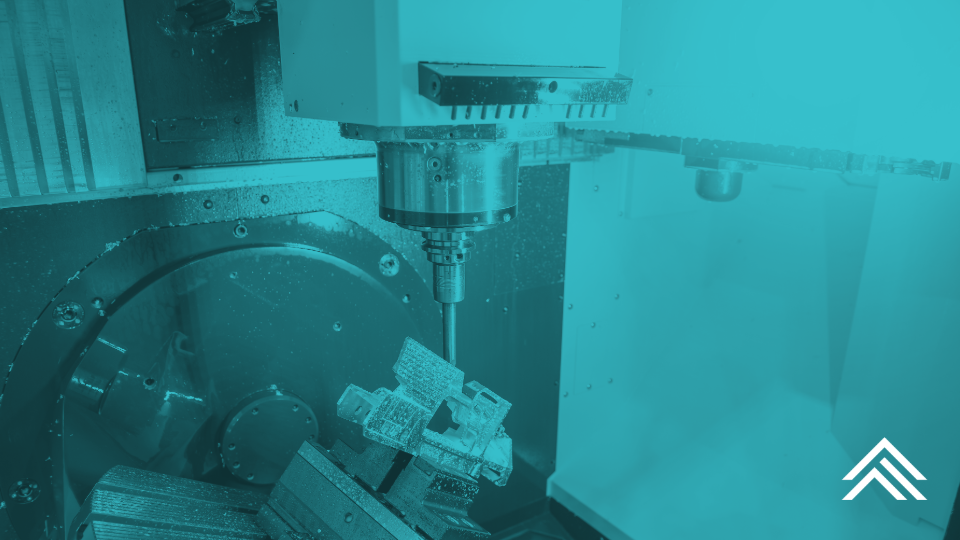
When an RFQ calls for a complex part in G-10 (or its flame retardant counterpart FR-4), a phenolic laminate, or a high-performance thermoplastic like PEEK or PEI, the process behind the quote matters as much as the price on it. Two suppliers can quote the same drawing and produce very different outcomes, because the equipment and process controls behind a composite or engineering-plastic part directly affect tolerance, lead time, and the risk of scrap or field failure.
The following is intended for sourcing and procurement teams evaluating machining suppliers for these materials, and covers what 5-axis capability changes, where the risk sits, and what to ask before awarding a contract.
Why the Distinction Matters for Sourcing
A five-axis CNC machine moves a cutting tool along three linear axes while also rotating around two additional axes, letting it reach a part from multiple angles without repeated repositioning. That capability is delivered two ways: 3+2 machining, where the part is fixed at an angle and then cut on three axes, and simultaneous 5-axis machining, where all five axes move together for continuously changing contours.
Not every part needs multi-axis machining. Flat profiles, simple pockets, and high-volume sheet components are often produced efficiently on three-axis or four-axis equipment at lower cost. The sourcing question isn’t “does this supplier have 5-axis machines,” but “does this part’s geometry require the capability, and does the supplier apply it correctly to this material.”
| Capability | What it Means for a Buyer |
|---|---|
| Multi-sided access | Fewer setups and handoffs, which reduces cumulative tolerance stack-up and handling risk. |
| Compound-angle features | Angled holes, ports, and chamfers produced without secondary operations or a second vendor. |
| Fewer fixture changes | Shorter lead time and lower per-part cost from reduced setup and datum-transfer error. |
| Complex 3D contouring | Complex geometrics can be sourced from one supplier instead of split across multiple vendors |
Why These Materials Complicate Sourcing
Thermoset composite laminates (G-10, FR-4, G-11, phenolics), high-performance thermoplastics (PEEK, PEI, PPS, PAI, PTFE, acetal, nylon), and filled or reinforced polymers do not machine like metals do, and they do not machine like each other. Glass and paper reinforcement in laminates wears cutting tools quickly and can cause delamination or fiber breakout at edges. Thermoplastics generate heat that plastic doesn’t conduct away easily, which can distort or discolor a part with no visible warning on a standard dimensional report. Internal stress in the raw stock can release unevenly during machining, causing a part that measured correctly in-process to bow or twist after it’s unclamped.
None of this shows up as a line item on a quote. It shows up later, as scrap, rework, or a part that fails incoming inspection at your dock.
Risk Factors to Ask Suppliers About
These are the failure modes most likely to be invisible until a part is in your hands – and the reason a supplier’s process discipline matters more than their equipment list:
- Tool wear drift. A dulling tool raises cutting forces and heat gradually, so dimensional and cosmetic quality can drift over a production run without an obvious trigger. Ask how the supplier tracks tool condition against cut length or part count.
- Delamination and edge breakout. These are functional defects in an electrical-insulation or structural part, and dimensional inspection alone won’t catch them. Ask what edge-quality criteria are applied and how they’re inspected.
- Post-release distortion. A part can be machined accurately and still move out of tolerance once clamps are released, particularly with thin walls or large panels. Ask about workholding approach and whether stabilization time is built into the process for tight-tolerance parts.
- Generic parameters applied to a specific grade. Speeds, feeds, and tooling qualified for “phenolic” in general are not necessarily correct for the specific grade on your drawing. Ask whether the supplier qualifies process parameters by material grade or applies family-level defaults.
Supplier Qualification Checklist
Questions worth including in an RFQ or supplier audit for composite and advanced-plastic machining:
- Do you qualify tooling and cutting parameters for the specific material grade, or apply the same settings across a material family?
- What inspection criteria do you apply beyond dimensional tolerance – delamination, breakout, flatness after stabilization, surface finish on sealing or bearing surfaces?
- Do you run a first-article or coupon part to validate a new program before committing production-grade stock?
- What workholding approach do you use for thin, large, or delicate composite and thermoplastic parts?
- How do you track tool wear, and is it tied to a defined acceptance limit rather than a fixed replacement schedule?
- What dust control and material-handling practices are in place for thermoset composite dust, and how do they affect capacity or continuity of supply?
Total Cost of Ownership: When 5-Axis Justifies the Premium
Five-axis machining typically carries a cost premium over three- or four-axis work. It’s justified when a part includes features on several faces, compound-angle holes, tight feature-to-feature relationships from one datum structure, or geometry that would otherwise require multiple fixtures or a second vendor. It’s harder to justify for flat, simple, high-volume components, where the added capability doesn’t reduce risk or setups enough to offset the cost.
| Part Characteristic | Sourcing Consideration |
|---|---|
| Single-face, simple pockets, high volume | 3- or 4-axis is usually the lower-cost, equally reliable route |
| Features on multiple faces, moderate volume | 5-axis reduces setups and handling risk – evaluate against outsourcing to a second vendor |
| Compound angles, tight datum relationships | 5-axis in one setup reduces stack-up error that’s hard to catch in incoming inspection |
| Deep or angled features, thin walls | 5-axis with a qualified process reduces distortion risk versus multiple manual setups |
What to Put in the Drawing or PO
Specifying quality requirements up front, rather than relying on a supplier’s default practice, closes most of the gap between what a dimensional report shows and what a part actually needs to do in service:
- Delamination or breakout limits at machined edges and hole exits
- Acceptable fiber pullout, resin burn, or burr condition
- Flatness and profile requirements measured after unclamping and stabilization, not just in-process
- Surface finish requirements on sealing, bearing, or electrical-insulation surfaces
- Cleanliness or particulate requirements where relevant
- Tool-life or process-control expectations for repeat production runs
The Sourcing Takeaway
The value of 5-axis machining isn’t the number of axes – it’s whether a supplier pairs that capability with a process built around the specific material grade on your drawing. A capable partner should be able to explain why a given part needs 5-axis versus simpler equipment, what could go wrong with the material if the process isn’t controlled, and how they inspect for it. That explanation is a better predictor of a clean production run than the equipment list on their capabilities page.
Atlas Fibre machines thermoset composite laminates and engineering plastics on 5-axis equipment alongside material selection and manufacturability review. Send a drawing or application requirement to discuss the right material and process for your part.