

Precision machining depends on more than the time a part spends in a CNC machine. Material identification, setup, scheduling, inspection, and movement between operations all affect how reliably a finished component reaches the customer.
For advanced plastics and thermoset composite laminates, those connections matter. A machined G-10 insulator, FR-4 terminal board, or phenolic wear component must meet its drawing requirements while moving through a process that preserves material identity and controls unnecessary handling, delays, and rework.
Lean manufacturing provides a vocabulary for understanding and improving that process. This glossary explains common lean terms, related supply chain concepts, and the people who helped shape the approach, with practical examples from advanced plastic and composite machining. The examples illustrate how the concepts can apply; implementation depends on the material, part geometry, production volume, and customer requirements.
Core Manufacturing Terms
5 Principles of Lean
The framework described by James Womack and Daniel Jones: specify customer value, identify the value stream, create flow, establish pull, and pursue perfection. In precision machining, the starting point is understanding what the customer needs: a conforming component, the correct material, required documentation, and dependable delivery. Process improvements should support those outcomes.
5 Whys
A root-cause analysis technique that uses repeated “why” questions to investigate a problem beyond its immediate symptoms. Five is a guide, rather than a required stopping point. For recurring edge damage on a composite laminate part, the investigation might examine tool condition, cutting parameters, workholding, and how the process is monitored. Each answer should be supported by evidence.
Advanced Plastic Machining
The use of machining processes such as milling, turning, drilling, and routing to produce components from engineering plastics and composite materials. Materials such as PEEK, PEI, glass epoxy, and phenolic laminates have different processing requirements. A lean approach must preserve the material-specific controls needed for dimensional accuracy and part quality.
Andon
A visual or audible signal that communicates production status or alerts a team to an abnormal condition. A machine alert, status light, or digital display can draw attention to an interruption or quality concern so it receives prompt attention. The signal supports a defined response; displaying a problem alone does not resolve it.
Build-to-Order (BTO)
Production initiated by a specific customer order. A machining job for a defined quantity of custom composite components is a typical example. Build-to-order can reduce finished-goods inventory, although it still requires decisions about material stock, capacity, and scheduling. It can coexist with repetitive production when customers reorder the same component.
Chaku-Chaku
A production arrangement in which an operator moves through a sequence of machines, loading each one while automatic unloading reduces manual work. Often translated as “load-load,” it supports single-piece flow. Its suitability for plastic machining depends on cycle times, part handling, and whether the operations can be arranged into a practical cell.
Cycle Time
The time required to complete a repeating operation before the next cycle begins. In CNC machining, distinguish the automatic machine cycle from the full station cycle, which may also include unloading, loading, and checks. A shorter cutting cycle may have little effect on delivery if parts spend most of their time waiting between operations.
Every Part Every Interval (EPEI)
The interval within which a process can produce every part in its regular product mix. A shorter EPEI enables more frequent replenishment and can reduce inventory requirements. In machining, the achievable interval depends on changeovers, available capacity, and the range of materials and geometries being processed.
Gemba and Gemba Walk
Gemba means the actual place where work happens. A gemba walk brings leaders and team members to that place to observe the process and learn from the people doing the work. In composite machining, that could mean following a job through material staging, setup, machining, inspection, and packing to understand where delays occur.
Heijunka
Leveling production volume and product mix over time to reduce disruptive swings in workload. In a machining environment, this may involve balancing recurring orders with varied job requirements. The objective is a more stable workload; the schedule must still account for real capacity, due dates, setup demands, and material availability.
Hoshin Kanri
A method for connecting strategic goals with specific improvement priorities, responsibilities, resources, and measures. A goal such as improving delivery reliability becomes actionable when teams define which scheduling, setup, or inspection constraints to address and how progress will be assessed.
Jidoka
Building the ability to detect abnormalities and stop into a process so problems do not continue unchecked. In machining, a monitoring system could stop an operation after detecting a tool or process issue. Effective jidoka also requires a response that investigates and corrects the cause before production resumes.
Just-in-Time (JIT)
Producing or supplying what is needed, in the quantity needed, when it is needed. For machined plastic components, this means coordinating material availability, production, and delivery with actual requirements. JIT relies on dependable processes and replenishment; simply removing inventory without addressing those conditions can create shortages.
Kaikaku
A substantial change to the way work is organized, rather than a series of small improvements. Reconfiguring a production area into a machining cell that connects related operations could be an example. The change should improve the performance of the overall process and preserve necessary quality controls.
Kaizen
Continuous improvement through ongoing changes informed by observation and problem-solving. Examples include improving fixture access, simplifying material identification, or reducing the distance parts travel to inspection. Small changes become valuable when they improve safety, quality, delivery, or cost and are incorporated into the normal process.
Kanban
A replenishment signal that authorizes production or movement based on downstream consumption. The signal may be a card, an empty container, or an electronic message. A controlled stock of regularly used machining blanks could use kanban to trigger replenishment. Quantities and triggers must reflect usage, replenishment time, and variability.
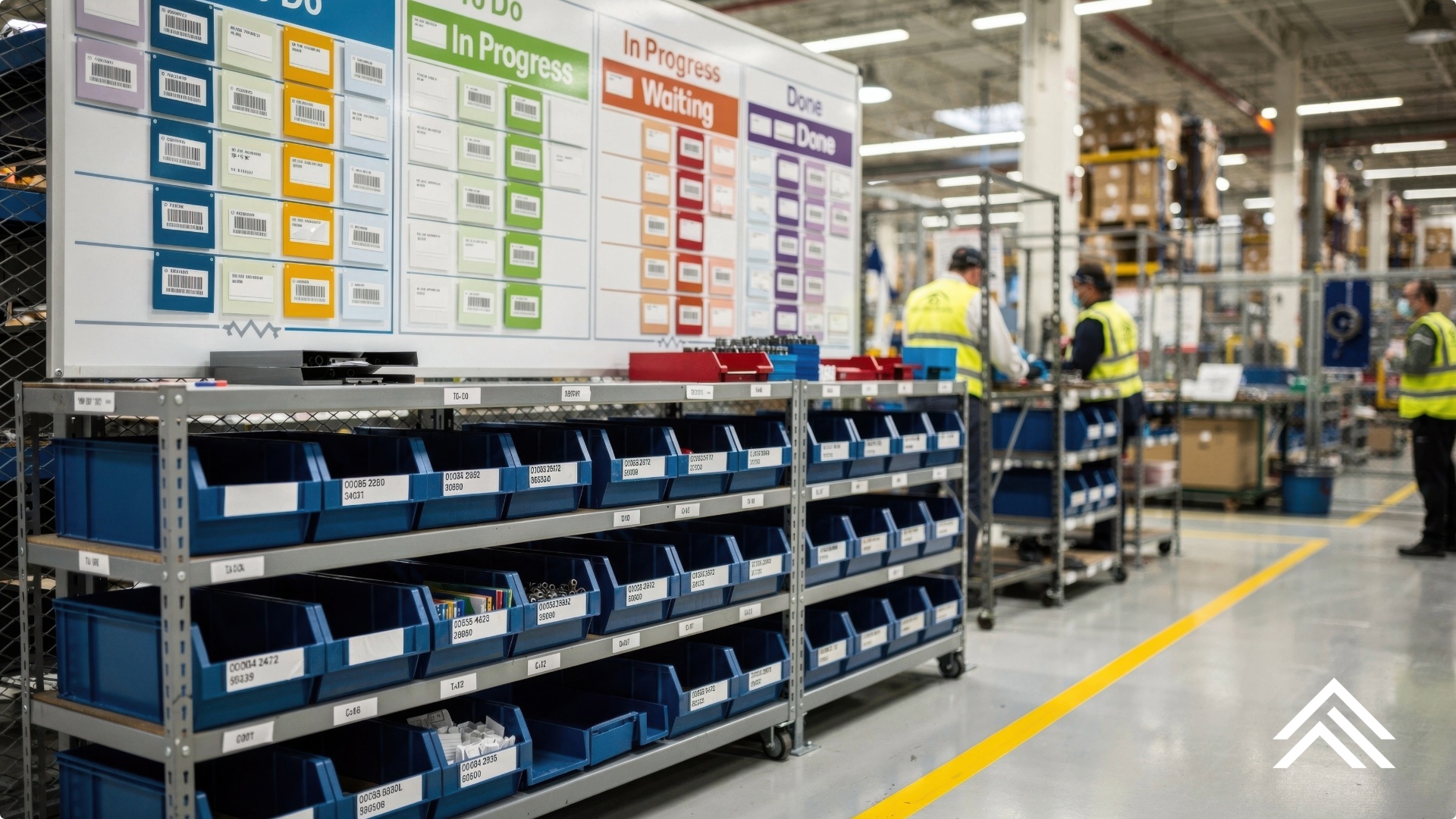
Kanban Board
A visual tool that shows work moving through defined stages. A machining workflow might include material ready, setup, machining, inspection, and shipping. Explicit work-in-progress limits help a board support flow control. A board without those controls can still provide visibility, but visibility alone does not establish a pull system.
Lead Time
The elapsed time between defined starting and ending points. Customer order lead time covers order placement through delivery; production lead time covers passage through the production process. Always specify the boundary being measured. For a machined composite part, lead time can include order processing, material preparation, queues, setup, machining, inspection, packing, and transit.
For a stable process measured over consistent boundaries, Little’s Law relates average work-in-progress, average throughput, and average flow time:
Average flow time = Average work-in-progress ÷ Average throughput rate
This relationship applies to the process being measured. Shop-floor WIP alone does not account for every element of customer order lead time.
Muda
Activities that consume resources without adding customer value. The traditional seven wastes are overproduction, waiting, transportation, excess processing, inventory, motion, and defects. Unused employee knowledge and skills are often identified as an eighth. In machining, examples include unnecessary handling, avoidable queues, and remaking rejected parts. Necessary controls should be improved thoughtfully rather than removed indiscriminately.
Mura
Unevenness in demand, workload, or process activity. Releasing many machining jobs at once can overwhelm one operation while another has little work. Better release control and scheduling can reduce these swings and the waiting they create.
Muri
Overburden placed on people, equipment, or processes. Examples include assigning more work than a machining center can complete or expecting an inspection team to absorb an unsustainable surge. Reducing overburden supports safer work, process stability, and realistic commitments.
Nagara System
Organizing work so an operator can perform another compatible task while equipment completes its automatic cycle. For example, an operator might prepare the next blank while a CNC machine runs. The arrangement must preserve safe machine operation, required monitoring, and the attention needed for each task.
One-Piece Flow
Moving individual parts through successive operations with minimal waiting between steps. In suitable applications, this can shorten production lead time and reveal defects sooner. Some plastic and composite machining jobs still require batches because of fixtures, setups, or process constraints; the objective is to reduce unnecessary accumulation between operations.
Overall Equipment Effectiveness (OEE)
A metric combining equipment availability, operating performance, and quality output:
OEE = Availability × Performance × Quality
Availability measures operating time against planned production time. Performance compares actual output with output at the defined ideal cycle time. Quality measures good units as a share of total units produced. In a machining shop, OEE can help identify losses, but high equipment utilization alone does not prove that customer orders are flowing efficiently.
Pacemaker
The process at which a value stream is scheduled, establishing the production rhythm for connected operations. Identifying a pacemaker helps avoid issuing conflicting schedules throughout the same flow. It is a scheduling role and is not automatically synonymous with the slowest machine or current bottleneck.
Pitch
The planned time interval for producing or releasing a standard quantity of work at the required demand rate. It provides a practical interval for checking progress:
Pitch = Takt time × Pack quantity
If takt time is 30 seconds per component and the pack quantity is 20 components, pitch is 10 minutes. Pitch represents the expected production rhythm, rather than the actual time spent packing a container.
Poka-Yoke
Error-proofing that prevents a mistake or makes it immediately detectable. In machining, examples include a fixture that prevents incorrect loading or a verification step that flags a mismatch between the job and material identification. The method should address a specific failure mode, such as using the wrong laminate grade or loading a part in the wrong orientation.
Pull-Based Manufacturing
A system in which downstream need authorizes upstream production or movement. The trigger may be an order, consumption, or a replenishment signal. For recurring machined components, pull can help control inventory while keeping production aligned with actual demand.
Push-Based Manufacturing
A system that releases work according to a predetermined schedule or forecast rather than a downstream consumption signal. It can support advance planning, but releasing work too early may increase queues and WIP. Manufacturing systems often combine forecast planning with pull controls for specific operations or inventories.
Repetitive Manufacturing
Repeated production of the same products or product families. Recurring orders for an established composite component can benefit from repeatable setups and process instructions. Repetitive manufacturing describes the production pattern; it does not require that the product be generic or manufactured for stock.
Respect for People
A lean principle that involves people in identifying problems and improving their work, while supporting safe conditions and skill development. Operators, programmers, inspectors, and material handlers each see different sources of variation. Their observations help turn improvement efforts into practical changes that can be sustained.
Shusa
A chief engineer or senior product development leader responsible for coordinating a product’s development across functions. The role connects customer needs, design decisions, and manufacturing requirements. For engineered plastic components, that coordination can help resolve material, geometry, and production concerns before release.
Six Sigma
A method for reducing process variation and defects through data-driven problem-solving. Its DMAIC framework stands for Define, Measure, Analyze, Improve, and Control. In machining, it can support investigation of recurring dimensional variation. The commonly cited benchmark of 3.4 defects per million opportunities uses a conventional long-term statistical shift assumption; it is not a guarantee of a particular process’s performance.
Single-Minute Exchange of Die (SMED)
A method for reducing setup and changeover time, with a goal of single-digit minutes. It separates tasks that require stopped equipment from tasks that can be completed while equipment is running. Preparing tools, fixtures, programs, and material in advance can reduce CNC downtime without rushing setup verification or required inspection.
Specify Value
Define the outcome the customer needs and is willing to pay for. For an advanced plastic component, value may include dimensional conformity, specified material, required traceability, and delivery that supports assembly. This definition helps teams assess whether a process change improves the customer’s outcome.
Standard Work
An established method for performing a process consistently and safely, providing a baseline for improvement. In lean production, standardized work connects takt time, work sequence, and required in-process inventory. Machining instructions and setup documentation support repeatability, while standardized work also addresses how people, equipment, and parts interact during the operation.
Supermarket
A controlled inventory buffer used to support replenishment where continuous flow is impractical. Downstream withdrawal triggers replacement. A supermarket of frequently used blanks could support recurring machining work, provided quantities are controlled and material grade, dimensions, and required identification are maintained.
Supply Chain Execution (SCE)
The activities and systems that carry out material movement, storage, fulfillment, and shipping. In composite machining, execution includes staging the correct material, tracking jobs through operations, and delivering finished components with the required documentation.
Supply Chain Management (SCM)
The coordination of materials, information, and commercial activities across suppliers, manufacturers, and customers. For advanced plastic components, SCM connects material sourcing, machining capacity, quality requirements, inventory, and delivery commitments.
Supply Chain Planning (SCP)
Planning future demand, material requirements, inventory, and capacity. It helps teams assess whether upcoming work can be supported and where adjustments are needed. Planning must account for the specific materials, equipment, and inspection resources required by the product mix.
Takt Time
The production pace required to meet customer demand:
Takt time = Net available production time ÷ Customer demand
For example, 450 available minutes and demand for 900 components produce a takt time of 30 seconds per component. Takt is a demand-based target; cycle time is the measured time an operation takes. In a varied machining environment, takt is most useful when applied to a clearly defined product family or flow.
Thermoset Composite Laminates
Materials made by combining reinforcement, such as glass fabric, paper, or cotton fabric, with a thermosetting resin and curing the structure. Examples include G-10 and FR-4 glass epoxy, G-7 glass silicone, and paper or fabric phenolics. Once cured, thermosets do not remelt for reshaping. In machining, lean improvements must account for grade-specific requirements and preserve required material identity throughout the process.
The Five Ss (5S)
A workplace organization method: Sort, Set in Order, Shine, Standardize, and Sustain. In machining, 5S can make tools, fixtures, gauges, and material locations easier to identify and use. Its purpose extends beyond appearance to reducing searching, exposing abnormalities, and supporting consistent work.
Toyota Production System (TPS)
The production approach developed at Toyota that helped form the foundation of lean manufacturing. Its two central pillars are just-in-time and jidoka. Applying its principles in plastic and composite machining requires adapting them to the operation’s product mix, process needs, and quality requirements.
Value Stream
The full sequence of activities needed to deliver a product, including activities that add value and those that do not. For a machined thermoset laminate component, the value stream may include order review, material preparation, setup, machining, inspection, documentation, and shipping. Reviewing the full stream helps prevent improvements in one area from creating delays elsewhere.
Value Stream Mapping (VSM)
A method for documenting material and information flow, identifying delays, and designing an improved future process. A map of a composite machining job might reveal that queues between operations contribute more to lead time than cutting itself. That finding helps teams focus improvement work where it will affect delivery.
Work-in-Progress (WIP)
Material and components that have entered production but are not yet finished. Cut blanks awaiting machining and machined parts awaiting inspection are both WIP. Excess WIP can lengthen queues, obscure priorities, and increase handling. Controlling it helps make production status and constraints easier to see.
Applying Lean Thinking to Advanced Plastic Machining
For engineers and sourcing teams, lean terminology is useful when it leads to better questions: How is material identified? Where do jobs wait? How are setup requirements controlled? What happens when an abnormality is detected? How does the supplier match released work to available capacity?
Those questions connect process efficiency with the outcomes that matter: conforming parts, dependable delivery, and fewer disruptions. In thermoset composite and advanced plastic machining, improvements need to preserve the controls that make those outcomes possible.
Atlas Fibre manufactures thermoset composite laminates and machines advanced plastics into precision components. Have a component to review? Share your drawing, material specification, quantity, and required delivery date to start a discussion about manufacturability and production requirements.
Further Reading
Lean Enterprise Institute — Lean Lexicon: https://www.lean.org/explore-lean/lexicon-terms/
Lean Enterprise Institute — Lean Thinking and Practice: https://www.lean.org/lexicon-terms/lean-thinking-and-practice/
Toyota — Toyota Production System: https://global.toyota/en/company/plant-tours/production-system/
ASQ — Six Sigma: https://asq.org/quality-resources/six-sigma