

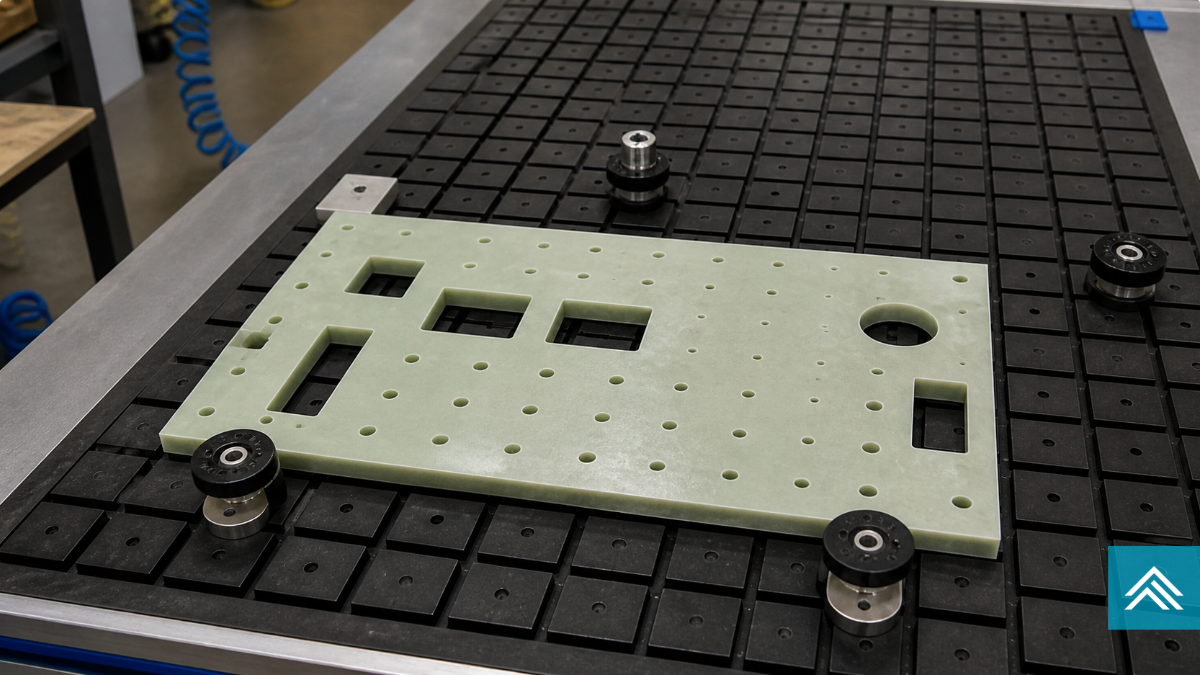
Thermoset composite laminates don’t machine like metals. And, actually, they don’t behave like standard plastics, either.
That’s where many machining problems begin. The process fails when the material is treated like a uniform substrate instead of a layered composite system.
Advanced plastic materials (like Atlas Fibre’s G10/FR-4, GPO-3) demand more than a capable CNC machine and operator. They demand a process built around the material. For shops accustomed to aluminum, steel, or standard plastics (like engineering thermoplastics), the instinct is often to treat thermoset laminates as another machinable substrate. That assumption can be costly.
Machining thermoset composites is less about cutting in the traditional sense and more about controlling how the material fractures. Getting that right – consistently, at volume – requires a different level of process discipline.
This guide is intended for anyone working on or around thermoset composite laminates or support customers who do. It is not a universal feeds-and-speeds chart. It is a framework for understanding the variables that determine machining quality, repeatability, and long-term production success.
Why Thermoset Laminates Machine Differently
Thermoset laminates are engineered systems: reinforcement and cured resin combined into a layered, high-performance structure. That structure is what makes them valuable in demanding applications – electrical insulation, dimensional stability, mechanical strength, heat resistance, and reliable performance in challenging environments.
It’s also what makes them unforgiving when the machining process is not built around the material.
Several characteristics set these materials apart.
The reinforcement is abrasive. Glass-reinforced grades wear tools faster than many operators expect. A cutter can appear functional long after edge quality has degraded – producing fuzzing, chipped edges, dimensional drift, and heat buildup before the problem becomes obvious.
The material is not homogeneous. Resin and reinforcement don’t respond to cutting forces the same way. Every pass engages resin, reinforcement, and layered structure simultaneously. There is no single, consistent substrate to tune against.
The laminate structure can separate. Delamination rarely has one cause. It is usually the result of compounding variables – tool geometry, dull edges, inadequate support, vibration, and heat. Managing those variables together is the job.
Heat behaves differently. Thermoset laminates don’t dissipate heat the way metals do. Excess heat can degrade the resin system, accelerate tool wear, and compromise the machined edge in ways that are not always visible until inspection – or after delivery.
Not every thermoset laminate machines the same way. Glass epoxy grades, paper phenolics, cotton phenolics, melamine laminates, and glass polyester materials can differ significantly in abrasiveness, edge behavior, dust characteristics, and tolerance stability. The machining strategy should account for the material’s reinforcement, resin system, thickness, and application requirements. A setup that works well for one grade may not transfer directly to another.
The Variables That Determine Outcome
A clean machined edge in a thermoset laminate depends on controlling how reinforcement fractures and how the resin responds during the cut. That means managing the full system simultaneously:
- Tool sharpness and geometry
- Feed rate, spindle speed, and chip load
- Fixturing and vibration control
- Dust evacuation
- Heat generation
- Entry and exit strategy
- Material grade and thickness
- Inspection requirements
When these variables are aligned, thermoset laminates can be machined into precise, repeatable, high-performance components. When they are not, the material responds immediately: delamination, fuzzing, burning, smearing, chatter, or premature tool wear.
Tooling: The Foundation of Edge Quality
Tooling is one of the most consequential variables in thermoset laminate machining – and one of the most often underspecified.
Because many thermoset laminates include abrasive reinforcement, tool wear happens faster than it would in metals or softer plastics. A tool may still be capable of removing material after it has started producing unacceptable edge quality. That is why tool selection and tool-life management need to be treated as part of the process, not as an afterthought.
PCD Tooling
Polycrystalline diamond tooling is often the preferred choice for production machining of abrasive laminates. PCD maintains a sharp cutting edge over longer runs, producing cleaner cuts, reducing fuzzing and delamination risk, and delivering the consistency that volume production demands.
The upfront cost is higher. The economics – measured in tool life, scrap reduction, quality stability, and repeatability – often justify it.
Diamond-Coated Carbide
CVD diamond-coated carbide offers a practical middle ground for applications that require better wear resistance than uncoated tooling but may not justify full PCD. Coating quality and edge preparation are critical. A poorly executed coating delivers little of the expected benefit.
Compression Geometry
Compression tooling combines upward and downward cutting forces, pushing the laminate toward its center rather than lifting or tearing the surface. This can significantly reduce breakout, fuzzing, and delamination on both faces of the sheet.
Properly matched to material thickness and cut depth, compression geometry is one of the highest-impact changes available to many thermoset machining processes.
Burr and Pineapple Cutters
Cross-cut burr-style tools grind and fracture fibers rather than slice them. They can be useful for trimming, roughing, and edge profiling where throughput takes priority over surface finish.
They may not be the right choice for every finished edge, but they can be effective when the priority is fast material removal, controlled fiber fracture, or rough profiling before a finishing operation.
Feeds, Speeds, and the Cost of Rubbing
The practical principle in thermoset machining is simple: keep the process cool and keep it cutting.
Rubbing (not cutting) is where heat originates. Heat accelerates tool wear, degrades the resin system, and destabilizes the process. The goal is a stable chip load that removes material cleanly without generating excess friction.
A working starting formula:
Feed Rate = RPM × Number of Flutes × Chip Load
That formula establishes a baseline. The right process is tuned from there – by material grade, thickness, tool diameter, machine rigidity, fixturing approach, and edge-quality requirements.
High spindle speed may look productive. If it produces rubbing rather than cutting, it introduces instability. Excessive feed rate can create mechanical stress, chatter, and breakout. The right balance is specific to the material, geometry, tooling, and production requirement.
The process should be tuned around:
- Consistent chip load throughout the operation
- Minimal dwell time
- No recutting of dust
- Controlled heat at the cutting edge
- Maintained edge quality across the tool’s usable life
Tool life in composite machining should not be measured only by tool failure. It should be measured by the point at which edge quality, surface finish, or dimensional stability begins to drift. That threshold should be defined before production runs, not discovered during inspection.
Toolpath Strategy
Climb milling is generally preferred for thermoset laminates. The cutter enters at maximum chip thickness and exits at minimum, reducing rubbing and managing fiber engagement more effectively than conventional milling. With rigid fixturing and appropriate tooling, climb milling can improve edge quality and reduce heat generation.
Entry and exit points deserve deliberate attention. Breakout most often occurs where the tool exits unsupported material. Toolpaths for holes, pockets, profiles, and edge features should be designed to control cutting-force direction and minimize unsupported fiber lift.
Toolpaths validated on metals or standard plastics should not be assumed to transfer. First article validation on thermoset laminates is the standard, not the exception.
Fixturing: The Variable Most Often Overlooked
Fixturing is frequently treated as a setup detail. In thermoset laminate machining, it is a process variable.
A laminate that moves, vibrates, or lacks support at the point of cut will not machine consistently. Even minor chatter can produce edge defects, dimensional instability, and layer separation. Good fixturing does not simply hold the part, it supports the material through the cut.
Effective approaches include vacuum tables, sacrificial spoil boards, backer materials, mechanical clamping, and custom fixtures designed around part geometry. For thin laminates, support is especially critical. Unsupported sections can vibrate, flex, and lift as the tool passes through.
Sacrificial backing can reduce exit-side breakout. A protective cap layer on the top surface can help reduce chipping and fuzzing on entry.
When machining quality becomes inconsistent, fixturing should be evaluated before the toolpath or tool selection. Vibration and unsupported material are responsible for more scrap than many operators realize.
Dust Extraction and Environmental Control
Dust management is not secondary to the machining process. It is part of it.
Glass-reinforced, carbon-reinforced, phenolic, and other composite systems can generate fine particulate during machining. Carbon dust can be conductive. Glass dust is abrasive. Both create operator safety considerations and can affect downstream part cleanliness, equipment performance, and surface finish.
High-velocity extraction at or near the spindle is often required for production thermoset machining. HEPA filtration may also be required depending on material, facility, and regulatory requirements.
Coolant decisions require care. Liquid coolant is common in metal machining, but it must be evaluated carefully in thermoset applications. Moisture absorption, contamination sensitivity, and cleanliness requirements can make dry machining with proper dust extraction the preferred approach. Material and application compatibility should be confirmed before coolant is introduced.
Quality Is Engineered In, Not Inspected In
Inspection confirms whether a process worked. It does not create repeatability.
The objective is a process that produces the same result, run after run, across operators, across production schedules, and across material lots. That requires quality to be built into the process design from the start, not added at the end.
Material selection should be evaluated alongside machining strategy. Grade, reinforcement type, resin system, thickness, and tolerance requirements all affect how a part should be produced. A high-performing material still needs to be compatible with the geometry and manufacturing process.
The variables that affect repeatability should be defined and documented:
- Material sourcing and preparation
- Fixture design and support strategy
- Tool selection and wear thresholds
- Heat management approach
- Dust extraction specification
- First article evaluation criteria
- Inspection data usage
- Process documentation for repeat runs
A single acceptable part proves that the part can be made once. A validated process proves it can be made every time.
From First Article to Repeat Production
The first acceptable part is not the finish line. It is the beginning of process validation.
In thermoset laminate machining, many problems appear only after the process is repeated. Tool wear changes edge quality. Unsupported sections begin to chatter. Dust evacuation becomes inconsistent. A setup that worked for a short run becomes unstable at production volume. A material lot change introduces enough variation to expose weaknesses in the process.
Repeatability depends on defining the process before production scales.
That includes tool-life thresholds, fixture strategy, inspection criteria, acceptable edge conditions, dust-control requirements, and documentation for future runs. A validated process protects the part, the schedule, and the customer’s confidence.
For fabricators, this means machining success should not be judged only by whether a first part meets print. It should be judged by whether the process can continue meeting print under real production conditions.
For companies with in-house machining capabilities, it means thermoset laminates require a different level of process discipline than metals or standard plastics.
For distributors, it means helping customers understand that material selection and machining success are connected. The right laminate grade matters, but so does the process used to turn that material into a finished component.
Common Issues and What They Indicate
Delamination: Evaluate tool sharpness, compression or down-cut geometry, backer support, feed and speed balance, and laminate movement during the cut.
Fuzzing: Evaluate tool geometry, chip load, and whether cutting conditions are producing shear or rubbing. PCD or diamond-coated tooling and compression geometry can often resolve persistent fuzzing.
Resin smearing: Treat this as a heat signature. Evaluate spindle speed, feed rate, chip load, dust extraction, and tool sharpness. The process should remove material cleanly without friction buildup.
Rapid tool wear: Some wear is expected with abrasive materials. Excessive wear may indicate the wrong tooling for the material or excess heat generation. PCD or diamond-coated tooling is often required for sustained production.
Chatter: Review fixture design, rigidity, part support, and tool overhang before assuming the issue is only in the program. In thermoset laminates, chatter can quickly become an edge-quality and dimensional-stability problem.
Edge breakout: Address through backer materials, sacrificial spoil boards, compression tooling, modified entry and exit strategy, and better support at the point where the tool exits the material.
The Relationship Between Variables
The most effective thermoset laminate machining processes are not optimized around one variable. They are built around the relationships between variables.
Tooling affects heat. Heat affects resin behavior. Fixturing affects vibration. Vibration affects delamination. Dust extraction affects cutting conditions. Material selection affects tool life. Tool wear affects edge quality. Inspection confirms whether the system is stable.
That level of process integration requires material knowledge, machining discipline, and documented repeatability, not just equipment.
When those elements work together, thermoset laminates become precise, high-performance components serving demanding applications in electric power generation, aerospace, defense, automotive, semiconductor, and myriad other industrial markets.
Build the Process Around the Material
There is a meaningful difference between machining thermoset laminates successfully once and building a repeatable process around them. That holds true when you’re machining G10 or any glass epoxy or phenolic
The right manufacturing resource brings more than equipment to the table. It brings material knowledge, tooling strategy, fixturing discipline, dust control, inspection practices, and the production experience needed to make quality repeatable.
If your application requires tight tolerances, demanding edge quality, or production-level repeatability in thermoset composite laminates, Atlas Fibre can help you evaluate the material, process, and production strategy behind the part.