
Paper, Canvas, or Linen? What’s the Right Phenolic Grade?
Phenolic laminates show up across electrical, industrial, and mechanical applications because they combine strength, electrical insulation, wear resistance, and machinability in a single material. But paper, canvas, and linen phenolics are not interchangeable. The reinforcement underneath the resin determines what the finished part does well – and where it falls short.
The right grade comes down to the part’s primary job. Is it mainly an electrical insulator? Will it carry load, wear, or impact? Does it need fine features, tight tolerances, or a smooth machined finish? Answer that first and the material list of the ideal phenolic grade narrows fast.
One note before the grades: paper, canvas, and linen phenolics are defined by the NEMA LI 1 standard, with matching MIL-I-24768 specifications (access a list of the Mil-Spec materials supplied by Atlas Fibre). Calling out the NEMA grade (and MIL spec where it applies) on a drawing keeps everyone quoting the same material.
Learn more about why today’s top companies choose thermoset composites for advanced engineeing applications.
The TLDR
- Paper (NEMA X, XX, XXX) – the economical choice for electrical insulation and general fabricated parts.
- Canvas (NEMA C, CE) – the toughest option, built for impact, wear, and structural load.
- Linen (NEMA L, LE) – a fine weave for detailed machining, small features, and smoother finishes.
Phenolic Grades at a Glance
| Family | Grades | Best fit | Key strength | Typical applications |
|---|---|---|---|---|
| Paper | X, XX, XXX | Electrical and insulating components | Good dielectric properties, economical, easy to punch and fabricate | Washers, switch and relay bases, terminal boards, barriers, spacers |
| Canvas | C, CE | Mechanical and wear components | Highest impact strength and wear resistance | Gears, bearings, bushings, piston rings, rollers, structural supports |
| Linen | L, LE | Precision-machined components | Fine detail, smooth finish, dimensional control | Fine-tooth gears, relay bases, terminal strips, instrument parts |
Representative Properties of Various Phenolic Grades
These are nominal Atlas Fibre values that show how the families compare. They are for guidance only, not a warranty; certified results for a specific sheet or lot are available on request.
| Grade | Reinforcement | Tensile (psi) | Flexural, LW (psi) | Izod impact, LW | Max temp | Water absorption, 24 hr |
|---|---|---|---|---|---|---|
| XX | Paper | 35,000 | 34,000 | 0.80 | 140 °C (284 °F) | 2.00% |
| XXX | Paper | 35,000 | 22,000 | 0.55 | 140 °C (284 °F) | 0.57% |
| C | Canvas | 37,000 | 22,000 | 1.95 | 125 °C (257 °F) | 1.60% |
| CE | Canvas | 36,000 | 17,000 | 1.70 | 125 °C (257 °F) | 2.00% |
| L | Linen | 35,000 | 23,000 | 1.70 | 125 °C (257 °F) | 1.04% |
| LE | Linen | 36,000 | 18,000 | 1.35 | 125 °C (257 °F) | 1.80% |
Two patterns are worth pulling out of that table. First, tensile strength is similar across all six grades (roughly 35,000–37,000 psi), so tensile is not what separates them. The real mechanical divide is impact strength: paper sits around 0.55–0.80, while canvas and linen run 1.35–1.95 — two to three times tougher. Second, paper carries the higher temperature rating (140 °C vs. 125 °C), so paper, not canvas, is the higher-temperature family despite canvas’s toughness edge.
Paper Phenolic (NEMA X, XX, XXX): Economical Electrical Insulation
Paper phenolic is built from layers of resin-impregnated cellulose paper consolidated under heat and pressure. The result is dependable electrical insulation with enough mechanical strength for a wide range of fabricated parts – at the lowest cost of the three families. It is also stiff and strong in bending (XX flexural strength is the highest in the table at 34,000 psi) and punches and machines cleanly.
The trade-off is impact toughness. With Izod values around 0.55–0.80, paper is comparatively brittle, so it is not the pick for repeated impact or heavy sliding wear.
Reading the X count: more X’s mean more resin, better electrical and moisture performance; fewer X’s lean mechanical. Grade X is the mechanical paper grade; XX is the general-purpose workhorse with good electrical properties and the highest flexural strength of the paper grades; XXX has the most resin, the best dielectric performance, and by far the lowest water absorption (0.57% vs. 2.00% for XX), making it the choice for humid or electrically demanding service. (XX meets MIL-I-24768/11; XXX meets MIL-I-24768/10.)
Common applications include insulating washers, terminal boards, switch and relay bases, electrical barriers, spacers, panelboards, and punched components.
Choose paper when electrical performance and cost matter more than impact strength or wear resistance.
Canvas Phenolic (NEMA C, CE): Built for Impact, Wear, and Load
Canvas phenolic uses a coarser-weave woven cotton fabric – a heavier reinforcement than paper. That fabric gives it the highest impact strength of the phenolic families (Izod around 1.70–1.95, versus 0.55–0.80 for paper) along with excellent wear resistance and toughness. It also runs quiet, non-abrasive, and non-sparking, which makes it a strong substitute where metal would be noisy, need lubrication, conduct electricity, or add weight.
C vs. CE: Grade C is the mechanical grade, with the highest tensile and impact strength of the two. Grade CE trades a little mechanical strength for improved electrical insulating properties. Reach for CE when a tough part also has to insulate. (C meets MIL-I-24768/14; CE meets MIL-I-24768/16.)
Typical applications include gears, bearings, bushings, piston rings, rollers, pulleys, sheaves, wear pads, and structural supports.
Choose canvas when the part will see impact, friction, or structural loading.
Linen Phenolic (NEMA L, LE): Detail, Finish, and Dimensional Control
Linen phenolic uses a fine-weave cotton fabric – tighter than canvas. (The “linen” name is historical; these grades are woven from fine cotton, not flax.) The finer weave supports small features, fine-tooth gears, crisp detail, and smoother machined surfaces, while keeping much of the toughness of a fabric grade (Izod around 1.35–1.70, well above paper).
That puts linen between paper and canvas: tougher and better for fine machining than paper, finer and smoother than canvas.
L vs. LE: Grade L is the mechanical and precision grade. Grade LE adds electrical performance for insulating parts and is the usual choice over canvas when small geometry and surface finish matter in an electrical component. (L meets MIL-I-24768/15; LE meets MIL-I-24768/13.)
Typical applications include fine-tooth gears, pinions, relay bases, terminal strips, instrument and radio/electronic parts, and precision-machined spacers and insulators.
Choose linen when the design has small features, tight tolerances, or demanding surface-finish requirements.
A Practical Decision Path
Work through these in order for a new application:
- Is the part mainly an electrical insulator? Start with paper. Use XXX for the best dielectric performance and the lowest moisture pickup; use XX where cost matters and conditions are dry.
- Will it see impact, wear, or structural load? Start with canvas (C). If it also has to insulate, step up to CE.
- Does it have fine features, small teeth, or tight finish/tolerance needs? Consider linen (L), or LE if the part must also insulate.
- Is moisture or humidity a factor? Among the paper grades, XXX has by far the lowest water absorption. Among the fabric grades, the electrical (E) grades are formulated for stable insulating performance in humid service.
- Does it need both electrical and mechanical performance? CE canvas balances toughness with insulation; LE linen is the better answer when that electrical part is small or finely detailed.
Look Past the Grade to the Finished Part
Material specs are the starting point, not the finish line. The final call should also weigh part geometry, tolerances, operating temperature, electrical requirements, moisture exposure, loading, and manufacturing method. A grade that performs beautifully as a flat washer may be the wrong choice for a fine-tooth gear or a tightly toleranced insulator.
Machining behavior is worth considering early, especially for thin walls, small holes, fine detail, or demanding surface finishes – all of which favor the finer-weave grades. All of these phenolics machine more quietly and with less abrasion than metal or fiberglass, and all run in roughly the 125–140 °C range. When a design pushes those limits or calls for specific dielectric numbers, confirm the values for the exact phenolic grade and thickness before finalizing.
Frequently Asked Question about Phenolic Grades
Is phenolic a good electrical insulator?
Yes. Paper grades – especially XXX – and the electrical fabric grades (CE, LE) are widely used as dielectric insulators. XXX offers the highest dielectric performance and lowest moisture pickup of the paper grades.
What’s the difference between C and CE, or L and LE?
The base letter (C or L) is the mechanical grade. The added “E” marks an electrical grade with improved insulating properties, usually at a small cost to mechanical strength.
Why isn’t “linen” phenolic made from linen?
The name is historical. L and LE grades use a fine-weave cotton fabric; “linen” refers to the fine weave, not to flax fiber.
Can phenolic replace metal gears and bearings?
Often, yes. Canvas and linen grades are common for gears, bushings, and bearings where a quieter, non-sparking, self-lubricating, lighter, non-conductive part is an advantage.
Which phenolic handles the highest temperature?
Among these grades, paper (XX and XXX) carries the highest rating at about 140 °C (284 °F); canvas and linen are rated to about 125 °C (257 °F).
Get Help Choosing – and Machining – the Right Phenolic Grade
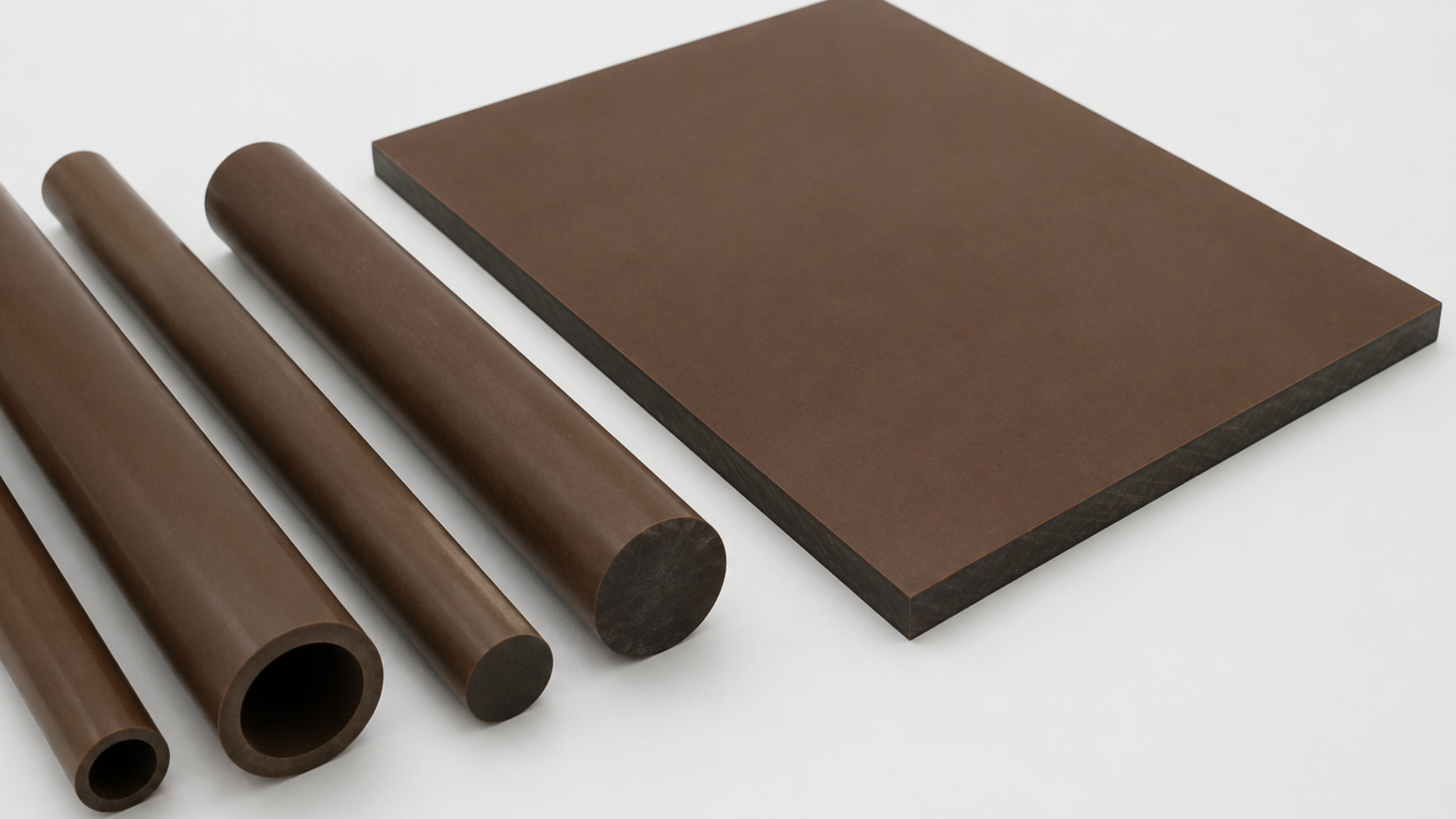
Atlas Fibre manufactures paper, canvas, and linen phenolic in sheet, rod, and tube, with in-house precision machining for prototypes, replacement parts, and production programs. By weighing both the material properties and the finished-part requirements, our team can help identify a practical grade for the application.
Not sure whether paper, canvas, or linen phenolic is the right fit? Connect with the Atlas Fibre team; send us your drawing, specifications, or application requirements to start a material and manufacturability review.