

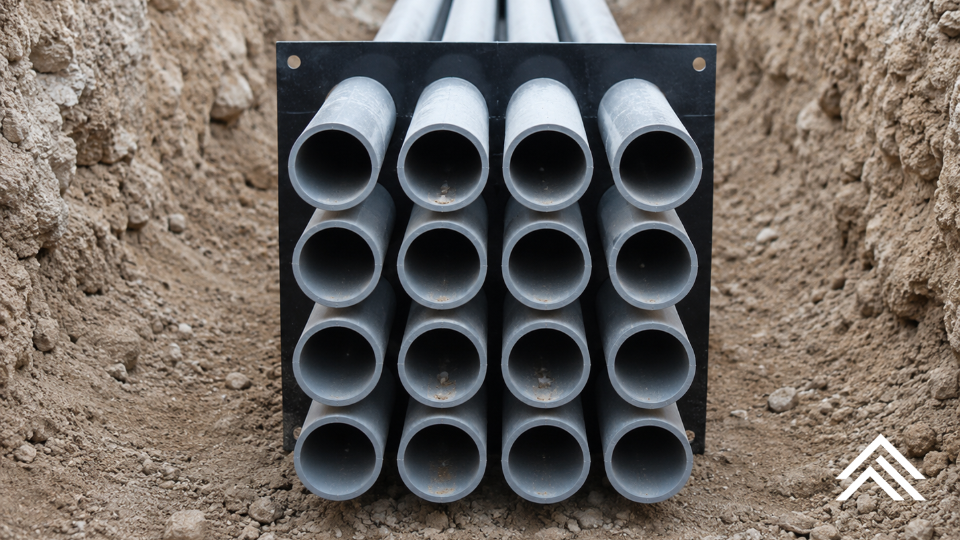
- Spacers hold conduits in a fixed, engineered position before and during the pour, maintaining spacing and alignment, letting concrete flow around the ducts, straightening cable pathways, and speeding field assembly.
- Three common types cover most jobs: base and intermediate, chair/modular, and template/grid spacers, selected by conduit arrangement.
- Standard molded spacers suit standard grids; custom spacers handle nonstandard diameters, mixed sizes, tight trenches, special cover, rebar conflicts, or drawing-specific dimensions.
- The material choice is toughness vs. rigidity: HDPE is tougher and more crack-resistant (better for impact and cold), PVC is stiffer and more dimensionally stable, and polypropylene sits between them.
- Machining from plastic sheet skips mold tooling, ideal for prototypes, replacements, and low-to-moderate runs, with repeatable production for recurring programs.
- The lowest material price isn’t always the lowest installed cost; factor in breakage, replacement, and field time.
Duct bank spacers are prefabricated plastic components that hold multiple conduits, or ducts, in a fixed, engineered arrangement before and during concrete placement. Simple as they are, they play an outsized role in how well a concrete-encased duct bank performs and how easily it goes together, helping crews hold the required spacing, keep conduits aligned, and repeat the same layout down the length of the trench.
You’ll find them anywhere multiple cable pathways run together underground: electrical power distribution, telecommunications, transportation infrastructure, data centers, and industrial facilities.
Off-the-shelf molded spacers work for standard installations. When conduit sizes, spacing, trench dimensions, or reinforcement layouts fall outside standard configurations, custom-machined spacers offer a more precise, practical fit.
What is a duct bank?
A duct bank is a group of underground conduits installed together to carry power, communications, fiber-optic, or control cables. In many applications the conduits are encased in reinforced concrete to protect them from soil loads, traffic, construction activity, and moisture, a configuration found beneath roads, railways, utility yards, substations, airports, data centers, and industrial sites.
Before the pour, the conduits have to sit exactly where the project’s spacing and configuration call for. Spacers hold that arrangement in place.
What duct bank spacers do
Spacers are set along the conduit run at intervals determined by the project engineer, conduit size, spacer design, and site conditions – five-foot spacing is common, though tighter intervals may be needed to prevent movement or deflection. Their job comes down to four things.
Maintaining spacing and alignment. Spacers hold each conduit in position so it can’t shift, bow, float, or slump during assembly and the pour. That matters most in banks with several rows or columns, where even small movement can throw off concrete cover, conduit separation, or the finished dimensions.
Supporting concrete placement. A well-designed spacer lets concrete flow around and between the conduits, reducing voids and supporting uniform load distribution. Many designs include openings, notches, or flow-through areas to make room for concrete and reinforcing steel.
Creating straighter cable pathways. By keeping conduits aligned, spacers create a more consistent pathway for the cables pulled through later, which means fewer unnecessary bends and less friction and pulling stress during cable installation.
Simplifying field assembly. Without a repeatable system, crews end up measuring, tying, blocking, and banding conduits into position by hand. Prefabricated spacers set a defined layout that cuts fitting and adjustment in the field, especially valuable on large banks with mixed conduit sizes or complex grids.
Common spacer configurations
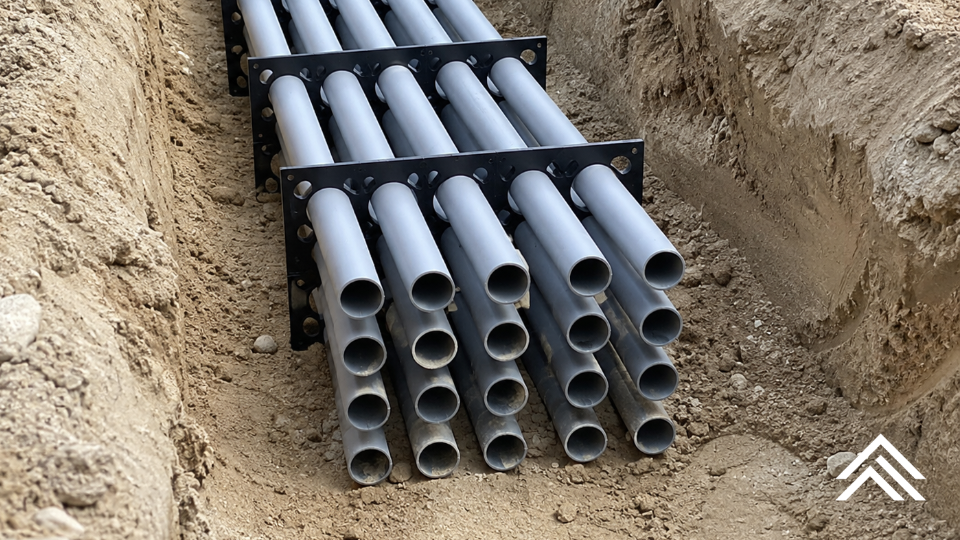
Spacers come in several forms depending on the conduit arrangement and installation requirements.
Base and intermediate spacers. Base spacers support the bottom row of conduit and set the initial spacing off the trench floor or formwork. Intermediate spacers go between rows and may stack, interlock, or band together to build a multi-level assembly.
Chair or modular spacers. Chair-style spacers support individual conduits or small groups, and multiple modules combine into larger arrangements. That modularity helps when conduit count or size varies across a project.
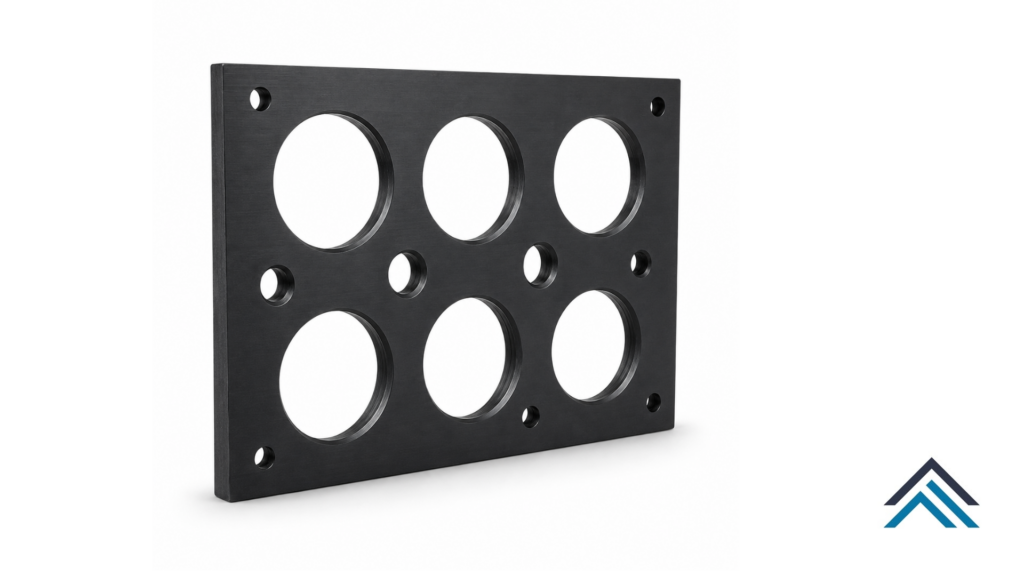
Template or grid spacers. Template-style spacers are flat components with machined openings in a set pattern – 2×2, 3×2, 3×3, or project-specific layouts. They’re useful when a project calls for fixed centerline spacing, unusual conduit diameters, or a mix of conduit sizes in one bank.
When you need custom spacers
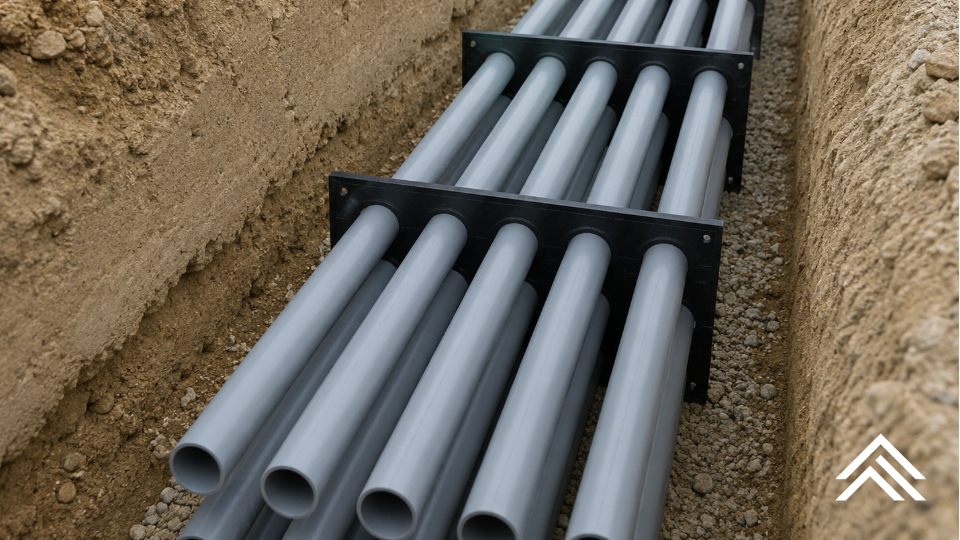
Standard molded spacers are practical when the conduit arrangement matches an established size and grid. Many installations don’t. Custom spacers may be the answer when a project involves:
- Nonstandard conduit diameters
- Multiple conduit sizes in one bank
- Unusual center-to-center spacing
- Restricted trench dimensions
- Special concrete-cover requirements
- Rebar conflicts or flow-through requirements
- Irregular rows or columns
- Project-specific tie-down or banding points
- Replacement parts for an existing installation
- Dimensions that must match an engineered drawing
In these cases, machining spacers from industrial plastic sheet offers more design flexibility than a molded, one-size-fits-all part.
Custom Machining at Atlas Fibre
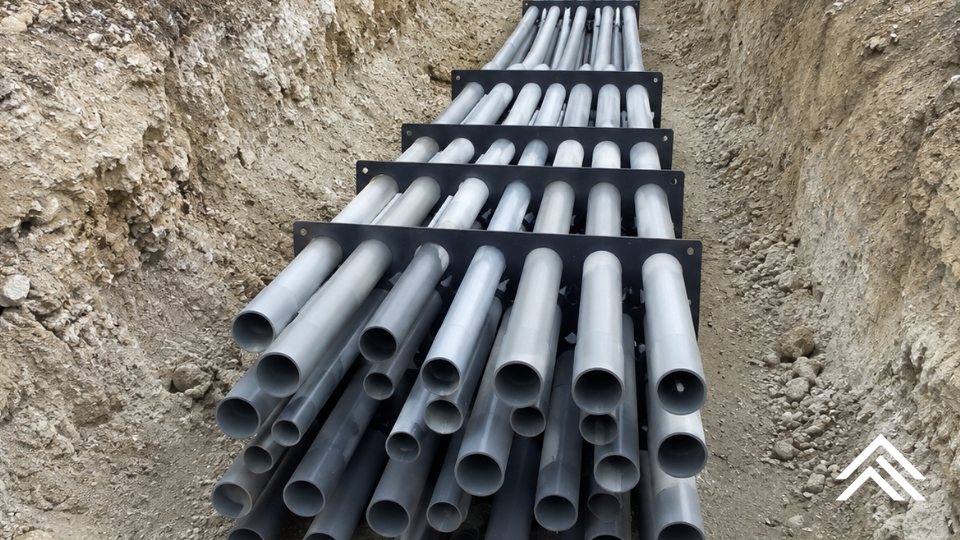
Atlas Fibre machines custom duct bank spacers from industrial-grade plastic sheet for utility contractors, infrastructure suppliers, fabricators, and OEMs. Instead of forcing a project into a standard molded pattern, we cut spacers to the conduit arrangement, opening size, material thickness, and outside dimensions on your drawing – so the same process serves both common grids and highly specialized installations. It’s especially useful when a spacer has to fit a fixed trench envelope, or when the layout simply can’t be built from commercially available molded parts.
Machined features can include:
- Rebar clearance slots
- Concrete flow-through openings
- Banding, tying, or fastening points
- Interlocking or stacking features
- Rounded edges and custom profiles
- Identification marks or part numbers
From drawing to finished spacer. Production usually starts with a drawing, sketch, sample, or defined conduit layout that identifies conduit outside diameters, spacing, material, thickness, overall dimensions, and any openings or notches for rebar, concrete flow, banding, or assembly. We review those requirements for machinability before cutting begins, flagging overly thin sections, tight clearances, or unsupported areas that could affect strength, machining efficiency, or field performance. Because the parts are machined rather than molded, design changes don’t require new tooling, a real advantage for prototypes, replacement parts, and quantities too small to justify a custom mold.
Prototypes through production. Requirements range from a handful of replacement parts to full production runs. A small initial run lets you verify conduit fit, spacing, handling, and assembly before committing to the full quantity; once a design is approved, it reproduces consistently from one run to the next. That repeatability matters when spacers are supplied across multiple project phases, job sites, or crews.
Material options
Duct bank spacers are made from durable plastics that resist moisture, corrosion, soil exposure, and contact with concrete. Atlas Fibre machines the three most common – HDPE, PVC, and polypropylene – to project specifications.
HDPE. High-density polyethylene is widely used for its toughness, impact resistance, and durability in buried environments. It resists moisture and many chemicals, absorbs little water, stays tough at low temperatures, and holds up to the cracking, uneven loading, and ground movement that come with installation. Because it’s more ductile than PVC, an HDPE spacer is less likely to crack if it’s dropped, struck, or loaded unevenly – and it machines readily into custom openings, grids, and profiles.
PVC. PVC is common where rigidity and dimensional stability matter most. It’s stiff, holds a stable and repeatable geometry, resists moisture and corrosion, is familiar within PVC conduit systems, and often carries a lower initial material cost. That stiffness helps maintain a precise grid, but PVC is less impact-resistant and less ductile than HDPE, so it needs more careful handling, particularly in cold weather or where the geometry includes thin sections or stress concentrations.
Polypropylene. Polypropylene is a middle option, offering good chemical resistance, low moisture absorption, and a useful balance of stiffness and toughness. Its suitability depends on the grade, operating temperature, spacer geometry, and project requirements.
HDPE vs. PVC: toughness or rigidity. Choose based on what the spacer has to do, not on the conduit material. The trade-off is essentially toughness versus rigidity. HDPE is more flexible and ductile, so it tolerates impact, installation loads, thermal movement, and minor ground settlement without cracking, and it holds that toughness across a wider cold-weather range – a plus for rough field handling and winter construction. PVC is stiffer and more dimensionally stable, which can resist short-term deflection better in some geometries, but it’s more prone to brittle failure under impact, especially as temperatures drop or where corners are sharp and cross-sections thin. (Exact temperature limits depend on the material grade and should be confirmed during selection.)
On cost, PVC may be cheaper up front for standard configurations, while HDPE can justify its price where impact resistance, field durability, cold-weather handling, and crack resistance are priorities. The lowest-priced material isn’t always the lowest installed cost – breakage, replacement, assembly time, and field modifications all factor in. And because HDPE flexes under load, its thickness, opening design, support distance, and grade have to be chosen carefully to hold conduit spacing during the pour.
Design considerations for machined spacers
Material is only one part of the design. Engineers, contractors, and manufacturers should also weigh:
- Conduit outside diameter
- Required conduit centerline spacing
- Number of rows and columns
- Spacer interval along the run
- Concrete-cover requirements
- Expected concrete-placement pressure
- Buoyancy and conduit restraint
- Rebar location
- Trench width and depth
- Installation temperature
- Spacer thickness
- Allowable spacer deflection
- Minimum wall thickness between openings
- Tie-down or banding requirements
- Applicable utility or project specifications
A spacer has to be strong enough to hold the engineered layout through assembly and the pour, while leaving enough clearance for concrete to consolidate around the conduit. On machined designs, the interplay of opening size, edge distance, section thickness, and overall material thickness deserves a careful look – and Atlas Fibre can help judge whether a proposed geometry is practical to machine and robust enough to handle and install.
Requesting a quote
To evaluate a custom duct bank spacer, send as much of the following as you can:
- A drawing, sketch, CAD file, or existing sample
- Conduit outside diameter and number of conduits
- Row and column arrangement
- Center-to-center spacing
- Spacer material and thickness
- Overall spacer dimensions
- Required quantity
- Rebar clearance and concrete flow-through requirements
- Banding or attachment features
- Installation temperature or environmental conditions
- Applicable project or utility specifications
Providing these details up front reduces design revisions and helps ensure the finished spacer matches both the engineered layout and the field installation process.
A small component with a significant role
A spacer is a small part of an underground utility project, but its job is critical: it sets the conduit layout, keeps installation consistent, and preserves spacing while the concrete goes in. A poorly designed or damaged one can lead to conduit movement, reduced concrete cover, misalignment, voids, or a harder cable pull down the line.
When standard systems don’t match the installation, custom-machined plastic spacers are a practical way to hit project-specific conduit sizes, grid arrangements, and trench constraints. Machining HDPE, PVC, polypropylene, and other industrial plastics straight from project drawings, Atlas Fibre supports custom duct bank spacer requirements from first prototype through repeat production.