


Moisture does not have to soak a composite to change it. Here is how water enters a laminate, what it can do once inside, and why “low moisture absorption” never tells the whole story.
Key Takeaways
- Moisture absorption is a process, not just a percentage. Diffusion rate, laminate thickness, exposed edges, temperature, and environmental conditions determine how quickly moisture reaches the interior.
- Small amounts of moisture can produce meaningful changes. Absorbed water can plasticize the resin, lower glass-transition temperature, weaken interfaces, and affect matrix-dominated mechanical properties.
- Moisture data must reflect the application. Engineers should evaluate the actual service environment, test method, exposure duration, temperature, geometry, and material condition during machining and inspection.
A thermoset composite laminate can look impervious. Its surface is hard, its reinforcing fibers are locked inside cured resin, and there is no obvious route for water to enter. But leave that laminate in humid air or immerse it long enough, and water molecules will begin working their way inside.
The process is usually slow. It is also easy to underestimate.
Even a relatively small amount of absorbed moisture can alter the resin matrix, weaken the fiber–resin interface, change dimensions, and reduce the laminate’s margin for elevated-temperature service. For a structural panel, an electrical insulator, or a close-tolerance machined component, those changes can matter long before the material appears wet.
The important question, then, is not simply whether a laminate absorbs moisture. It is how much it absorbs, how quickly moisture reaches its interior, and what that moisture does to the properties the application depends on.
Water Finds More Than One Way In
Moisture absorption is the uptake of water vapor or liquid water from a laminate’s surroundings. In most thermoset composites, the reinforcing fibers are not the primary route. Moisture moves mainly through the polymer matrix, the microscopic free volume within the cured resin, and the interfaces between resin and reinforcement.
It can also exploit flaws. Voids, microcracks, damaged edges, and poorly consolidated regions create additional pathways. A laminate with higher void content may therefore take up moisture faster – or appear to absorb more – than a well-consolidated version made from the same nominal resin and reinforcement.
Resin chemistry matters, too. Epoxy, polyester, vinyl ester, phenolic, and other thermoset systems do not interact with water in the same way. Fiber type, orientation, and volume fraction change the amount and continuity of the resin through which moisture must travel. Thickness, coatings, edge sealing, temperature, humidity, and exposure time all influence the result.
That is why a single moisture-absorption number, stripped of its test conditions, is rarely enough to predict performance.
How Moisture Uptake Is Measured
Moisture content is commonly reported as a percentage of the material’s dry mass:
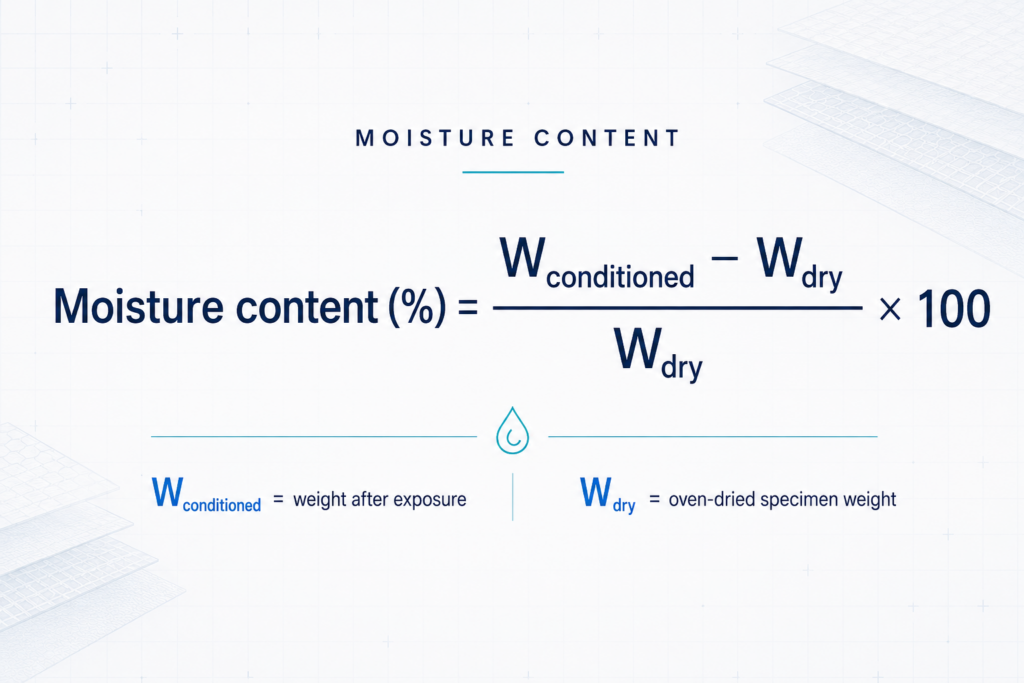
The calculation compares the specimen’s weight after exposure with its original dry weight. The difference is reported as a percentage of the dry weight, showing how much moisture the material absorbed.
The arithmetic is simple. The experiment is not. Drying procedure, specimen dimensions, exposed edges, weighing intervals, temperature, humidity, immersion conditions, and the definition of equilibrium can all affect the reported value.
ASTM D5229/D5229M is commonly used with polymer-matrix composites to track moisture uptake over time, determine equilibrium moisture content, estimate diffusivity, and condition specimens before mechanical testing. ASTM D570, meanwhile, is often used for water absorption of plastics over a specified immersion period. The two methods can answer different questions. A short-term immersion result from one should not automatically be treated as equivalent to long-term atmospheric conditioning from the other.
Diffusion Is a Race That Slows Down
For many laminates, moisture uptake is approximated as a Fickian diffusion process. In plain language, water moves from regions of higher concentration toward regions of lower concentration.
At first, uptake can be relatively quick because moisture is entering material near the exposed surfaces. As it travels toward the center, the rate slows. Under stable conditions, the laminate eventually approaches equilibrium, where its measured moisture content changes very little with time.
This progression matters because the surface can become conditioned well before the core. A thick laminate may still contain a steep moisture gradient after a thin coupon has effectively reached equilibrium. Exposed edges can shorten the route into the material, while sealed edges can make through-thickness diffusion more dominant.
When thickness, exposure conditions, and an appropriate diffusivity value are known, a diffusion calculator can help estimate how moisture uptake may progress with time. That makes it useful for comparing scenarios, planning conditioning intervals, or determining whether the center of a part is likely to lag behind its surfaces. The result should be treated as an estimate: cracks, voids, complex geometry, changing environments, and non-Fickian behavior can all push the real laminate away from the idealized model.
The Damage Often Starts in the Resin
Once water enters a laminate, it can plasticize the polymer matrix. The resin becomes more mobile at the molecular level, which can reduce stiffness and lower the glass-transition temperature, or Tg.
That drop in Tg is especially important. A component does not need to reach the laminate’s dry Tg to encounter trouble. If absorbed moisture lowers Tg, the safety margin between operating temperature and resin softening becomes smaller. Under hot/wet conditions, the laminate may lose stiffness or strength sooner than expected and may become more susceptible to creep and deformation.
The fiber–matrix interface can also weaken or degrade. As a result, properties that depend heavily on the matrix and interface – such as interlaminar shear, transverse strength, compression, and flexural performance – are often more moisture-sensitive than properties dominated by the reinforcing fibers.
Other potential effects include:
- Matrix swelling and dimensional change
- Reduced modulus and increased damping
- Greater susceptibility to microcracking and delamination
- Internal stresses during heating or thermal cycling
- Blistering when trapped moisture rapidly turns to vapor or desorbs
- Changes in electrical performance and insulation behavior
Not every laminate will exhibit every effect, and the severity depends on the material system and exposure. But “low moisture absorption” should never be translated to “unaffected by moisture.”
Temperature Turns Up the Pressure
Humidity alone tells only part of the story. Temperature accelerates diffusion and can intensify the consequences of absorbed water.
At elevated temperatures, moisture can penetrate a laminate more quickly. At the same time, a moisture-related reduction in Tg brings the resin closer to the range in which its mechanical behavior begins to change. The combined environment can produce greater losses in stiffness and strength than either heat or moisture would suggest on its own.
This is why aerospace and other demanding composite programs evaluate hot/wet performance rather than relying only on room-temperature, dry-property data. A laminate that performs well on a dry laboratory coupon may behave differently after months in a humid enclosure, repeated outdoor cycles, or service near a heat source.
Moisture Can Move a Machined Dimension
For close-tolerance components, strength may not be the first concern. Dimensions may be.
A conditioned laminate can swell before machining. If the finished component later dries, its dimensions may shift. The reverse can occur when a dry component enters a humid service environment. Even small movements can matter when tolerances are tight, mating features must align, or inspection takes place under conditions different from machining or service.
Moisture may also change machining behavior, expose subsurface defects, or create internal stresses during elevated-temperature processing. A rapid heating cycle can drive moisture out faster than it can escape, increasing the risk of blistering or localized damage.
For precision components, it is good practice to define or document the material’s moisture condition during machining, inspection, assembly, and expected service. Otherwise, a part can pass inspection in one condition and drift after the environment changes.
How to Compare Two Laminates Without Fooling Yourself
Moisture data is only comparable when the surrounding details are comparable. Before deciding that one material absorbs less water – or tolerates moisture better – check the following:
- Resin system
- Fiber type, orientation, and volume fraction
- Laminate construction and thickness
- Edge exposure or edge sealing
- Exposure temperature and relative humidity
- Atmospheric conditioning or water immersion
- Conditioning duration and equilibrium criteria
- Test standard
- Drying and weighing procedures
- Void content, consolidation quality, and existing damage
Then connect the result to the application. What is the expected equilibrium moisture content in service? How long will it take the interior of the actual part – not just a small test coupon – to approach that condition? Is the critical property controlled by the fibers or by the resin and interface? What happens to Tg, dimensions, electrical behavior, and machinability after conditioning? Does drying restore the original properties, or has the exposure caused permanent damage?
Those questions turn moisture absorption from a catalog number into an engineering decision.
The Bottom Line on Moisture Absorption
Water rarely announces its arrival inside a thermoset laminate. It diffuses through the resin, works along interfaces, and takes advantage of defects. The uptake may be small by weight, yet still large enough to affect temperature capability, matrix-dominated strength, dimensional stability, or processing behavior.
The best evaluation combines controlled testing with a realistic understanding of the part’s geometry and service environment. Use moisture-uptake data to establish how much water the laminate may hold. Use diffusion estimates to understand how quickly it may get there. Then test the properties that actually determine whether the component succeeds.
Because with composites, the most consequential moisture is often the moisture you cannot see.