

Thermoset composite laminates are used in steel mills primarily as nonmetallic sliding, bearing, and impact-interface parts – especially where steel-on-steel contact would gall, seize, corrode, transmit vibration, or demand frequent lubrication.
Typical materials are cotton-fabric phenolics (canvas or linen grades), glass-cloth phenolics/epoxies, and other fiber-reinforced thermoset laminates machined from plate, sheet, tube, or rod.
The design intent is not to replace every high-load metallic wear part. Laminates serve as a sacrificial, low-friction interface that protects expensive mill structure, survives intermittent shock, and can be replaced during planned maintenance. Industrial laminate suppliers specifically identify steel rolling mills as an impact-resistance application, and phenolic laminates are broadly used for bearings, bushings, gears, wear strips, guides, rollers, and spacers.
How They Function
Sliding and sacrificial wear interfaces
A fabric-reinforced phenolic pad or liner is bolted, bonded, clamped, or captured in a steel holder. The laminate becomes the intentional wear element between moving steel members. During operation, its resin/fiber structure carries compressive load while its surface avoids direct steel-on-steel scoring.
Common shapes include:
- Flat liners and shims
- U-channel or box-guide liners
- Replaceable wear pads
- Split bushings and bearing shells
- Thrust washers
- Machined gears, rollers, and sheaves
- Tube-based sleeve bearings
- Laminated blocks machined with oil grooves, retention features, or bolt patterns
When a component wears to a specified thickness, maintenance replaces the inexpensive liner rather than rebuilding a rolling-mill housing, carriage, or guide structure.
Bearing and bushing service
Canvas- and linen-reinforced phenolics have long been used in bearing surfaces, bushings, pulleys, gears, and structural supports. The fabric reinforcement supplies toughness and compressive-load capability; the cured phenolic matrix supplies stiffness, chemical resistance, and stable geometry relative to many commodity plastics.
For oscillating or slow-speed pivots – linkages, guide arms, and some handling equipment – laminate bushings can be favorable where lubrication is unreliable, contamination is present, or corrosion makes metallic bearing solutions troublesome. The result is often lower noise and less risk of seizure than an unprotected steel-on-steel interface.
Impact and vibration management
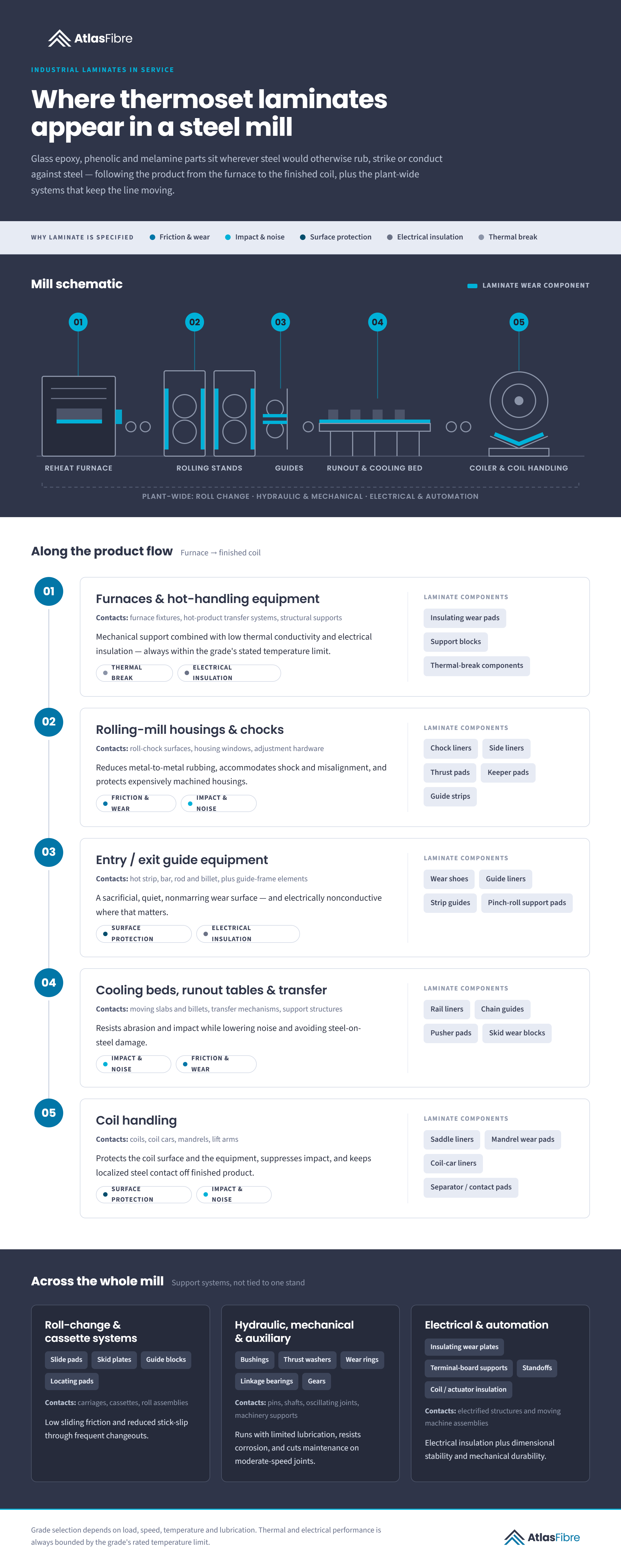
Rolling, cropping, transfer, and coil-handling systems impose impact loads. Compared with a hard steel-to-steel interface, a reinforced thermoset laminate can distribute contact stress over a broader area, damp vibration, and reduce noise. This is particularly useful for:
- Coil-car and coil-saddle contact pads
- Transfer-car and pusher wear blocks
- Mill-guide backup pads
- Stops, bumpers, and locating pads
- Chock or cassette side-wear liners
The laminate should be regarded as a tough, rigid engineering composite, not a soft elastomeric cushion. It moderates contact and is replaceable, but high-energy impact cases may still require a separate elastomeric or metallic energy-absorbing design.
Material Selection by Duty
Cotton-fabric phenolic
Canvas phenolic is the usual workhorse for rugged, economical mechanical wear parts. It offers good wear behavior, strength, modest moisture uptake, and machinability, and is commonly used for structural supports, gears, spacers, piston rings, and bearing surfaces.
Use it for moderate temperatures, compressive sliding loads, machinery liners, guide blocks, and bushings where electrical insulation is helpful but not the governing requirement.
Linen phenolic
Linen grades use a finer fabric and are generally selected when a smoother machined finish, better dimensional control, and more precise bearing or gear geometry are needed (such as those used in tight-tolerance liners, thrust elements, smaller gears, and machined bearing components). Phenolic laminates are commonly specified for precision parts, bearings, bushings, and wear plates.
Glass-cloth phenolic or epoxy laminate
Glass-reinforced laminates are appropriate when electrical insulation, compressive strength, moisture resistance, and higher temperature capability matter more than benign sliding behavior. They are common around electrical equipment, insulating fixtures, and mechanically loaded insulating structures. The tradeoff is that glass reinforcement can be more abrasive to mating surfaces and cutting tools than cotton-fabric grades.
Specialty systems
In more demanding locations, mills may specify resin/fabric systems with lubricant additives, PTFE-bearing layers, graphite, aramid reinforcement, flame-retardant formulations, or custom bonded multilayer constructions. These materials need application-specific validation, especially for hot-strip, furnace-adjacent, scale-contaminated, or chemically aggressive service.
What Designers Must Check
A successful laminate wear component depends more on the duty cycle than on the generic material name.
- PV loading: Evaluate pressure–velocity conditions for any continuous sliding or rotating bearing duty. A laminate that handles high static compression can still overheat or wear rapidly at excessive speed.
- Temperature at the part: Don’t use nominal resin temperature ratings as the operating design temperature. Account for radiant heat, frictional heat, scale, steam, cooling-water cycling, and local hot spots.
- Water, steam, and scale: Wet scale creates an abrasive slurry. Choose a grade with appropriate moisture resistance and plan for contaminant escape rather than trapping scale under the pad.
- Impact and edge loading: Laminates are strong in compression but can crack from unsupported edges, sharp corners, concentrated bolt loads, or poorly distributed loads. Use generous radii, backing plates, and broad bearing areas.
- Attachment design: Use counterbores, metal retainers, dovetails, recessed fasteners, or capture features so the part can’t creep, extrude, or delaminate. Avoid overtightening fasteners, which can create splitting stresses.
- Thermal expansion and fit: Provide clearance for the laminate, steel holder, and any temperature gradient. A tight cold fit can become problematic in a hot mill environment.
- Mating surface: Finish, hardness, alignment, and contamination determine actual wear life. A well-supported laminate against a smooth, aligned counterface behaves very differently from a pad forced over rough welds, gouges, or embedded scale.
- Fire and smoke requirements: Near furnaces, hydraulic systems, or enclosed plant areas, verify the exact resin system’s flame, smoke, and temperature qualification rather than assuming all phenolics behave identically.
Practical Example
Consider a roll-change carriage that slides a cassette or chock assembly into a mill stand. Steel rails sliding directly on steel supports can gall, corrode during downtime, and damage costly alignment surfaces. A mill can instead install bolted canvas-phenolic or specialty composite slide pads in the carriage shoes:
- The pads carry the compression load over a broad area.
- They provide the sacrificial sliding surface against the steel rail.
- They reduce noise and the tendency toward steel-on-steel seizure.
During a shutdown, technicians measure pad thickness and replace the pads before the steel structure becomes the wear item. The same principle applies to guide liners, coil-car pads, chock-window liners, and many transfer-system wear strips.
Limits
Thermoset laminates are not the universal choice for every steel-mill wear point. Hardened steel, bronze, carbide overlays, ceramic, UHMW-PE, nylon, polyurethane, rubber, or advanced self-lubricating composites may outperform them depending on temperature, sliding speed, chemical exposure, impact energy, and contamination. Their strongest niche is moderate-to-high compressive load, low-to-moderate speed, intermittent sliding or oscillation, impact-prone, corrosion-prone, and electrically insulating duties where a replaceable nonmetallic interface brings maintenance value.