

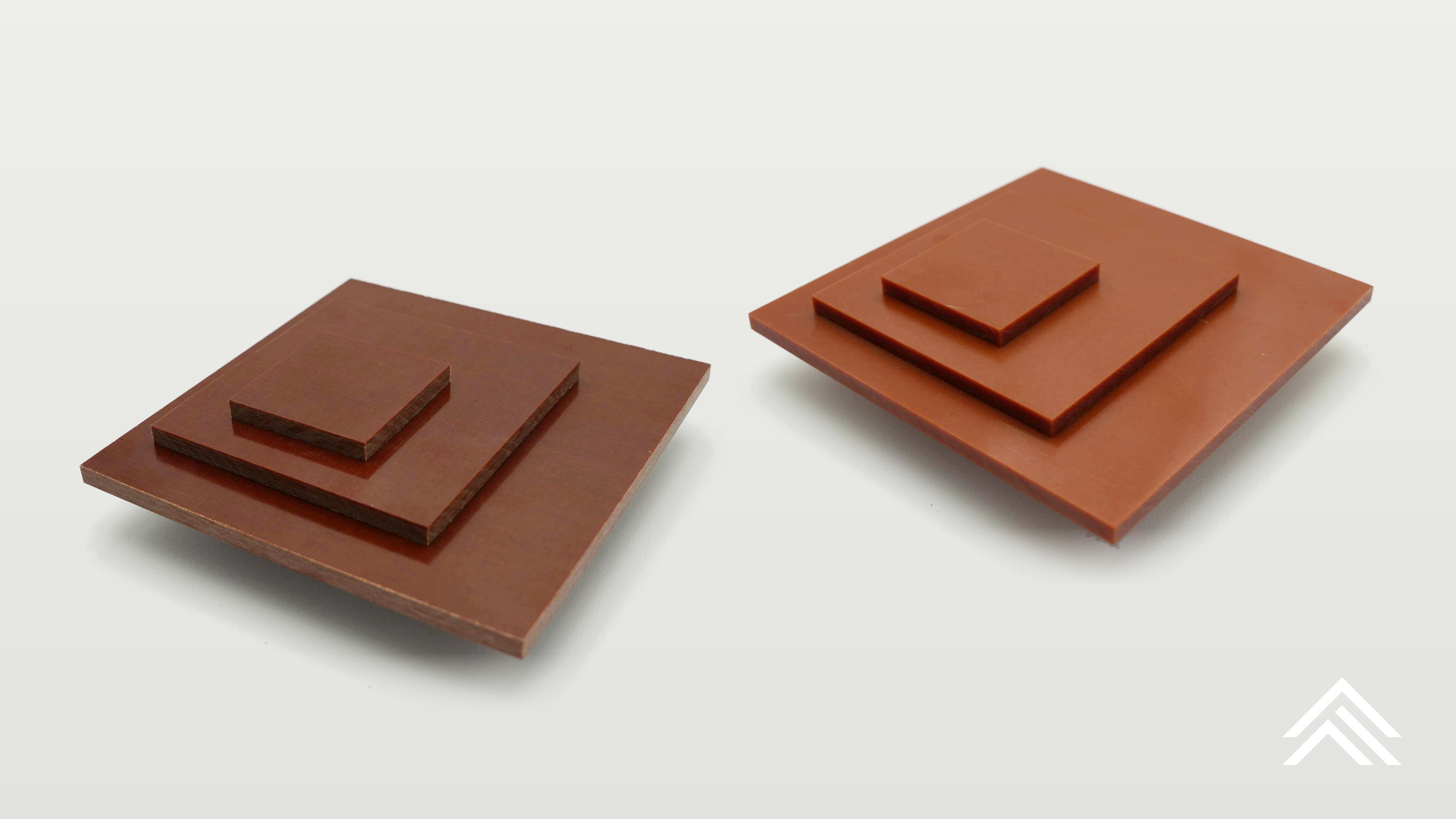
A fine thread that strips during assembly, or a gear tooth that comes off the machine with a ragged edge, can trace back to a choice made before any cutting started: which phenolic grade went on the drawing. Linen and canvas phenolic look alike on a materials list, but the fabric inside them behaves differently under a cutting tool.
Linen’s finer weave generally suits small, detailed features, while canvas suits general mechanical parts where fine detail matters less. Strength, electrical performance, and moisture behavior are separate decisions that depend on the specific grade. In the real world, there are many decisions that need to be made.
Two fabrics, four grades
Both material families are made from woven cotton fabric laminated with phenolic resin. “Linen” in this context means fine-weave cotton, not flax. Linen grades commonly use fabric weighing less than 4 oz/yd², while canvas grades use heavier fabric at 4 oz/yd² or more. The lighter, tighter fabric gives linen a finer reinforcement structure.
That gives engineers two choices to make: the fabric family, and whether the part needs a general mechanical grade or an electrical grade. Together, fabric weave and electrical need “set the grade”:
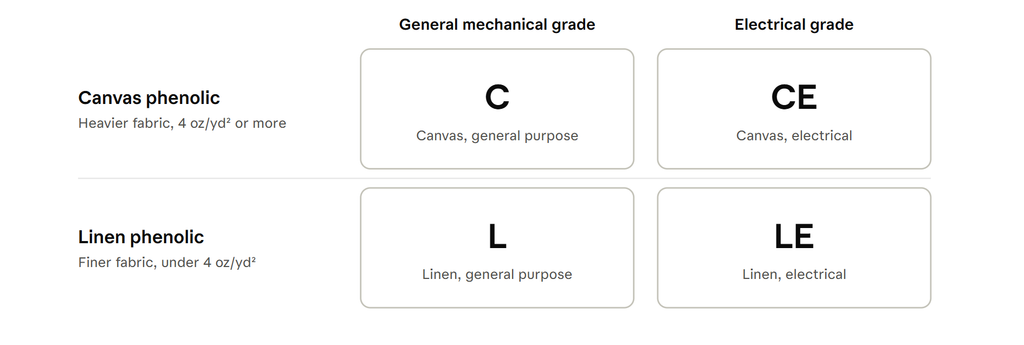
The weave mainly affects how the material machines. The resin system and grade determine electrical properties. CE and LE are formulated for applications that need better electrical performance than C and L provide.
Feature geometry and surface finish
This is where the weave makes the clearest difference. Manufacturers recommend linen grades for more intricate shapes and finer machined finishes than canvas grades typically allow.
Linen Phenolic (L, LE): Generally preferred for small or detailed features and for surfaces where finish matters. Typical examples include fine gear teeth, narrow slots, small profiles, thin sections, and detailed insulating components.
Canvas Phenolic (C, CE): A practical choice for general mechanical components such as plates, spacers, larger bushings, and wear bars, where fine features and surface texture are less critical.
A finer weave improves the odds of a clean feature, but it does not guarantee one. Edge quality and chip-out also depend on part geometry, tooling, feeds and speeds, and fixturing. If a feature is borderline, review it with your machining supplier before finalizing the drawing.
Threaded features
Linen is a reasonable starting candidate for fine threaded features, because the tighter weave gives the cutting tool more consistent material to form the thread in. Whether a given thread will work in either material should be confirmed for the actual design rather than decided by a fixed size cutoff.
Two requirements are easy to conflate:
- Machining the thread. Can the thread form be cut or tapped cleanly to the required class in this grade and thickness?
- Retaining the fastener. Will the thread hold the assembly torque and service load without stripping?
The second depends on more than the weave. Review the grade, thread engagement length, thread orientation relative to the laminations, and the assembly and service loads. For threads that carry meaningful load or will be assembled repeatedly, consider testing a sample or using a threaded insert.
Mechanical strength is a separate question
A finer weave improves the ability to machine detail. It does not establish a general strength advantage for linen or for canvas.
Compressive strength is a useful example. Atlas Fibre’s published data sheets list similar values across grades (e.g. compressive strength in the range of 35,000 to 37,000 psi).
The differences are small, and they do not favor linen. When strength drives the design, compare the exact grades you are considering, using the same property, test method, and load direction relative to the laminations. Check impact, flexural, and compressive values separately rather than assuming one fabric leads across all of them.
Bearing and wear applications
Both canvas and linen phenolics are used for bearings, gears, rollers, and guides. Linen’s finer machined finish can be an advantage on running surfaces, but surface finish alone does not establish lower friction, less wear, or longer service life.
For a bearing or wear part, the operating conditions usually matter more than the fabric choice. Review:
- Load and contact pressure
- Surface speed
- Lubrication method, or whether the part runs dry
- Mating surface material and finish
- Running clearances, including allowance for moisture and temperature changes
Moisture and dimensional stability
Cotton-reinforced phenolics absorb some moisture, and absorption varies with grade, thickness, and test conditions. That makes a single range for “linen” or “canvas” unreliable. As one example, a manufacturer reports 2.30% water absorption for a specific linen grade at 0.0625 in. thickness under a defined ASTM D570 condition.
Electrical grades (CE and LE) are generally formulated for better moisture resistance than their general-purpose counterparts, so the grade choice can matter more than the fabric choice here.
If the part will see humidity or immersion, or has tight running clearances, compare published absorption data for the exact grades and thicknesses under the same test condition. Then allow for dimensional change in the clearance design.
What to put on the drawing
The more of this a drawing or RFQ includes, the fewer assumptions your machining supplier has to make:
- The exact grade: C, CE, L, or LE
- Critical threads, thin sections, and edges with quality requirements
- Required surface finish on functional surfaces
- Load direction and laminate orientation
- Operating humidity, temperature, and critical running clearances
Next Step: Choosing Between Linen & Canvas
Choosing the right material does not need to be complicated – just choose the weave for the features you need to machine, then confirm the grade against the demands of the part – strength, electrical, and moisture requirements.
If you are making that choice on a current design, send your drawing or RFQ to Atlas Fibre. We will review the features and operating conditions, recommend a grade, and quote the part machined to print.