

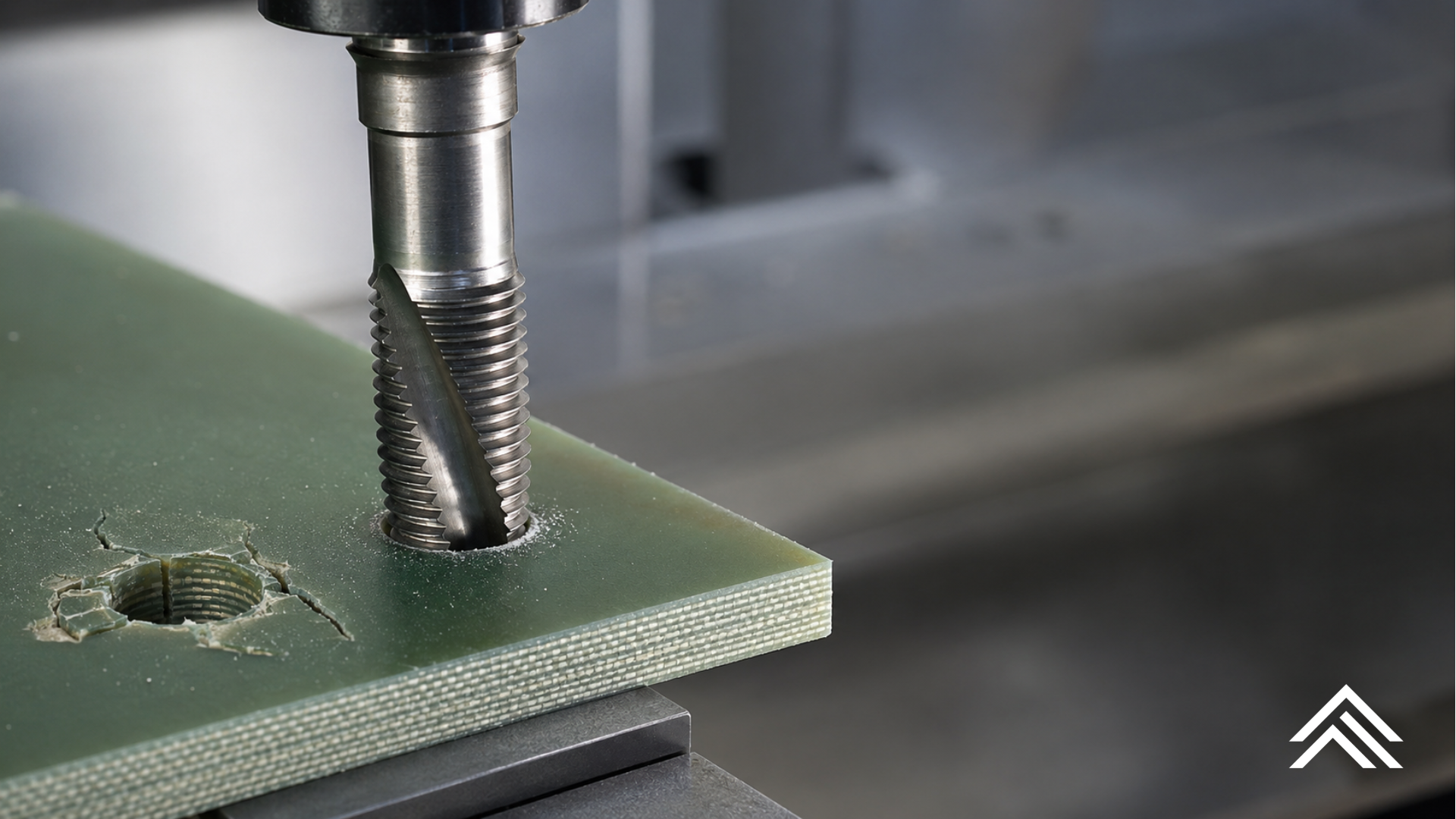
G-10/FR-4 and phenolic laminates can be tapped and threaded successfully. The problem is that the standard metal-shop approach often assumes the workpiece will behave like metal.
It will not.
Metals can deform locally as a tap cuts or forms a thread. Thermoset composite laminates have very little ductility. They are made from cured resin reinforced with layers of glass cloth, paper, or fabric. When a threading operation generates too much interference or wedging force, the material cannot simply yield. Instead, the resin may crack, thread flanks may crush, fibers may break out, or the laminate may begin to separate between plies.
That difference explains why a nominal tap-drill size, a standard high-speed-steel tap, high thread engagement, and aggressive power tapping can produce tight threads, broken taps, splitting, or joints that fail earlier than expected.
The practical rule is straightforward: cut the thread instead of displacing material, validate the pilot hole in the actual laminate, keep tooling sharp, and use an insert when the joint will carry meaningful load or see repeated service.
G-10/FR-4 and Phenolic Are Not the Same Material
Before selecting a machining process, it helps to distinguish between the laminate families.
G-10 and FR-4 are glass-cloth epoxy laminates. FR-4 is formulated to provide flame-retardant properties. Both contain abrasive glass reinforcement that can wear cutting edges quickly. Learn more about G10 machining at Atlas Fibre.
“Phenolic” is a broader shop term that commonly refers to paper-, cotton fabric-, or glass-reinforced phenolic laminates. Paper and fabric phenolics are generally less abrasive to machine than glass-epoxy grades, but their layered construction still creates a risk of splitting, especially when drilling parallel to the laminations or placing a threaded hole too close to an edge.
The grade, reinforcement, resin system, laminate orientation, thickness, hole depth, and edge distance can all change the result. A process that works in a thick linen phenolic part should not automatically be transferred to thin FR-4 sheet.
Why the Standard Metal-Shop Recipe Breaks Down
1. The material does not yield like metal
A conventional metal-threading process assumes some local plastic deformation at the thread root. A cured thermoset laminate responds differently. Excessive radial pressure can crack the resin, crush the reinforcement-supported thread flanks, or separate adjacent plies.
This is also why form taps are generally a poor choice. Form tapping relies on ductile material flowing into the thread profile. G-10/FR-4 and phenolic do not cold-form into a coherent thread the way aluminum or mild steel can. The tap is more likely to wedge and damage the laminate than to create a stronger internal thread.
For direct threads in laminate, use a sharp cutting tap.
2. A nominal drill may not produce a nominal hole
A steel tap-drill chart is only a starting reference. In most instances, holes drilled in thermoset laminates commonly finish approximately 0.002 inch smaller than the drill diameter. A dull drill may increase that difference.
That matters because an undersized pilot hole raises tap interference, cutting torque, and radial stress. A setup that appears correct on paper can produce a tight thread or a broken tap in practice.
Consider starting with a tap drill 0.002 inch oversize and a high-speed tap 0.002 inch oversize for laminate work. That recommendation should be treated as a qualification starting point, not a universal tolerance. Measure the hole produced in the actual grade, thickness, and setup, then adjust the drill size to achieve the required fit without unnecessary engagement.
3. More thread engagement does not automatically create a stronger joint
Metalworking practice often favors a high percentage of thread engagement. In a brittle laminate, increasing engagement can raise installation torque and wedging stress faster than it improves useful stripping resistance.
A thread can feel tight while already containing crushed resin or microcracks. The apparent fit may look reassuring during assembly, yet the fastener can strip at a low torque or lose preload after only a few cycles.
Use only the engagement needed for the application, then verify pull-out strength and torque-to-failure with representative material. Do not assume that a longer thread or tighter fit will compensate for poor laminate integrity.
4. Glass reinforcement changes tool life
Glass-based laminates are highly abrasive. High-speed-steel tooling may be adequate for short runs, but edge wear quickly changes the process. As the tap dulls, it begins to rub rather than cut cleanly. Torque rises, heat increases, and the tap becomes more likely to bind, particularly during reversal.
Many experts in composite laminates recommend carbide drills for glass-based grades and carbide taps for sizable production quantities. For paper- and cotton-fabric phenolics, sharp HSS tooling may be satisfactory, while carbide can improve consistency in deep holes and longer production runs.
Tool replacement should be based on process behavior and hole quality, not only on catastrophic tool failure. Rising torque, worsening surface finish, tight gauging, or increased breakout are signs that the cutting edge may already be unsuitable.
5. Composite debris does not behave like a metal chip
Tapping laminates produces fine abrasive dust and short fiber-and-resin fragments. This material can pack the flutes, abrade the tool, interfere with gauging, and increase heat.
Use effective dust extraction and clear the flutes often enough to prevent packing. When drilling paper or fabric phenolics, frequent tool withdrawal also helps control binding and heat. Any use of coolant should be evaluated against material, cleanliness, and downstream requirements; dry machining with effective extraction is common for these materials.
A More Reliable Tapping Process
Design out direct composite threads when practical
For high loads, repeated assembly, or service-critical joints, consider a through-bolt with washers, a captive nut, bonded or molded-in hardware, or a mechanically retained threaded insert. Directly tapped laminate is better suited to light-load, low-cycle fastening. Always keep in mind, if a thread will be used frequently, a metal insert may be the best option.
Qualify the pilot hole in production material
Drill sample holes using the intended machine, tool geometry, fixturing, feed, and laminate grade. Measure the finished hole instead of relying only on the drill marking or a metal-oriented chart.
For through-holes, support the exit face with scrap laminate or another suitable backing material to reduce chipping and breakout. When drilling parallel to the laminations, clamp the material carefully to resist splitting.
Reduce wedging and breakout
Use a sharp cutting tap, maintain axial alignment, and avoid dwell or rubbing. Chamfer the entry so the tap starts cleanly. Fixture the workpiece so it cannot flex, and give particular attention to thin sections and holes near an edge.
Coarser threads are generally more forgiving than fine threads in a brittle substrate because they provide a deeper, more substantial thread form. Even so, adequate wall thickness, edge distance, and laminate thickness remain essential.
Control the tapping cycle
Aggressive power tapping can hide a deteriorating process until the tap breaks or the part is damaged. Monitor torque where possible, keep reversal controlled, and clear debris before it compacts in the flutes. Glass-based laminates may cut close to finished size and tend to bind when the tap backs out.
For production work, validate tap life and establish a replacement interval before torque and thread quality drift beyond acceptable limits.
Consider single-point threading for larger holes
For threaded holes larger than 0.500 inch, consider a chased thread on a lathe. Internal and external threads in glass-based laminates can be cut using carbide tooling and fine cuts. This approach can reduce the wedging associated with forcing a large tap through a brittle laminate.
What Common Failures Are Telling You
The tap breaks or torque rises sharply. The pilot hole may be effectively undersized, the tap may be dull, debris may be packed in the flutes, or the tap may be entering out of alignment.
The thread feels tight but strips at low torque. The thread flanks may have been crushed or microcracked. High apparent engagement did not translate into usable thread strength.
The exit face shows fuzz, breakout, or a ring crack. Check drill sharpness, feed, backing support, edge distance, and the amount of force applied as the drill exits.
A side-drilled hole begins to open between layers. The hole orientation or fastener load is separating the laminations. Reorient the feature, add a retained insert or bushing, or redesign the joint around a through-fastener.
The fastener loses torque after repeated assembly. The resin-supported thread flanks are wearing. Replace the direct thread with an insert or through-bolt arrangement.
Test the Joint, Not Just the Thread
A go/no-go gauge can confirm thread dimensions, but it cannot prove that the surrounding laminate is undamaged or that the joint will carry the intended load. Qualification should reflect the application and may include installation torque, prevailing torque, pull-out strength, stripping torque, preload retention, and repeated assembly cycles.
Test specimens should match the production grade, thickness, orientation, edge distance, hole type, and machining process. Blind holes deserve particular attention because debris evacuation is more difficult and bottoming taps create higher local loads.
The Bottom Line
Successful threading in G-10/FR-4 and phenolic begins by abandoning the assumption that the material is simply a softer version of metal. These laminates are brittle, layered, and (when glass reinforced) highly abrasive.
Use a measured and validated pilot hole. Cut rather than form the thread. Keep tools sharp and use carbide where glass reinforcement or production volume makes tool wear a concern. Support the laminate, control debris, and avoid unnecessary thread engagement. Most importantly, use a metal insert or through-fastened joint when the connection must withstand meaningful load, repeated assembly, or long-term service.
That approach does more than protect the tap. It protects the integrity of the laminate and the reliability of the finished assembly.
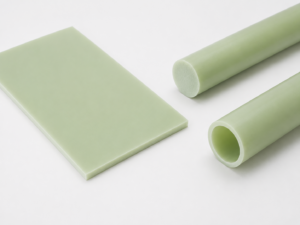
Need help specifying a laminate for your application?
Check the G10 data sheet for dielectric strength, flexural strength, moisture resistance and other values. For a closer look at how G10 material properties stack up against other thermoset composite laminates, review the comparative data sheet from Atlas Fibre.