

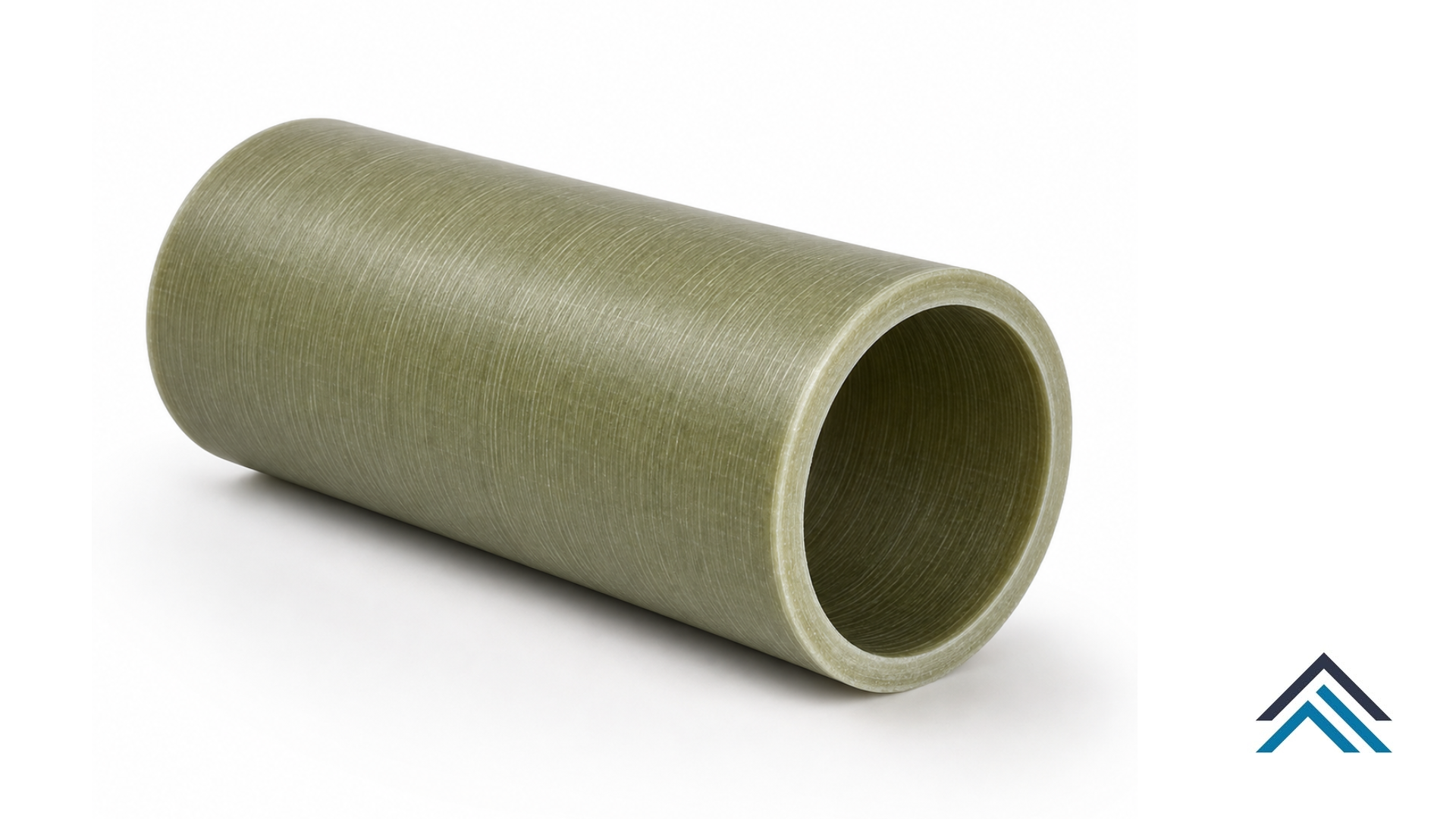
A plain-English guide to choosing the right composite tube for cryogenic, electrical, and structural applications
Key Takeaways...
The manufacturing process determines what a tube can do, not just what it’s made of. Filament winding lets engineers orient continuous fiber in specific directions (around the circumference for hoop strength, along the length for axial strength_ so the tube is built around the actual forces it will face, rather than a generic strength profile.
Filament winding earns its place in cryogenic and electrical applications because it can do double duty. A single tube can act as both a load-bearing structural member and an electrical/thermal insulator, useful anywhere a part needs to isolate and support at the same time.
No process is universally “best.” Pultrusion wins for straight, high-volume, mostly axial-load profiles (beams, rails). Convolute winding wins where a dense, layered wall and strong dielectric performance matter most. Filament winding wins when the tube faces pressure, hoop loads, crushing, torsion, or a combination of these.
Material selection should never be assumed from a general label. Cryogenic compatibility (liquid oxygen, liquid hydrogen, etc.) depends on the full system (fiber type, resin chemistry, winding pattern, and wall construction) and needs to be tested against the actual operating environment, not inferred from a spec sheet.
Why the Manufacturing Process Behind Filament Wound Tubes Matters
Picture a tube that has to survive liquid-nitrogen temperatures one moment and carry mechanical load the next – while also acting as an electrical insulator.
That’s the kind of job cryogenic systems and high-voltage electrical equipment hand to their structural components every day. These parts face extreme temperature swings, high electrical potential, mechanical stress, and corrosive conditions, sometimes all at once.
Filament-wound fiberglass tubes are built for exactly this kind of multi-job assignment. The manufacturing process lets engineers combine structural strength, electrical insulation, low heat transfer, and corrosion resistance into a single component – and, more importantly, lets them aim that strength in the specific directions the tube will actually need it.
That’s what makes filament winding worth a closer look whenever a cylindrical part has to do more than just hold something up.
How Filament Wound Tubes Works
Think of filament winding like wrapping thread around a spool – except the “thread” is continuous fiberglass fiber soaked in resin, and the “spool” is a rotating cylindrical form called a mandrel. As the mandrel spins, the fiber is laid down at carefully controlled angles.
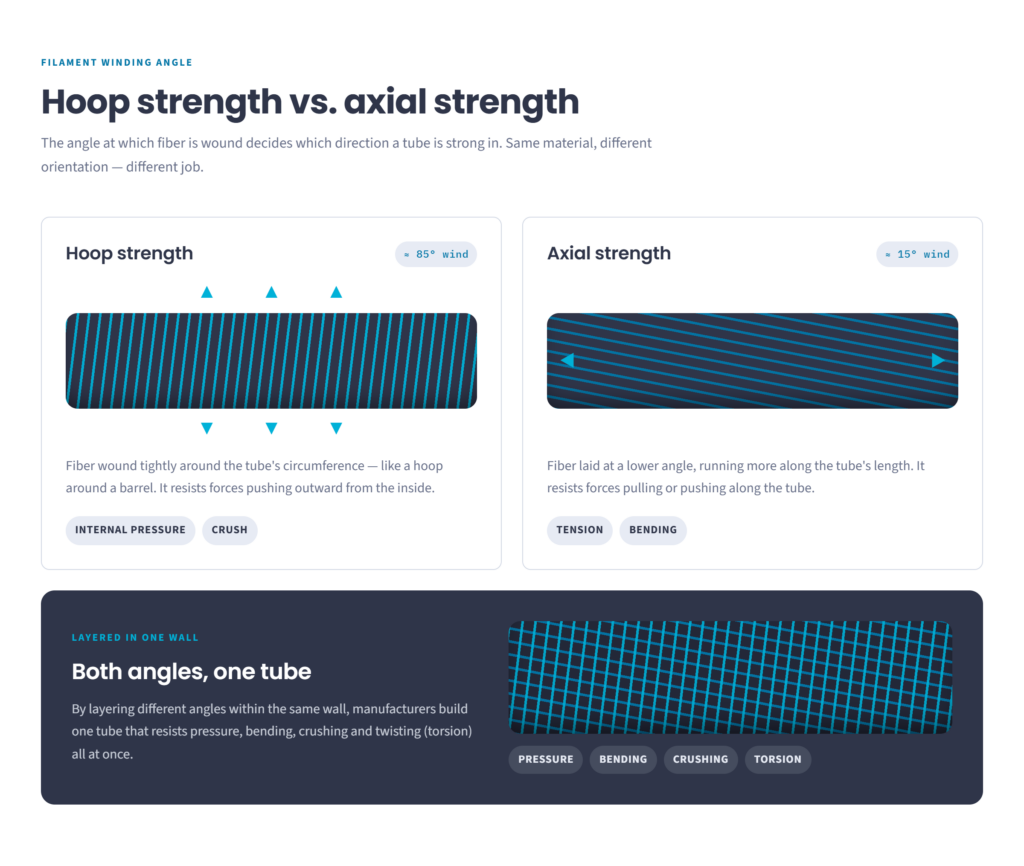


That angle is the whole trick. Fiber wound more tightly around the tube’s circumference (like a hoop around a barrel) builds hoop strength – resistance to forces pushing outward from the inside. Fiber laid at a lower angle, running more along the tube’s length, builds axial strength – resistance to forces pulling or pushing along the tube. By layering different angles within the same wall, manufacturers can build one tube that resists pressure, bending, crushing, and twisting (torsion) all at once.
This is the key difference between filament winding and processes that mainly run fiber in a single direction: it lets engineers design the internal “skeleton” of the tube around the actual forces it will face.
Where Filament Winding Excels: Cryogenic Applications
Cryogenic environments – think liquid oxygen or liquid hydrogen storage and transfer – put materials through severe temperature swings that cause contraction, stress, and shifting dimensions. A material used here has to hold its mechanical properties without acting as a heat highway between components at very different temperatures.
With the right fiberglass-and-resin combination, filament-wound tubes can offer:
- Low thermal conductivity compared with metal (meaning less heat sneaks through)
- High strength relative to weight
- Electrical isolation between components
- Controlled expansion and contraction as temperatures shift
- Resistance to fatigue from repeated temperature cycling
- Low-outgassing resin systems – important in sealed or vacuum environments, where off-gassing materials can contaminate sensitive equipment
These properties make filament-wound composites a fit for thermal isolators, equipment supports, transfer-line components, and other structural parts used around cryogenic storage and processing systems. They’ve been used in cryogenic dewars (insulated storage vessels), aerospace hardware, and pressure vessels.
That said, no material system should be assumed compatible with liquid oxygen, liquid hydrogen, or any other cryogenic fluid just because it carries a general “cryogenic-rated” label. Fiber type, resin chemistry, winding pattern, and wall construction all have to be evaluated together, and tested against the real operating environment – not assumed from a spec sheet.
Where Filament Winding Excels: Electrical Applications
Fiberglass composites, and filament wound tubes specifically, show up throughout electrical equipment for a simple reason: they add structural reinforcement without adding the conductivity that comes with metal parts.
Typical uses include:
- High-voltage insulation structures
- Interrupter and switchgear tubes
- Transformer and power-distribution components
- Battery and energy-storage equipment
- Electrified transportation systems
- Protective housings and barriers
- Electrically isolating supports
Done well, a filament-wound tube can be both the electrical insulator and the load-bearing structural member in the same part – useful anywhere a single component needs to do both jobs. The winding process also lets the tube wall be engineered around radial pressure, crushing, bending, or torsion, which is an advantage over tube designs built mainly for simple end-to-end (axial) loads.
Filament Winding vs. Pultrusion vs. Convolute Winding
Filament winding isn’t automatically the best process for every composite tube – it’s one of three main options, and the right one depends on the job:
- Choose filament winding when the tube needs to handle pressure, hoop loads, crushing, torsion, or a mix of forces from different directions.
- Choose pultrusion – where reinforced material is pulled continuously through a forming die – when the load is mostly straight-line (axial) or bending, and you’re producing a constant-shape profile in volume. Think beams, rails, and supports.
- Choose convolute winding – where resin-soaked reinforcement is wrapped in overlapping layers – when the priority is electrical insulation performance and a dense laminate wall that machines well.
None of the three is “better” across the board. It comes down to what the part actually needs to do: resist pressure, carry axial load, insulate electrically, or be easy to machine into a finished shape.
Composite Tube Decision Table
| Application | Likely process | Why it fits | When another process may be appropriate |
|---|---|---|---|
| Cryogenic supports and transfer systems | Filament winding | Fiber angles can be tailored to axial, hoop, and combined loads, with low thermal conductivity and electrical isolation built in. | Pultrusion may be more economical for straight, constant-section supports carrying mainly axial loads. Convolute winding may fit if the application needs a layered wall or heavy secondary machining. |
| High-voltage insulation | Filament or convolute winding | Both processes produce fiberglass tubes with strong dielectric and mechanical properties. Filament winding gives more control over fiber direction; convolute winding offers a layered construction common in electrical parts. | Pultrusion may be preferred for long, constant-section insulating profiles at higher volume, especially when loads run mostly lengthwise. |
| Pressure-bearing tubes and vessels | Filament winding | Continuous fibers can be positioned to resist hoop and axial stress efficiently – a good match for internal pressure and combined loading. | Another process may suit low-pressure parts, nonstructural sleeves, or cases where cost or machinability matters more than pressure efficiency. |
| Axially loaded structural tubes | Pultrusion | Continuous lengthwise reinforcement gives high axial strength and stiffness through an efficient production process. | Filament winding may be preferable if the tube also faces hoop loading, radial pressure, crushing, or torsion. |
| Machined electrical components | Convolute or filament winding | Convolute construction gives a dense, layered wall suited to dielectric parts and secondary machining. Filament winding can add deliberately oriented structural reinforcement on top of that. | Pultrusion may be enough for simpler shapes, longer production runs, and mostly lengthwise loads. |
| Tubes under combined or multidirectional loads | Filament winding | Multiple winding angles can be combined to handle axial, hoop, radial, and torsional demands within the same wall. | Pultruded or convolute-wound tubing may be more economical when the load case is simpler and doesn’t need tailored fiber angles. |
What to Consider Before You Decide
The right choice comes from the application, not a default preference for one process. A full technical review typically weighs:
- Operating temperature range
- Frequency and severity of thermal cycling
- Electrical-insulation requirements
- Axial, hoop, radial, and torsional loads
- Internal or external pressure
- Chemical and environmental exposure
- Dimensional tolerances
- Outgassing requirements
- Machining and finishing needs
- Production quantities
- Testing and certification requirements
Reinforcement direction is only one piece of the puzzle. Fiber type, resin system, fiber-to-resin ratio, wall thickness, cure quality, and secondary operations all affect how the finished tube actually performs.
When an application combines demanding structural loads with electrical or thermal isolation needs, filament wound tubes offers a real advantage: the ability to place continuous fiber exactly where it does the most good.
Working With Atlas Fibre
Atlas Fibre is a specialized manufacturer of precision-machined components built from thermoset composite laminates and advanced engineering plastics, including both convolute and filament wound tubes machined into finished parts. Our team can work with you to evaluate the operating environment, load conditions, dimensions, and performance requirements and help determine the material and tube construction suited to your application.
If you’re working through a cryogenic, electrical, or structural tube requirement, connect with an Atlas Fibre representative to talk through the specifics.